
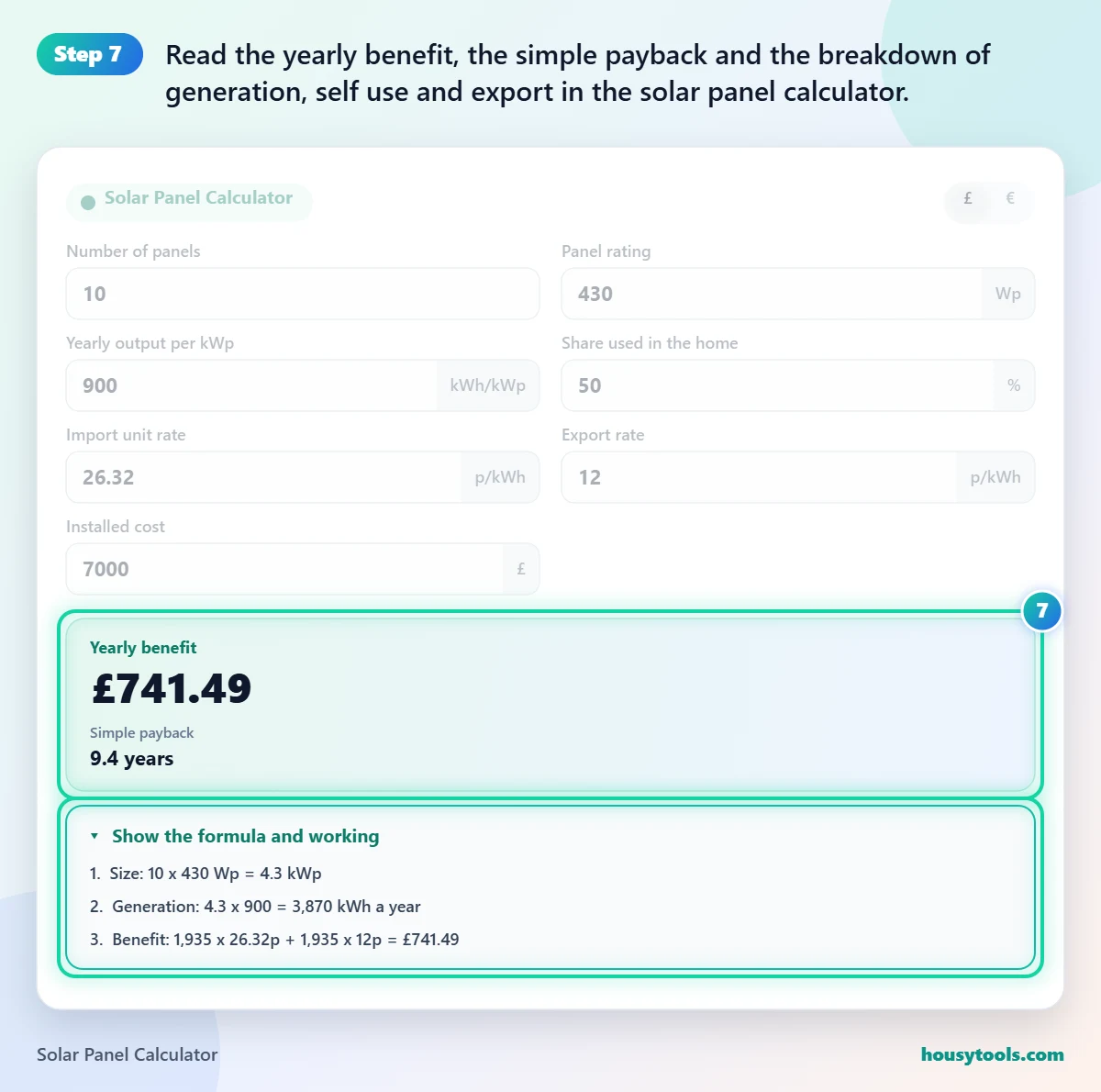
Show the formula and working
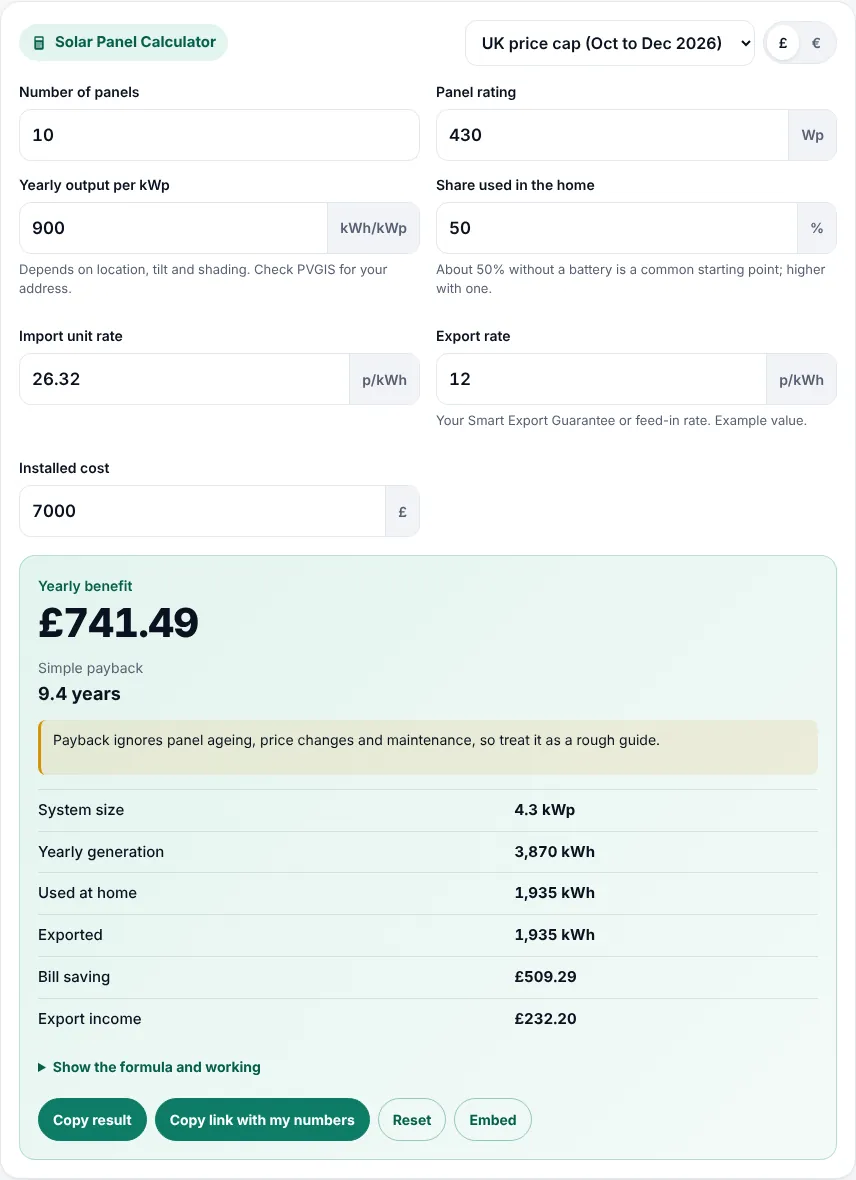
This solar panel calculator estimates how much electricity a home solar PV system will generate each year, how much it will save on your bills, what it will earn from exports and how long it takes to pay back, for homes in the UK and Europe. Enter your panel count, panel rating, the yearly yield for your roof, how much you expect to use at home, your tariffs and the installed price.
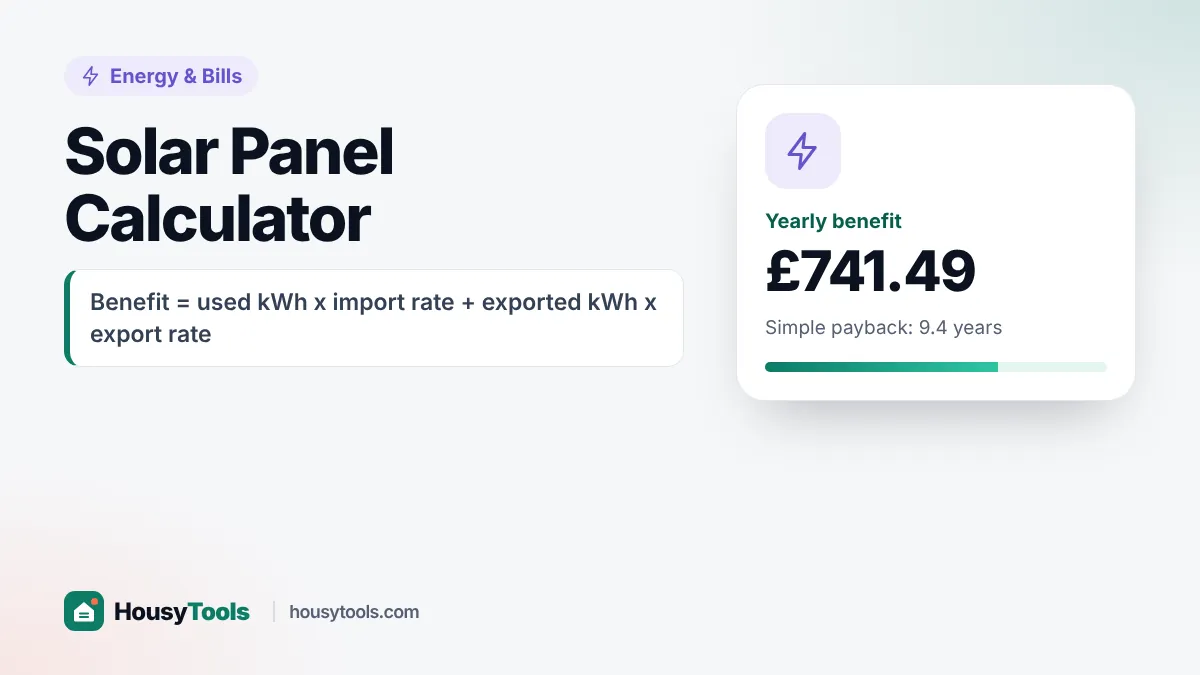
Quick answer: a solar panel calculator multiplies system size (kWp) by yearly yield per kWp, values the share you use at your import rate and the rest at your export rate. Ten 430 Wp panels yielding 900 kWh per kWp, half used at home, give about £741 a year at 26.32p import and 12p export.
What Is a Solar Panel Calculator?
A solar panel calculator is a tool that estimates the yearly electricity, savings and payback of a rooftop solar PV system from its size, your roof’s yield and your tariffs.
The formula in plain words: system size in kWp equals the number of panels times the panel rating in watts peak, divided by 1,000. Yearly generation equals kWp times the yield per kWp for your location. The share you use at home is valued at your import unit rate, because it is electricity you no longer buy. The rest is exported and valued at your export rate. Savings plus export income give the yearly benefit, and the installed cost divided by that benefit gives a simple payback in years.
How Do You Use the Solar Panel Calculator?
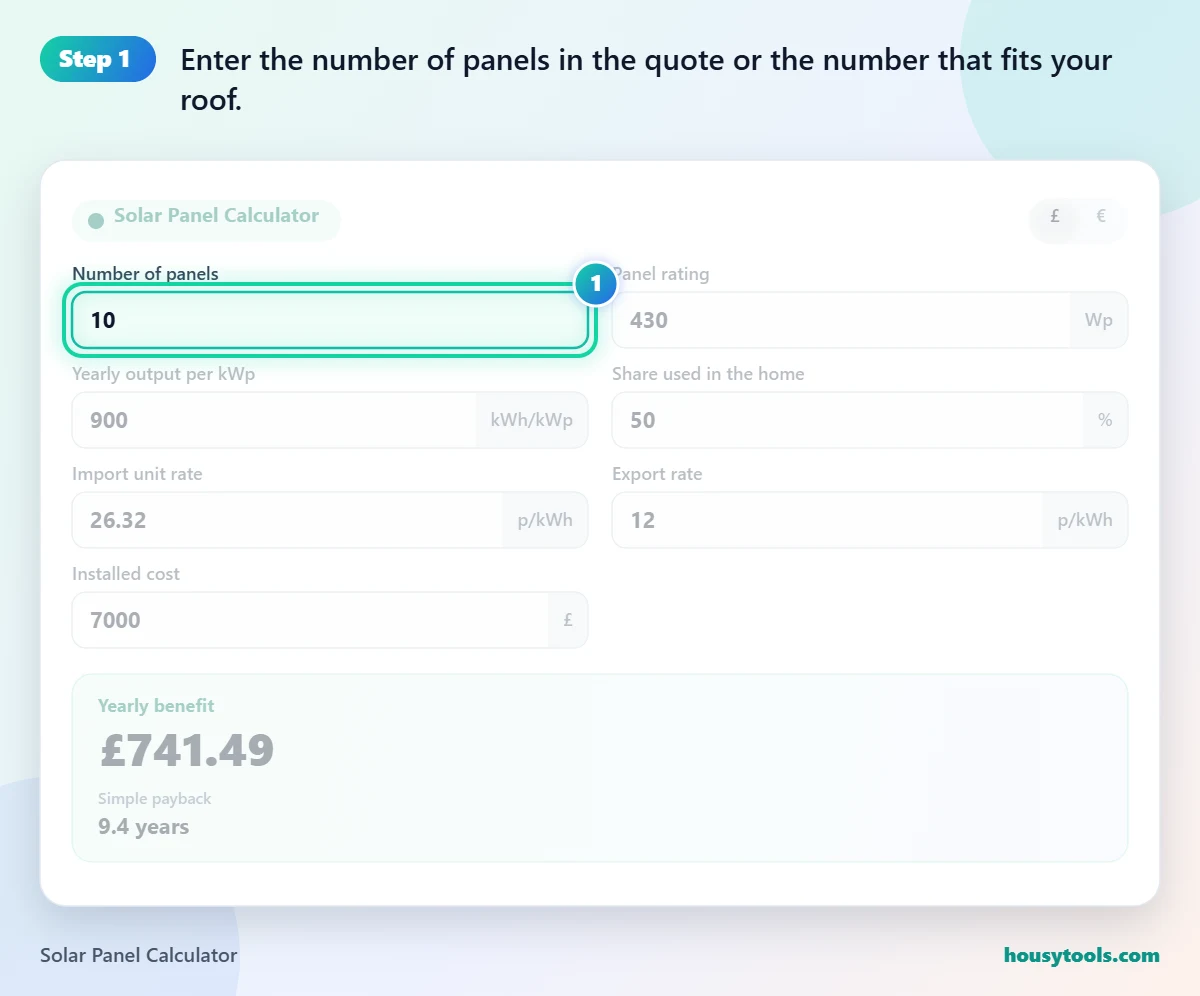
- Enter the number of panels in the quote or the number that fits your roof.
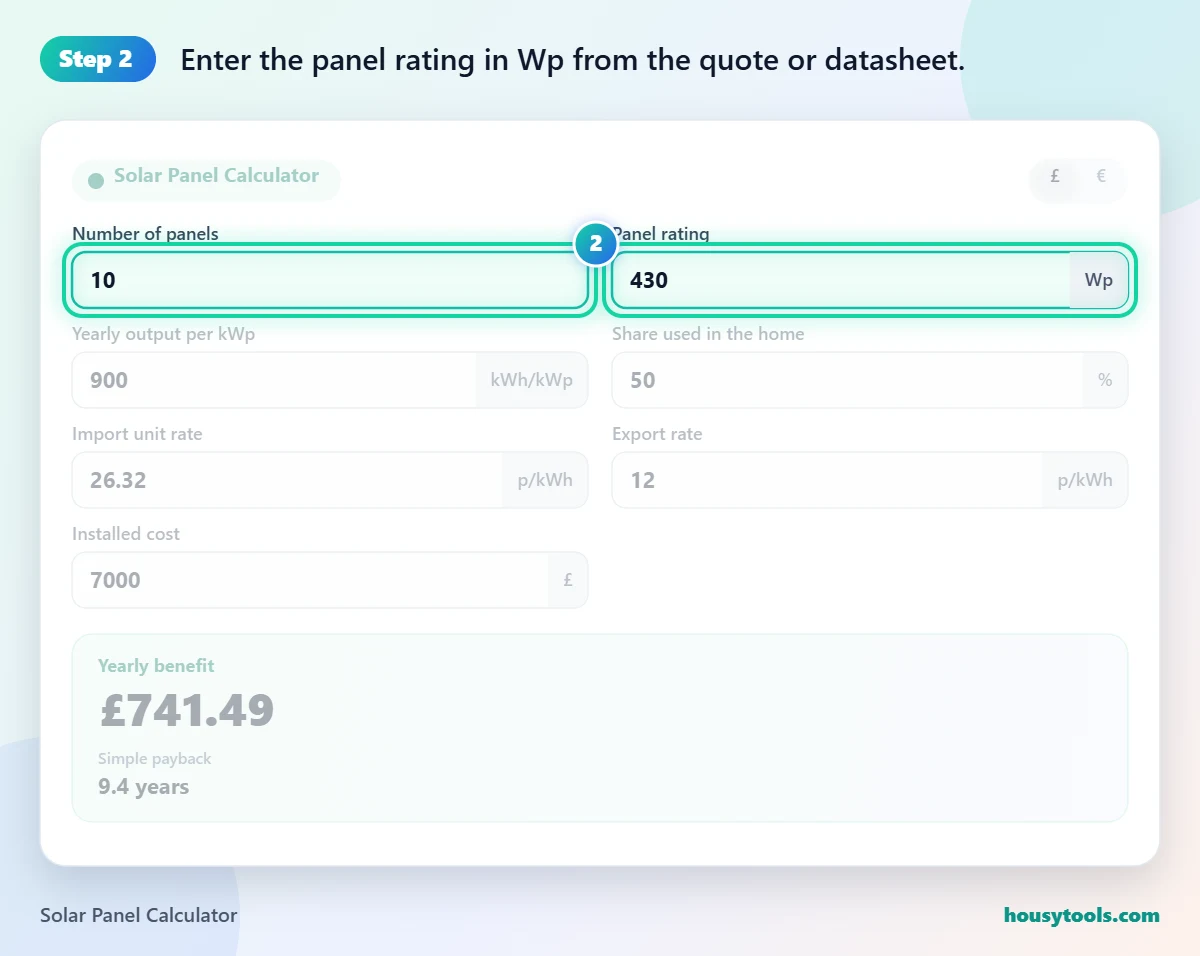
- Enter the panel rating in Wp from the quote or datasheet. 430 Wp is the default.
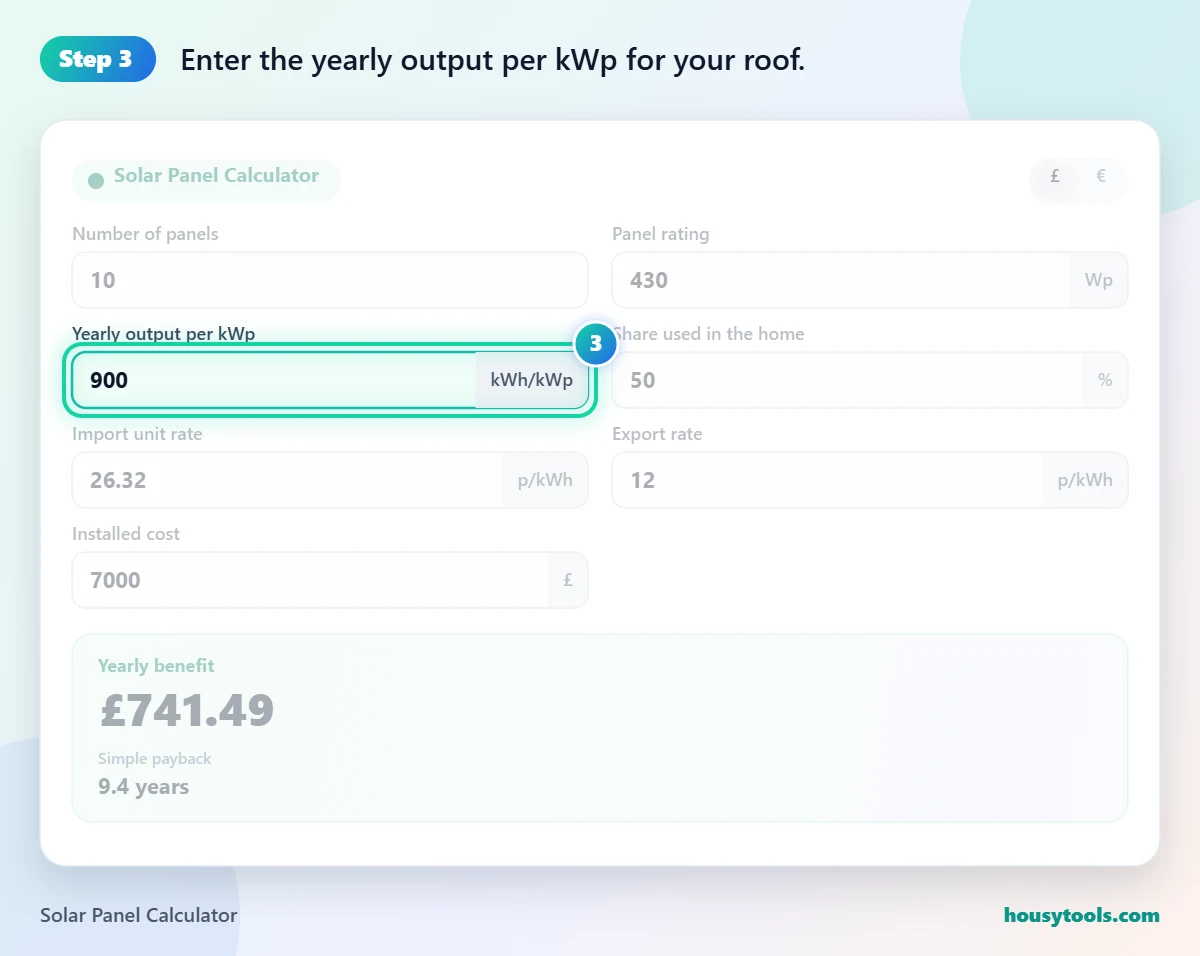
- Enter the yearly output per kWp for your roof. The default of 900 is an example: get your own figure from PVGIS or your installer.
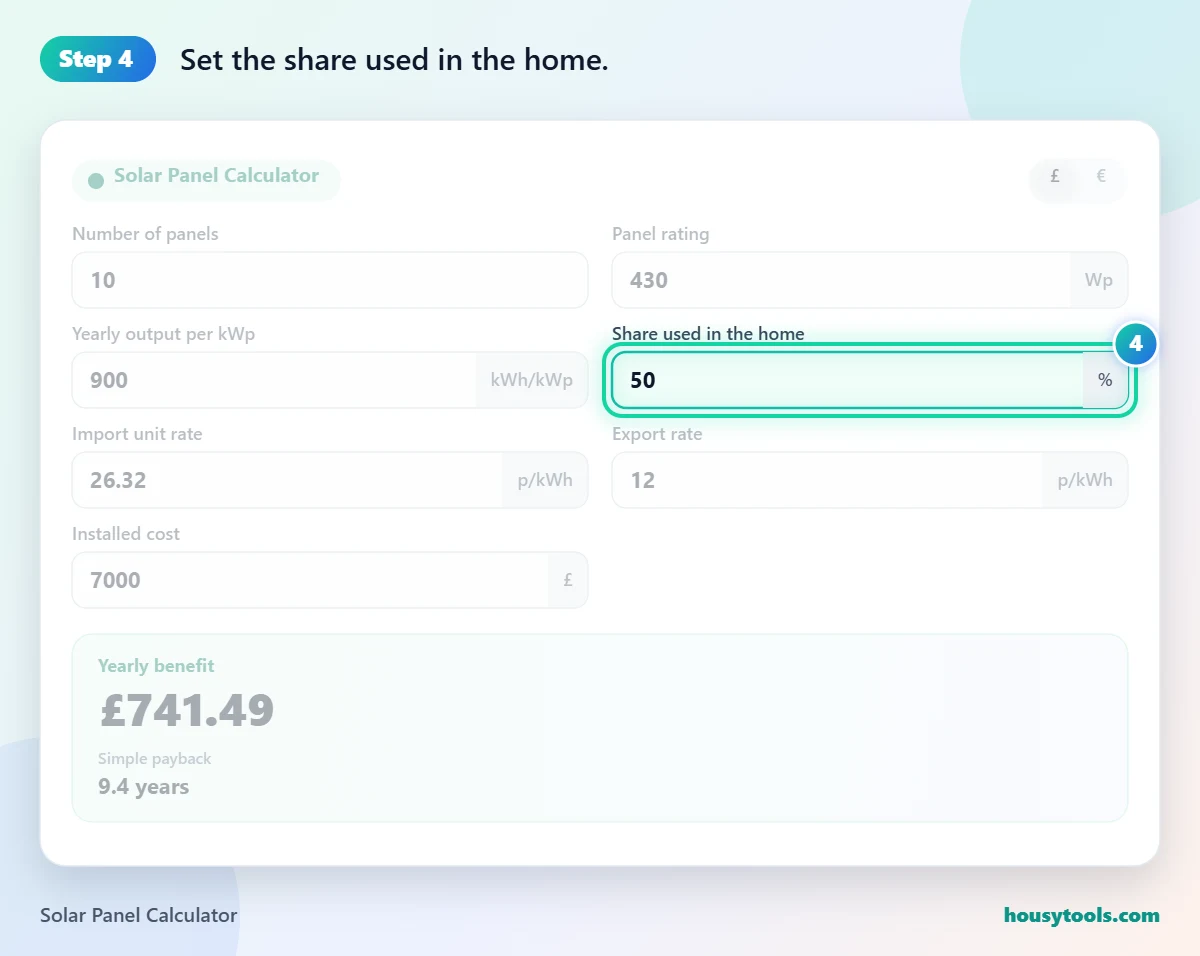
- Set the share used in the home. Around 50% is a reasonable start without a battery; raise it if you are home in the day or add a battery.
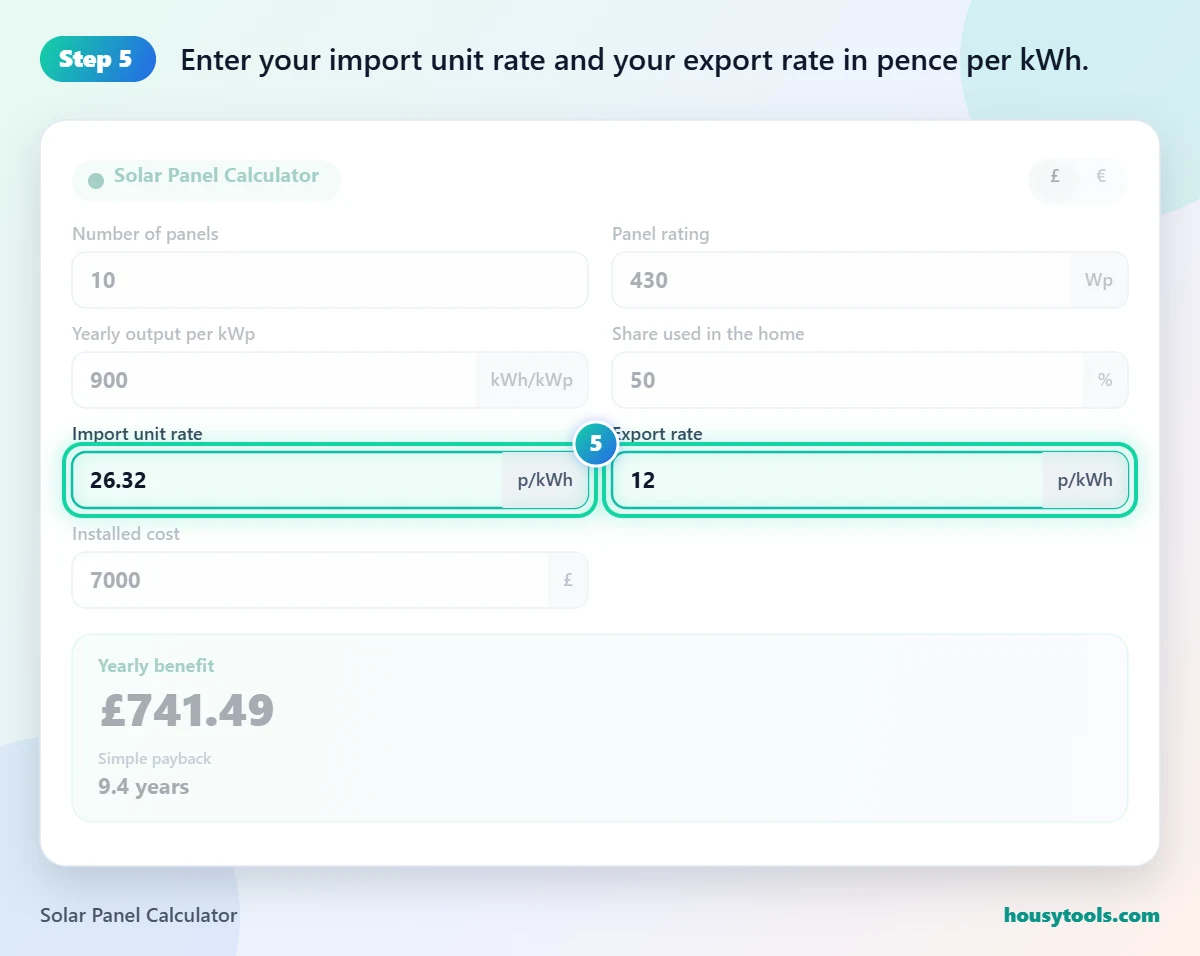
- Enter your import unit rate and your export rate in pence per kWh.
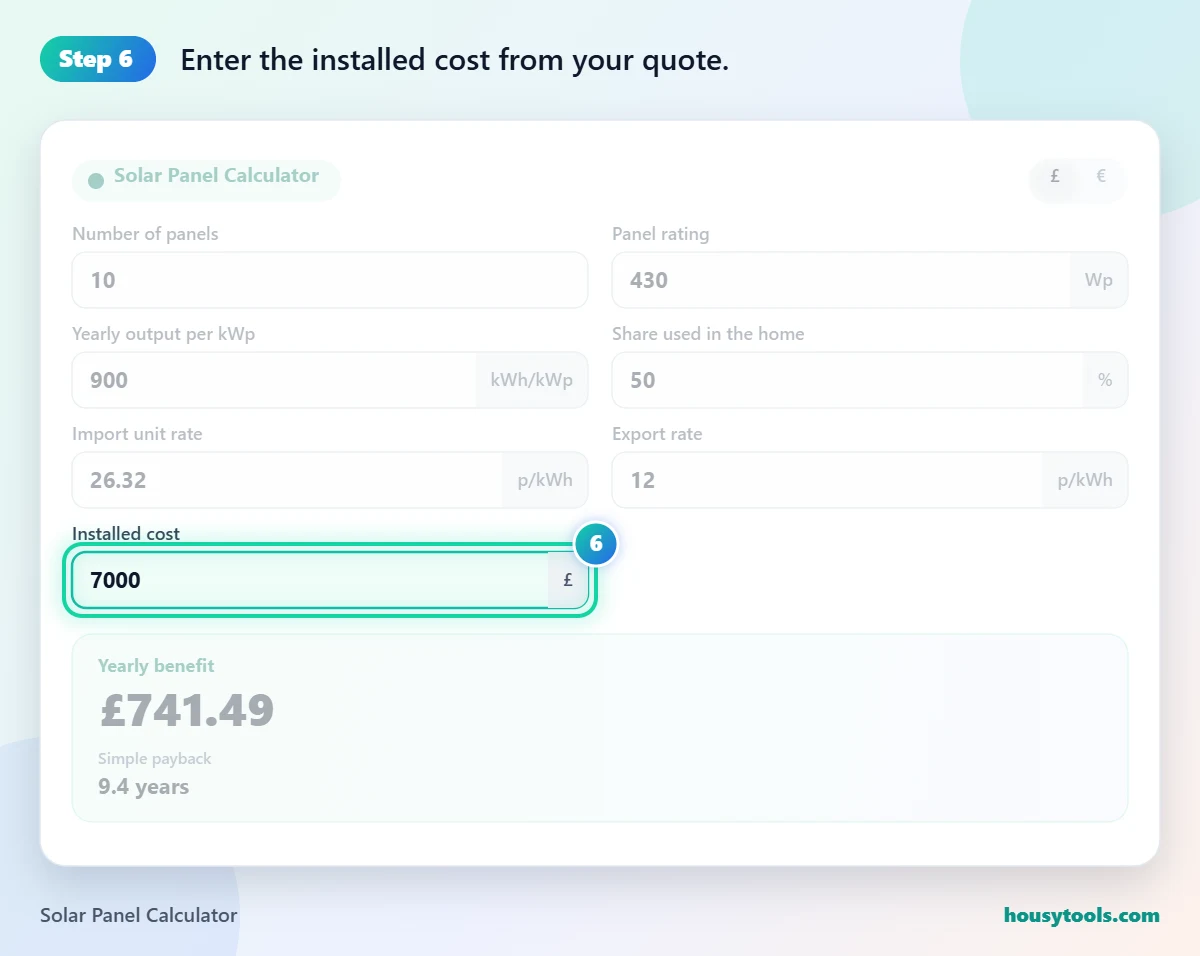
- Enter the installed cost from your quote.
- Read the yearly benefit, the simple payback and the breakdown of generation, self use and export in the solar panel calculator.
How Much Electricity Does a Solar Panel System Generate in the UK?
A rule of thumb for the UK is that each kWp of panels produces somewhere in the high hundreds of kWh a year, so a 4 kWp system makes a few thousand kWh. The exact figure depends on latitude, roof direction, tilt and shading, which is why the solar panel calculator asks for a yield per kWp instead of guessing.
The best free source for that number is the European Commission’s PVGIS tool from the Joint Research Centre. Pick your address, enter 1 kWp, your roof angle and direction, and it returns the yearly kWh for one kWp. Type that straight into the yield box of the solar panel calculator. Installers certified by MCS should also give you a generation estimate in their quote, which you can enter instead.
How Long Do Solar Panels Take to Pay for Themselves?
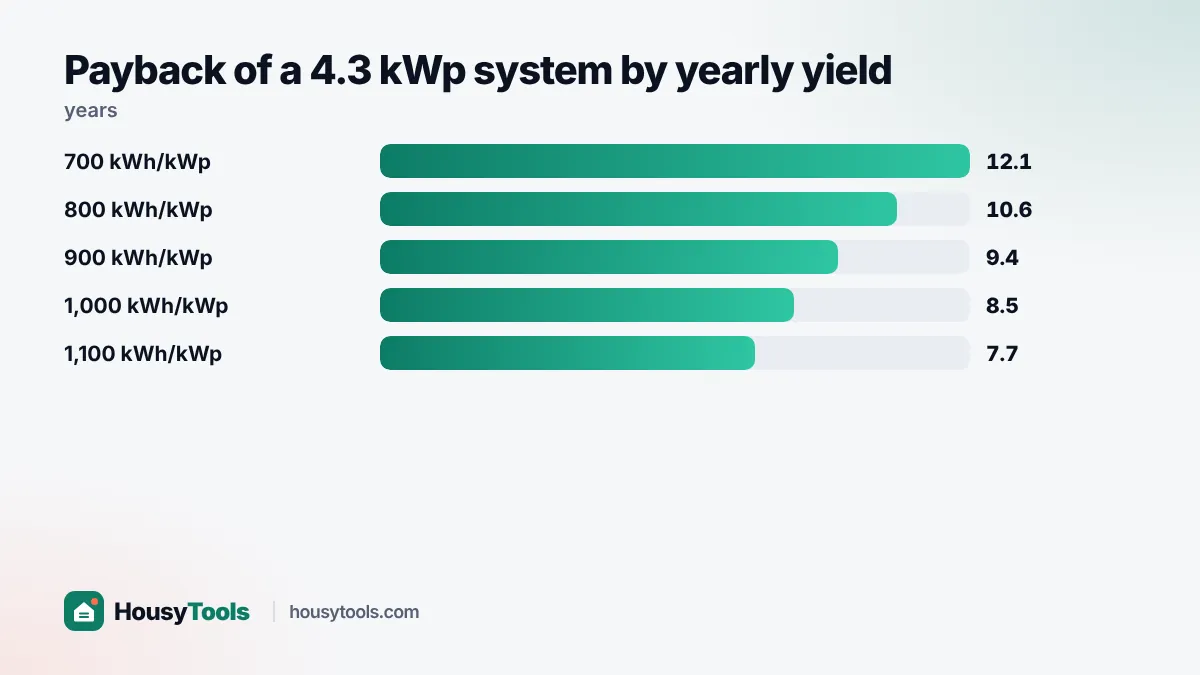
With the default inputs in this solar panel calculator, a £7,000, 4.3 kWp system pays back in about 9.4 years, and payback ranges from about 7.7 to 12.1 years as yield moves from 1,100 down to 700 kWh per kWp.
| Yield (kWh per kWp) | Yearly generation | Yearly benefit | Simple payback |
|---|---|---|---|
| 700 | 3,010 kWh | £576.72 | 12.1 years |
| 800 | 3,440 kWh | £659.10 | 10.6 years |
| 900 | 3,870 kWh | £741.49 | 9.4 years |
| 1,000 | 4,300 kWh | £823.88 | 8.5 years |
| 1,100 | 4,730 kWh | £906.27 | 7.7 years |
How Much Do You Get Paid for Exporting Solar Power?
In Great Britain you are paid through the Smart Export Guarantee, and the rate is set by each supplier: it must be above zero, but it varies widely, so the 12p default is only an example. Enter the rate from the tariff you choose.
Under the Smart Export Guarantee guidance on GOV.UK, systems up to 50 kW need MCS certification or an equivalent scheme, and you need a meter that records half hourly exports, which usually means a smart meter. Your export supplier does not have to be the company that supplies your electricity, so it pays to compare.
Does Using More of Your Own Solar Power Save More Money?
Yes: every kWh you use yourself is worth your full import rate, which is usually more than twice a typical export rate. Raising self use from 30% to 70% lifts the yearly benefit of the default system from £630.66 to £852.33 in the solar panel calculator, and cuts payback from 11.1 to 8.2 years.
Running the washing machine, dishwasher or hot water diverter in sunny hours helps. A battery raises self use further, but adds cost, so add its price to the installed cost box to see whether it shortens or lengthens payback. If you drive electric, the EV charging cost calculator shows how much of your solar output a car could soak up.
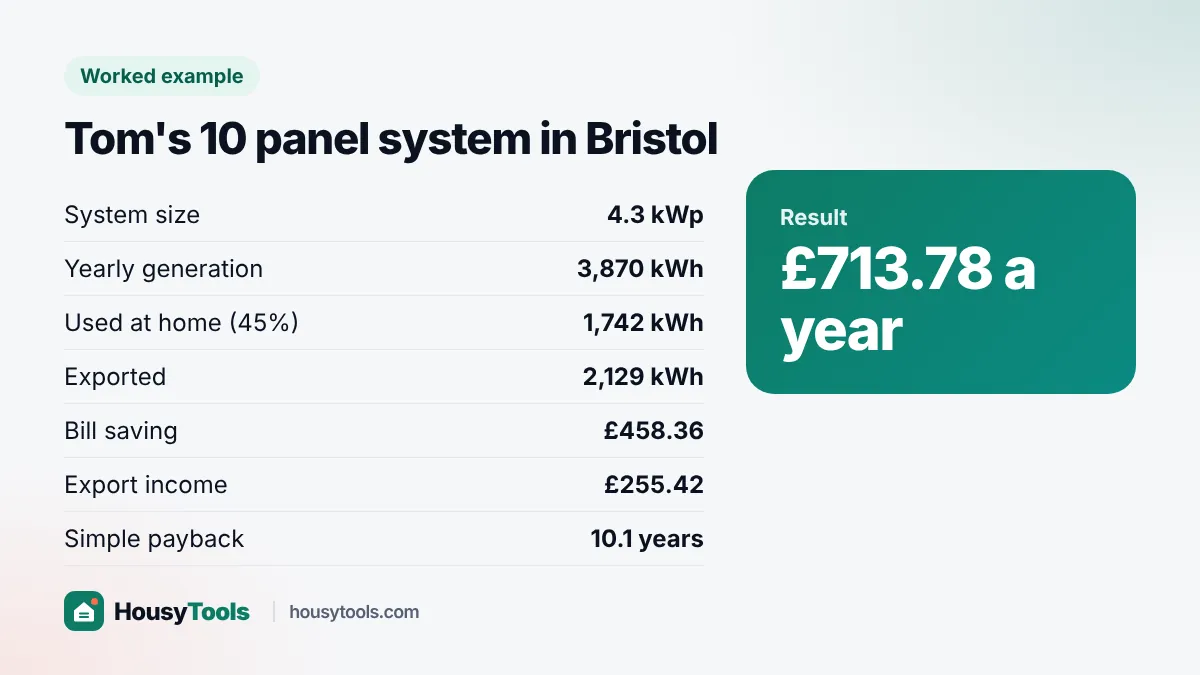
Worked Example: Tom’s 10 Panel System in Bristol
Tom has a south facing roof in Bristol and a quote for ten 430 Wp panels at £7,200 installed. He used PVGIS for his roof and rounded the result to 900 kWh per kWp. He works from home two days a week, so he expects to use 45% of the output. He has a 12p export tariff in mind and pays 26.32p for electricity.
- Size: 10 x 430 Wp = 4.3 kWp
- Generation: 4.3 x 900 = 3,870 kWh a year
- Used at home: 1,742 kWh, saving £458.36
- Exported: 2,129 kWh, earning £255.42
- Yearly benefit: £713.78, simple payback 10.1 years
Like any solar panel calculator result, Tom’s payback ignores panel ageing, inverter replacement and future price changes, so he treats 10.1 years as a guide rather than a promise.
Solar Panel Costs, VAT and Grants in the UK
Installing solar panels and batteries in a home in Great Britain is zero rated for VAT until 31 March 2027, after which the reduced rate of 5% applies from 1 April 2027, according to HMRC’s energy saving materials notice. Make sure your quote shows VAT clearly, and enter the full installed price in the solar panel calculator.
One timing point affects savings: the October to December 2026 cap electricity rate of 26.32p carries no VAT, because VAT on household electricity is 0% from 1 October 2026 to 31 March 2027. If VAT returns, import prices rise and so does the value of each kWh you use yourself. Electrical work on the roof and consumer unit must be done by a qualified, certified installer.
Common Mistakes When Estimating Solar Savings
- Confusing kWp with kWh. kWp is the size of the system; kWh is the energy it makes over time. The solar panel calculator converts one into the other with your yield.
- Assuming you will use 100% of the output. Most homes without a battery export a large share in summer afternoons.
- Valuing exports at the import rate. Exported units earn only your export tariff.
- Using a yield for a south facing roof when yours faces east or west, or is shaded by trees or chimneys.
- Leaving the battery or scaffolding cost out of the installed price.
- Treating payback as fixed. Run the solar panel calculator again whenever your tariff changes.
A quick sense check: if a quote promises a payback far shorter than this solar panel calculator gives with the same yield, self use and tariffs, ask the installer to show their assumptions in writing.
Is Solar Worth It in Ireland and the EU?
Higher electricity prices make self use worth more: Eurostat puts household electricity at an average of €28.96 per 100 kWh across the EU in the second half of 2025, €38.69 in Germany and €40.42 in Ireland. Switch the tariff to your country, enter the price in cents and use PVGIS for your yield, since sunnier southern locations produce far more per kWp than Ireland or northern Germany.
To see what your remaining grid electricity will cost, try the electricity cost calculator, or explore the full energy and bills hub.
Solar Panel Calculator FAQs
How many solar panels do I need for my house?
Divide your yearly electricity use by your roof’s yield per kWp to get the kWp needed, then divide by the panel rating in kW. For 3,000 kWh at 900 kWh per kWp you need about 3.3 kWp, or eight 430 Wp panels.
What is a good yield per kWp in the UK?
It depends on your location, roof angle, direction and shading, so use the free PVGIS tool for your address or the MCS installer’s estimate. South facing, unshaded roofs in southern England give more than north facing or shaded roofs in Scotland.
Do I need a battery with solar panels?
No. A battery lets you use more of your own power, which raises savings, but it adds cost. Add the battery price to the installed cost and raise the share used at home in the solar panel calculator to see whether payback improves.
Do I need MCS certification to get paid for exports?
For systems up to 50 kW, GOV.UK guidance says the system and installer need MCS certification or an equivalent scheme such as Flexi-Orb to qualify for the Smart Export Guarantee. You also need a meter that records half hourly exports.
Is there VAT on solar panels in the UK?
Residential solar panels and batteries in Great Britain are zero rated for VAT until 31 March 2027. From 1 April 2027, HMRC guidance says they return to the reduced 5% rate, so installations after that date will cost slightly more.
Do solar panels work in winter and on cloudy days?
Yes, but output is much lower in winter and under heavy cloud. That is why the solar panel calculator uses a yearly yield per kWp, which already averages sunny summers and dull winters for your location.
Checked October 2026. Sources: EU Joint Research Centre PVGIS, GOV.UK Smart Export Guarantee, HMRC VAT Notice 708/6, Ofgem energy price cap, Eurostat.