
Show the formula and working
This wood burner size calculator works out what heat output, in kW and BTU per hour, a wood burning or multi fuel stove needs to heat a room, and whether the room needs a permanent air vent under Building Regulations. It is designed for homes in the UK, Ireland and the rest of Europe, uses metres by default with a feet switch, and lets you add an open plan area or open stairwell that the stove also has to heat.
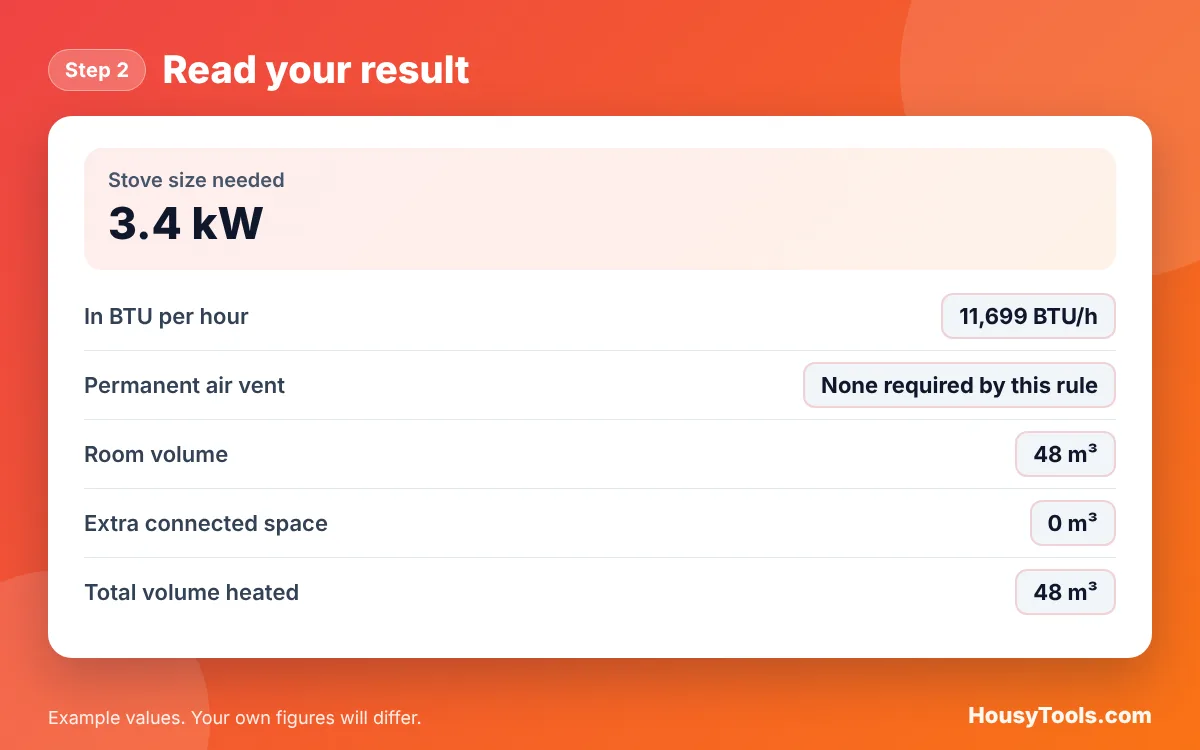
Quick answer: Multiply the room’s length x width x height in metres, then divide by 14 to get the stove output in kW. A 5 m by 4 m room with a 2.4 m ceiling is 48 m³, so it needs about 3.4 kW, or 11,699 BTU per hour. This wood burner size calculator also checks the air vent rule.

What Is a Wood Burner Size Calculator?
A wood burner size calculator is a tool that estimates the nominal heat output a stove needs to keep a room warm, based on the volume of space it heats. In plain words: volume = length x width x ceiling height, plus any connected space. Stove output in kW = volume / 14. BTU per hour = kW x 3,412.14.
The figure of 14 cubic metres per kW is the rule of thumb stove makers such as Stovax give, aimed at about 21°C inside when it is 0°C outside. It assumes average insulation, so the calculator lets you change it: use a smaller number for a draughty older room with single glazing, and a bigger one for a well insulated room.
How Do You Use the Wood Burner Size Calculator?
- Enter the Room length, Room width and Ceiling height in metres.
- If the stove also heats an open plan area or an open stairwell, add its volume as Extra connected space.
- Leave Cubic metres heated per kW at 14, or adjust it for a very draughty or very well insulated room.
- Choose How airtight is the home, and tick Stove has a flue draught stabiliser only if the installer has fitted one.
- Read the stove size in kW and BTU per hour and the air vent size, then open “Show the formula and working” to see each step.


What Size Wood Burner Do I Need for My Room?
Divide the room’s volume in cubic metres by 14: a 7 m by 4 m room with a 2.5 m ceiling is 70 m³, which needs a 5 kW stove. Choose a stove whose nominal output is close to the result rather than much bigger.
An oversized stove quickly makes the room too hot, so people turn the air down and burn it slowly. That wastes fuel, blackens the glass and builds up soot and tar in the flue. Several outside walls, large windows, high ceilings or an open staircase all raise the heat needed, while a small, well insulated room needs less. A HETAS registered installer can do a survey that takes these into account, in the same way as our radiator size calculator adds up the heat loss of each wall and window.
Does a Wood Burner Need an Air Vent?
In most UK homes a stove of 5 kW or less needs no extra air vent, but above 5 kW you need a permanent vent of 550 mm² for every kW over 5 kW. That is the rule in Table 1 of Approved Document J for homes with an air permeability above 5.0 m³/(h.m²), which covers most homes built before 2008.
Very airtight homes, with an air permeability of 5.0 or less, need 550 mm² per kW of the stove’s full rated output. If the flue has a draught stabiliser, the figures rise to 300 mm² per kW for the first 5 kW and 850 mm² per kW above that, or 850 mm² per kW of the full output in an airtight home. The vent size depends on the rated output of the stove you buy, not on the room calculation, so check it again once you have chosen a model.
How Many BTU Do I Need From a Stove?
Multiply the kW result by 3,412.14 to get BTU per hour, so a 5 kW stove gives about 17,061 BTU/h. UK and European stove makers quote output in kW, but some older stoves and North American models still use BTU, and the calculator shows both.
What Rules Apply to Installing a Wood Burner?
In England and Wales a stove installation is notifiable building work, so use a HETAS registered installer who can self certify, or apply to building control. Approved Document J also expects a carbon monoxide alarm in the room where a solid fuel appliance is installed, plus a suitable hearth, flue and clearances to anything combustible.
If you live in a smoke control area, you can only burn wood in an exempt appliance, according to the GOV.UK smoke control area rules, and releasing smoke from a chimney can lead to a penalty of up to £300. Your local council can tell you whether your home is in a smoke control area.
Wood Burner Size by Room Size
The table uses 14 m³ per kW and the air vent rule for a typical home without a draught stabiliser. It shows the vent needed if you buy a stove rated at exactly the output shown.
| Room size (L x W x H) | Volume | Stove output | BTU per hour | Air vent (typical home) |
|---|---|---|---|---|
| 3 x 3 x 2.4 m | 21.6 m³ | 1.5 kW | 5,264 | None |
| 4 x 3.5 x 2.4 m | 33.6 m³ | 2.4 kW | 8,189 | None |
| 5 x 4 x 2.4 m | 48 m³ | 3.4 kW | 11,699 | None |
| 6 x 4 x 2.4 m | 57.6 m³ | 4.1 kW | 14,039 | None |
| 7 x 4 x 2.5 m | 70 m³ | 5 kW | 17,061 | None |
| 8 x 5 x 2.4 m | 96 m³ | 6.9 kW | 23,398 | 1,022 mm² |
| 9 x 6 x 2.4 m | 129.6 m³ | 9.3 kW | 31,587 | 2,342 mm² |
Worked Example: A Lounge With an Open Staircase
Example: a lounge in a 1970s semi is 5.5 m by 4.2 m with a 2.4 m ceiling, and an open staircase adds about 20 m³ of space the stove will also warm. The house has never had an air test, so it counts as a typical home.
- Room volume: 5.5 x 4.2 x 2.4 = 55.4 m³, plus 20 m³ = 75.4 m³.
- Stove size: 75.4 / 14 = 5.39 kW, about 18,387 BTU per hour.
- Air vent at that output: 550 mm² x 0.39 kW = 214 mm².
Enter those room sizes and 20 in Extra connected space to reproduce this. Compare a 5 kW stove, which needs no vent in this home, with a 6 kW model, which would need 550 mm². For other heating sizing tools, see our heating calculators.
Wood Burner Size Calculator FAQs
Is a 5 kW stove big enough for my room?
A 5 kW stove suits about 70 m³ of space using the 14 m³ per kW rule, for example a 7 m by 4 m room with a 2.5 m ceiling. In a typical UK home it also needs no extra air vent, which is one reason 5 kW stoves are so popular.
What happens if my wood burner is too big?
The room overheats, so the stove is turned down and burns slowly with too little air. Slow burning wastes wood, blackens the glass and deposits tar in the flue, which raises the risk of a chimney fire. A correctly sized stove can burn hotter and cleaner.
Can a wood burner heat the whole house?
A room stove mainly heats the room it is in, plus any open connected space. Heat spreads poorly through closed doors. To heat radiators in other rooms, you would need a boiler stove connected to the heating system, designed by a qualified installer.
How do I convert kW to BTU for a stove?
Multiply kW by 3,412.14 to get BTU per hour. A 4 kW stove gives about 13,649 BTU/h and an 8 kW stove about 27,297 BTU/h. To go the other way, divide BTU per hour by 3,412.14.
Do I need a carbon monoxide alarm with a wood burner?
Yes. Approved Document J expects a carbon monoxide alarm to be fitted in the room when a solid fuel appliance such as a wood burner is installed. Test it regularly and replace it when it reaches the end of its stated life.
Does ceiling height change the stove size?
Yes, because the calculation uses volume. A 5 m by 4 m room needs about 3.4 kW with a 2.4 m ceiling but about 4.3 kW with a 3 m ceiling. High ceilings in period homes and barn conversions often call for a larger stove.
Checked October 2026. Sources: GOV.UK: Approved Document J, combustion appliances and fuel storage systems, GOV.UK: Smoke control areas, the rules, Stovax: What size stove do I need?, Wikipedia: British thermal unit.