
Show the formula and working
This free vinegar cleaning ratio calculator works out how many millilitres of vinegar and water to mix for windows, tiles, taps, kettles and floors, for households in the UK, Ireland, Europe and beyond. It scales the mix to any bottle or bucket, shows the acidity of the finished solution, and adjusts the amount automatically if you use a stronger cleaning vinegar instead of ordinary 5% vinegar.
Quick answer: A vinegar cleaning ratio calculator splits your bottle into parts. For windows and mirrors, a common mix is 1 part 5% vinegar to 1 part water, so a 500 ml spray bottle takes 250 ml of each, giving 2.5% acetic acid. With 10% cleaning vinegar, 125 ml is enough.

What Is a Vinegar Cleaning Ratio Calculator?
A vinegar cleaning ratio calculator is a tool that converts a vinegar to water ratio into exact amounts for your container, and checks the strength of the mix.
The formula in plain words: the active part of vinegar is acetic acid, and the percentage on the label is how much of it the vinegar contains. For a ratio of 1 part vinegar to X parts water, divide the total by 1 + X for the vinegar and make up the rest with water. The mix strength is the vinegar’s acidity times the vinegar volume divided by the total. If your vinegar is stronger than the 5% the usual ratios assume, the tool reduces the vinegar so the mix ends up the same strength.
How Do You Use the Vinegar Cleaning Ratio Calculator?
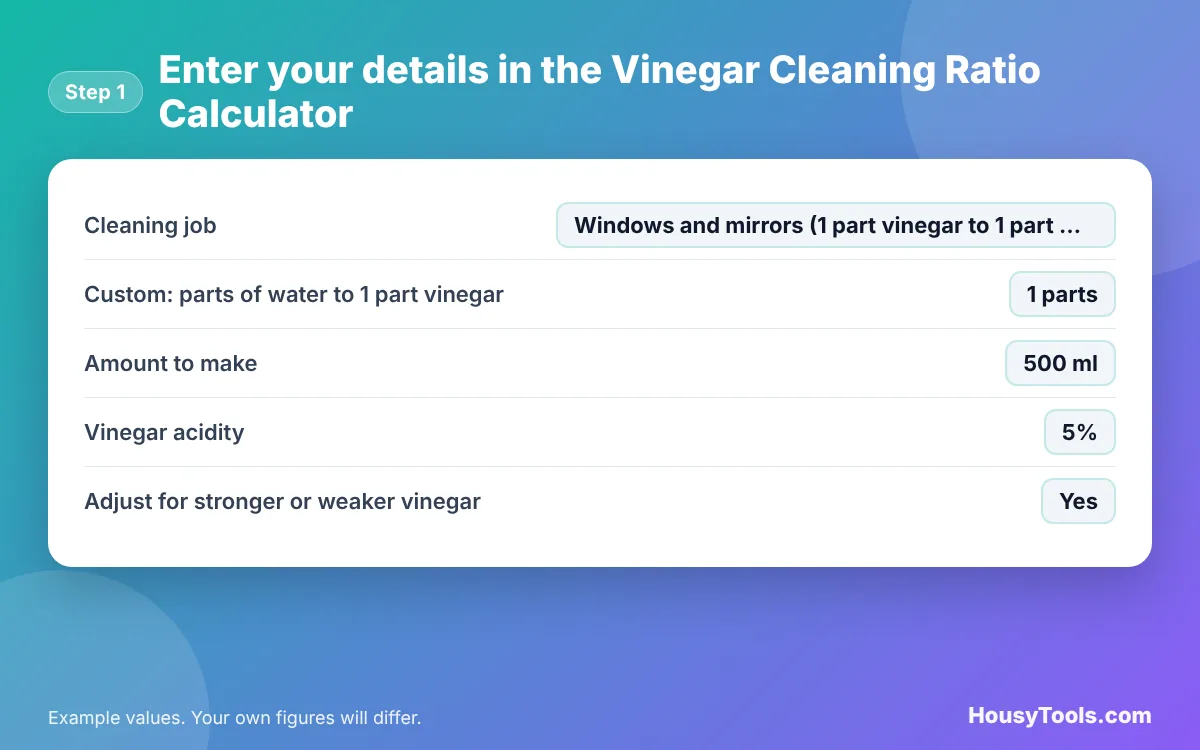
- Choose the Cleaning job, or “Custom ratio” to set your own.
- For a custom mix, enter Custom: parts of water to 1 part vinegar.
- Enter the Amount to make in ml, for example the size of your spray bottle.
- Enter the Vinegar acidity from the bottle’s label.
- Leave Adjust for stronger or weaker vinegar ticked to keep the usual strength, or untick it to follow the ratio exactly.
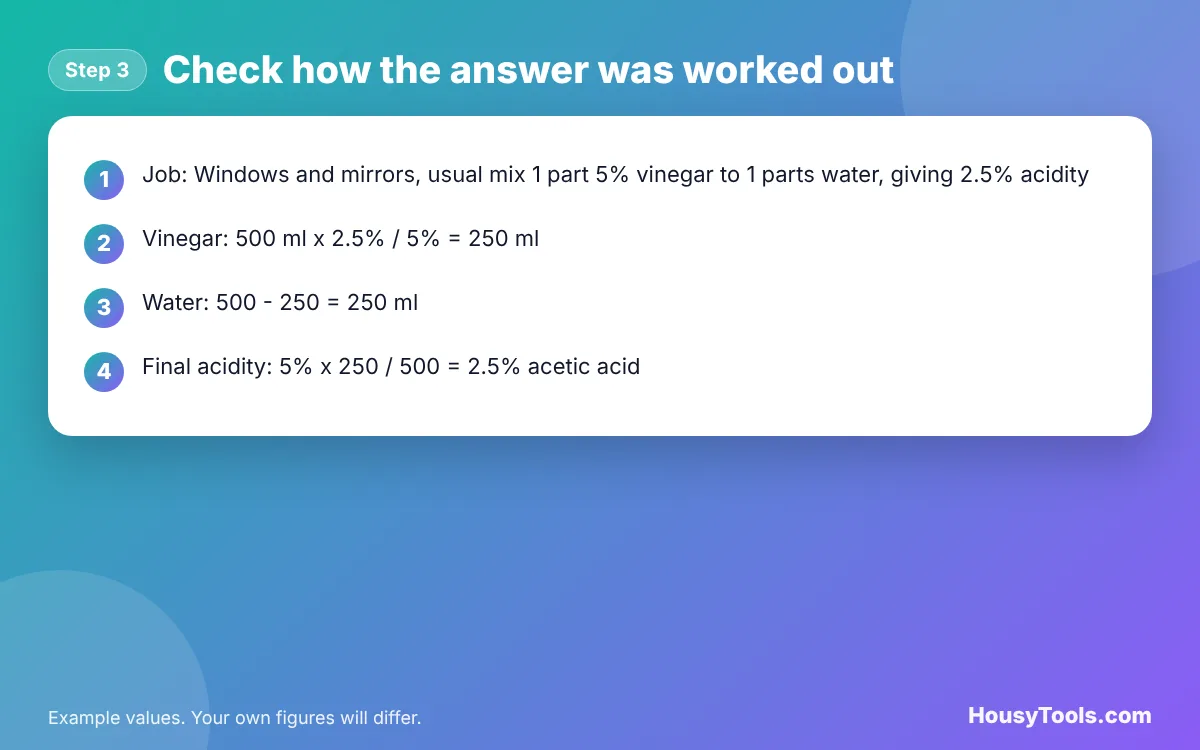
- Read the result and open “Show the formula and working” to see the vinegar, water and mix strength.

What Is the Best Vinegar to Water Ratio for Cleaning?
For most household cleaning with ordinary 5% vinegar, 1 part vinegar to 1 part water is a common all purpose mix, weaker mixes such as 1 to 10 suit sealed floors, and neat vinegar is kept for heavy limescale. These are common household mixes rather than a standard, so follow any instructions from the maker of what you are cleaning.
| Job | Ratio with 5% vinegar | Mix acidity | 500 ml bottle, 5% vinegar | 500 ml bottle, 10% vinegar | 5 L bucket, 5% vinegar |
|---|---|---|---|---|---|
| Windows and mirrors | 1 to 1 | 2.5% | 250 ml | 125 ml | 2,500 ml |
| Tiles, sinks and taps | 1 to 1 | 2.5% | 250 ml | 125 ml | 2,500 ml |
| Kettle descaling | 1 to 1 | 2.5% | 250 ml | 125 ml | n/a |
| Sealed hard floors | 1 to 10 | 0.45% | 45.5 ml | 22.7 ml | 455 ml |
| Heavy limescale | Neat | 5% | 500 ml | 250 ml | 5,000 ml |
Vinegar amounts shown; make up the rest with water. The 10% column keeps the same mix acidity as the 5% column.
What Should You Never Clean With Vinegar?
Do not use vinegar on natural stone such as marble, limestone, travertine or granite, because acid can etch the surface. Also avoid waxed or unsealed wood, cast iron, and anything whose maker warns against acidic cleaners, such as some appliance seals and coated surfaces. Never mix vinegar with bleach, which releases toxic chlorine gas, as the HSE guidance on hazardous substances explains in general terms.
Is Cleaning Vinegar Stronger Than Normal Vinegar?
Cleaning vinegars are often sold at a higher acidity than ordinary cooking vinegar, so check the label. If yours is 10%, you need only half as much as a 5% vinegar for the same strength mix, which is what the adjustment option does. Stronger acid can irritate skin and eyes, so wear gloves and keep it away from children. To measure small amounts, the tablespoons to grams converter and fluid ounces to ml converter help with older recipes.
Worked Example: A Spray Bottle for Windows
Example: a 500 ml spray bottle for windows and mirrors, using a 5% vinegar with the strength adjustment on. These are the tool’s default inputs.
- Usual mix: 1 part 5% vinegar to 1 part water, so 5% / 2 = 2.5% acidity.
- Vinegar: 500 x 2.5% / 5% = 250 ml.
- Water: 500 minus 250 = 250 ml.
- With 10% cleaning vinegar instead: 125 ml vinegar and 375 ml water, still 2.5% acidity.
Vinegar Cleaning Ratio Calculator FAQs
How much vinegar do I put in a spray bottle?
For a 1 to 1 mix with 5% vinegar, fill half the bottle with vinegar and half with water: 250 ml of each in a 500 ml bottle. With 10% cleaning vinegar, use 125 ml of vinegar and 375 ml of water.
Can I use malt vinegar for cleaning?
Malt vinegar has a similar acidity to white vinegar but is brown and has a stronger smell, so it can mark pale surfaces. Clear distilled or white vinegar is the usual choice. Check the acidity on the label and enter it in the calculator.
Does vinegar disinfect?
Vinegar is good at removing limescale and grime, but household vinegar is not sold or tested as a disinfectant. Where you need to disinfect, such as raw meat spills, use a product labelled as a disinfectant and follow its instructions.
How do I descale a kettle with vinegar?
A common method is a 1 to 1 mix of vinegar and water left to soak in the kettle, then emptied and rinsed, with fresh water boiled once or twice before use. Follow your kettle maker’s own instructions first, as some advise specific descalers.
Can I mix vinegar with bicarbonate of soda?
They react and fizz, which mostly neutralises the acid, so the mix cleans less well than either used separately. It is not dangerous like vinegar and bleach, but there is little benefit. Never seal the mixture in a closed bottle.
Is vinegar safe on stainless steel?
A diluted vinegar mix is often used on stainless steel sinks and taps for limescale, but rinse and dry afterwards and do not leave it standing. Check the maker’s care advice for appliances and coated finishes.
Checked October 2026. Sources: Wikipedia, Vinegar, Wikipedia, Acetic acid, HSE, COSHH. Ratios are common household mixes, not a standard.