
Show the formula and working
This lumens calculator works out how much light a room needs, in lumens, and how many bulbs give it, for homes in the UK, Ireland and the rest of Europe. Choose a room type or your own target in lux, enter the room size in metres or feet, and it shows the total lumens, the number of bulbs at the lumens printed on the box, and the LED power that uses.
Quick answer: A lumens calculator multiplies the target brightness in lux by the floor area in square metres. A 5 m by 4 m living room at 150 lux needs 150 x 20 = 3,000 lumens, which is four 806 lumen bulbs, the EU equivalent of a 60 W filament bulb, or about 30 W of LED.

What Is a Lumens Calculator?
A lumens calculator is a tool that estimates the total light output, in lumens, needed to light a room to a chosen brightness. In plain words: lumens needed equals the target illuminance in lux multiplied by the floor area in square metres, because one lux is one lumen spread over one square metre. Divide the lumens by the lumens of one bulb to get the number of bulbs, and divide by the bulb’s lumens per watt to get the power.
Lumens measure how much light a bulb gives out, while watts measure how much electricity it uses. The lux is the SI unit of illuminance, the light falling on a surface. Not every lumen reaches the floor or table, because dark walls, deep shades and high ceilings absorb some of it, so the optional extra field lets you add a margin.
How Do You Use the Lumens Calculator?
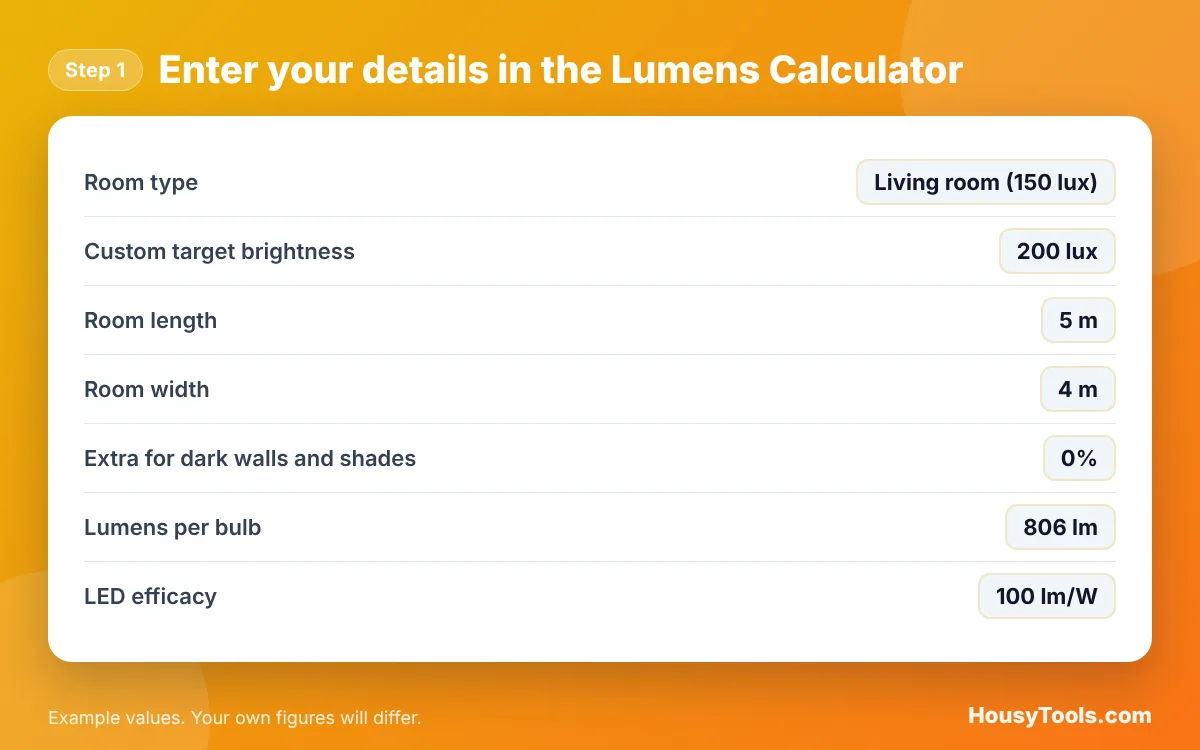
- Choose the Room type, or pick Custom lux and enter a Custom target brightness.
- Enter the Room length and Room width. Switch to feet if you measured in feet.
- Add a percentage in Extra for dark walls and shades if the room has dark decor or deep lampshades.
- Enter the Lumens per bulb from the box of the bulbs you plan to buy.
- Enter the LED efficacy in lumens per watt if you know it.
- Read the lumens, the number of bulbs and the LED power, then open “Show the formula and working” to see each step.


How Many Lumens Do I Need per Square Metre?
Most rooms need roughly 100 to 300 lumens per square metre for general lighting, and a desk or worktop for reading or detailed tasks needs about 500. The lux values in the calculator are example targets, not legal rules, because there is no UK standard for lighting levels in homes. The 500 lux figure for a desk follows the level widely used for writing and reading in offices. Use dimmers or separate lamps if you want both bright task light and softer evening light in one room.
How Many Lumens Is a 60 W Bulb?
A 60 W filament bulb is equal to 806 lumens under the EU equivalence table, so an LED that gives at least 806 lumens can be sold as a 60 W equivalent. The full list below was set by the EU directional and LED lamp regulation of 2012, and packaging sold in the UK and EU still uses these figures for equivalence claims. An LED bulb giving 806 lumens typically uses well under 10 W, which is why the calculator asks for lumens, not watts.
| Old filament bulb | Minimum lumens for the equivalent claim |
|---|---|
| 15 W | 136 lm |
| 25 W | 249 lm |
| 40 W | 470 lm |
| 60 W | 806 lm |
| 75 W | 1,055 lm |
| 100 W | 1,521 lm |
| 150 W | 2,452 lm |
| 200 W | 3,452 lm |
How Bright Should Each Room Be?
Kitchens, bathrooms and workspaces need the most light, about 200 to 500 lux, while bedrooms and hallways are comfortable at about 100 lux. The table shows the lumens and 806 lm bulbs the calculator gives for a 12 m² room at each example target.
| Room type | Target | Lumens for 12 m² | 806 lm bulbs |
|---|---|---|---|
| Bedroom | 100 lux | 1,200 lm | 2 |
| Hallway, stairs or landing | 100 lux | 1,200 lm | 2 |
| Living room | 150 lux | 1,800 lm | 3 |
| Bathroom | 200 lux | 2,400 lm | 3 |
| Kitchen | 300 lux | 3,600 lm | 5 |
| Home office or study desk | 500 lux | 6,000 lm | 8 |
Worked Example: A 5 m by 4 m Living Room
Example: a living room is 5 m by 4 m, so the floor area is 20 m². At the living room target of 150 lux it needs 150 x 20 = 3,000 lumens. With 806 lumen bulbs, 3,000 / 806 = 3.72, which rounds up to 4 bulbs giving 3,224 lumens. At 100 lumens per watt, 3,000 lumens of LED uses about 30 W in total. These are the default inputs, so the calculator shows the same figures.
If the room has dark green walls and fabric shades, adding 25% raises the target to 3,750 lumens and 5 bulbs. Check that new bulbs match your fittings with the light bulb base converter, and see what lighting costs to run with the electricity cost calculator. Swapping bulbs in existing fittings is simple, but adding new light points or circuits is electrical work that should be done by a qualified electrician.
Lumens Calculator FAQs
What is the difference between lumens and lux?
Lumens measure the total light a bulb gives out, and lux measures how much of that light falls on each square metre of a surface. One lux equals one lumen per square metre, so 1,000 lumens spread evenly over 10 m² gives 100 lux.
How many lumens do I need for a kitchen?
A kitchen is often lit to about 300 lux, so a 10 m² kitchen needs about 3,000 lumens. Add under cabinet lights over the worktops, because ceiling lights behind you cast your shadow onto the surface you are working on.
Is 800 lumens bright enough for a bedroom?
For a small bedroom of about 8 m², yes: 800 lumens gives about 100 lux, a comfortable general level. A larger bedroom of 12 to 15 m² needs about 1,200 to 1,500 lumens, plus bedside lamps for reading.
How many lumens per watt does an LED give?
Household LED bulbs commonly give around 80 to 150 lumens per watt, compared with about 13 to 14 for an old 60 W filament bulb. Divide the lumens on the box by the watts to find your bulb’s figure and enter it as LED efficacy.
Does colour temperature change how bright a room looks?
Yes, slightly. Cool white light around 4,000 K can look brighter than warm white around 2,700 K at the same lumens. Warm white suits living rooms and bedrooms, while neutral or cool white suits kitchens, bathrooms and workspaces.
Should spotlights be counted the same way?
Yes for the total, but spotlights send light in a narrow beam, so a room lit only by downlights can look patchy. Space them evenly and check the beam angle. GU10 LED spotlights often give about 350 to 500 lumens each, so more of them are needed.
Checked October 2026. Sources: Commission Regulation (EU) No 1194/2012 (EUR-Lex), Lux (Wikipedia), Lighting (Energy Saving Trust).