
Show the formula and working
This electricity bill calculator works out your electricity bill from two meter readings, the number of days between them, your unit rate and your daily standing charge, with optional VAT. It is pre-filled with the UK price cap rates for October to December 2026 and works with any tariff in pounds or euros.
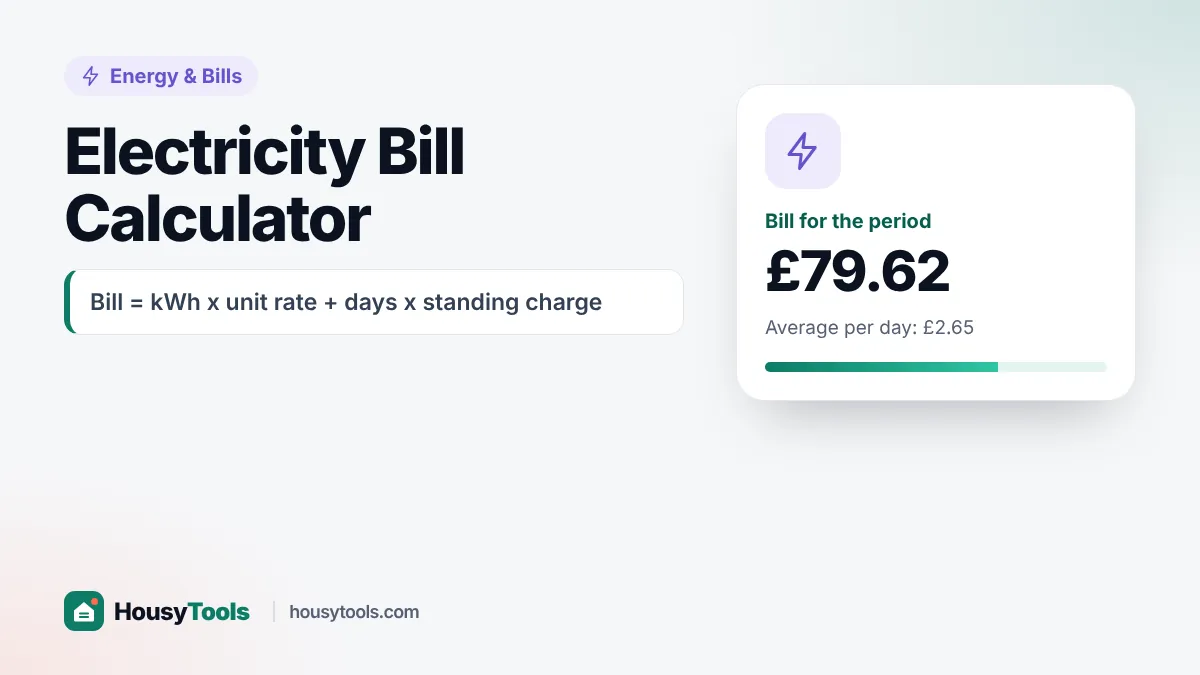
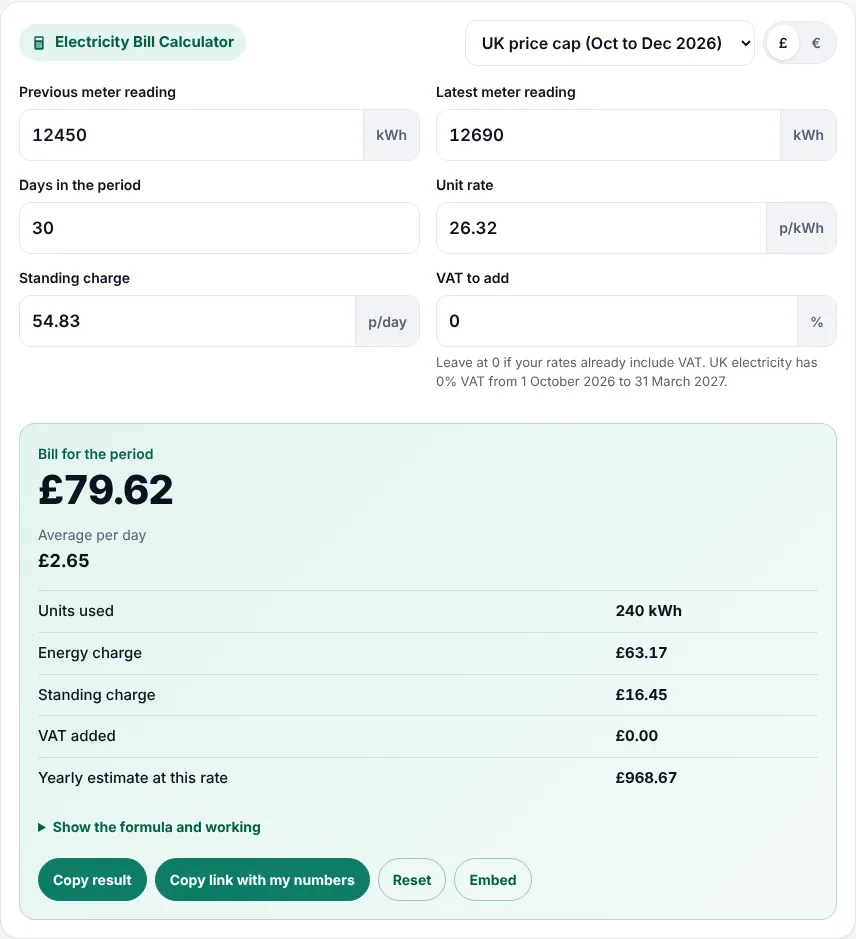
Quick answer: an electricity bill calculator subtracts your previous meter reading from the latest to get kWh, multiplies by the unit rate, then adds the daily standing charge for each day. At 26.32p per kWh and 54.83p a day, 240 kWh over 30 days costs £63.17 plus £16.45, a bill of £79.62.
What Is an Electricity Bill Calculator?
An electricity bill calculator is a tool that estimates what you owe for a billing period from the units you used and your tariff’s charges. It lets you check a supplier’s bill, or work out a bill before it arrives.
The formula has four parts. Units used = latest reading minus previous reading. Energy charge = units x unit rate. Standing charge = days x daily standing charge. Bill = (energy charge + standing charge) x (1 + VAT %). The electricity bill calculator also divides the bill by the days to give an average per day, and multiplies that by 365 for a rough yearly figure.
How Do You Use the Electricity Bill Calculator?
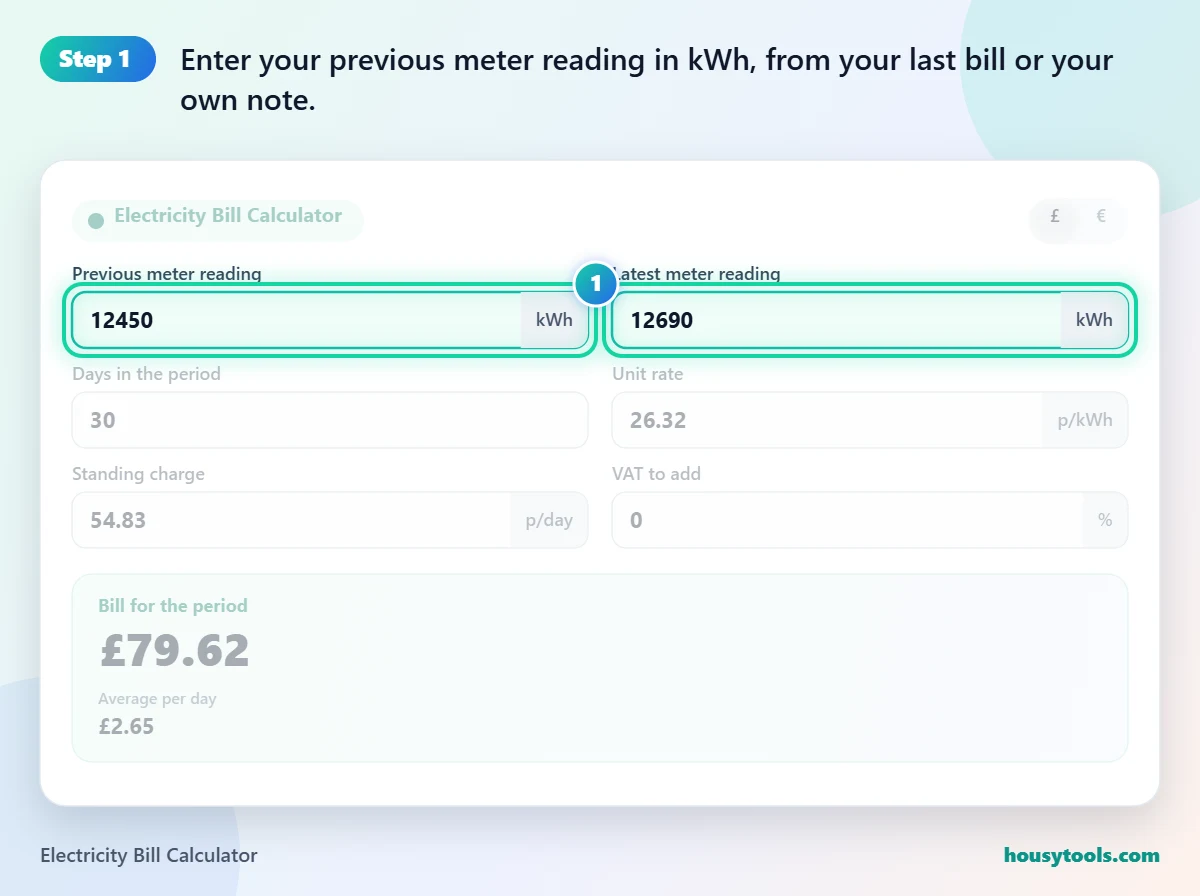
- Enter your previous meter reading in kWh, from your last bill or your own note.
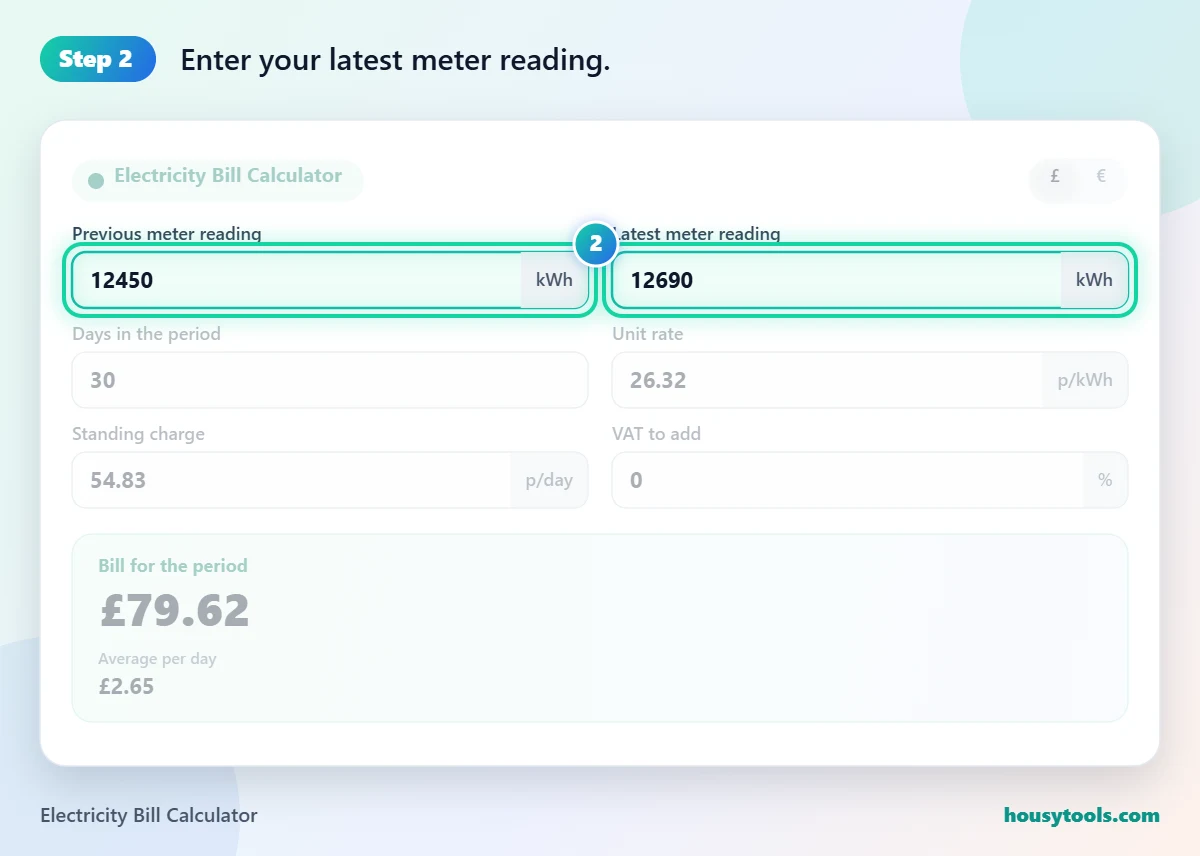
- Enter your latest meter reading. It must be higher than the previous one.
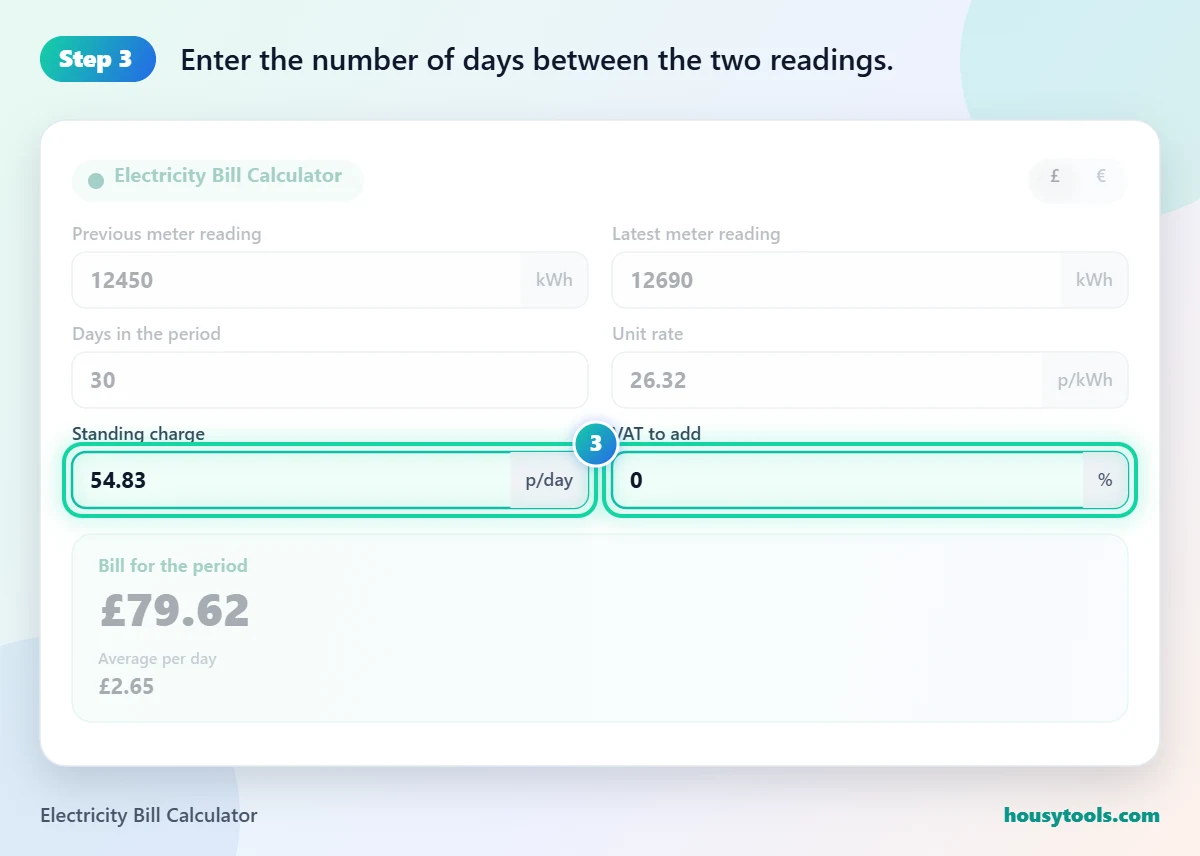
- Enter the number of days between the two readings.
- Check the unit rate in pence per kWh. The UK price cap rate is pre-filled; replace it with the rate on your bill.
- Check the daily standing charge in pence per day, again from your bill.
- Leave VAT at 0 if your rates already include VAT or carry none, or enter your VAT rate, then read the bill and daily average.
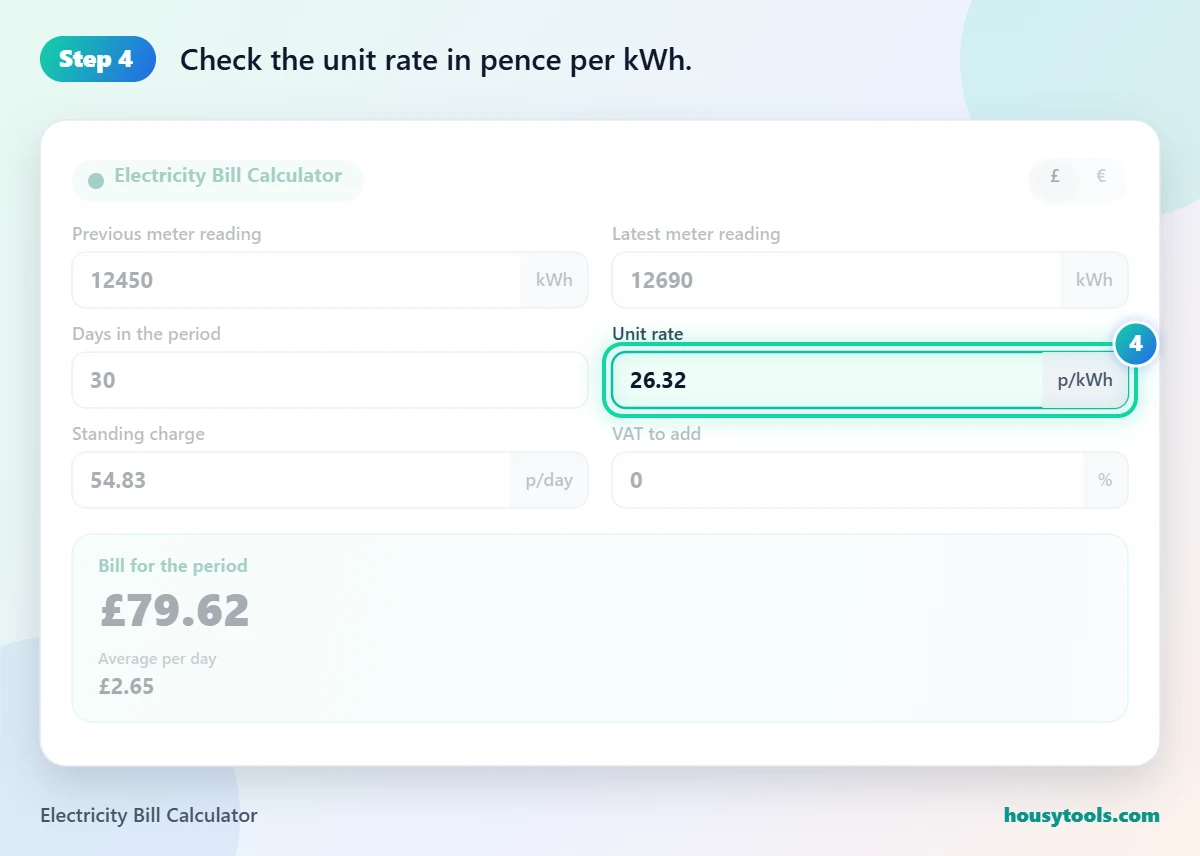
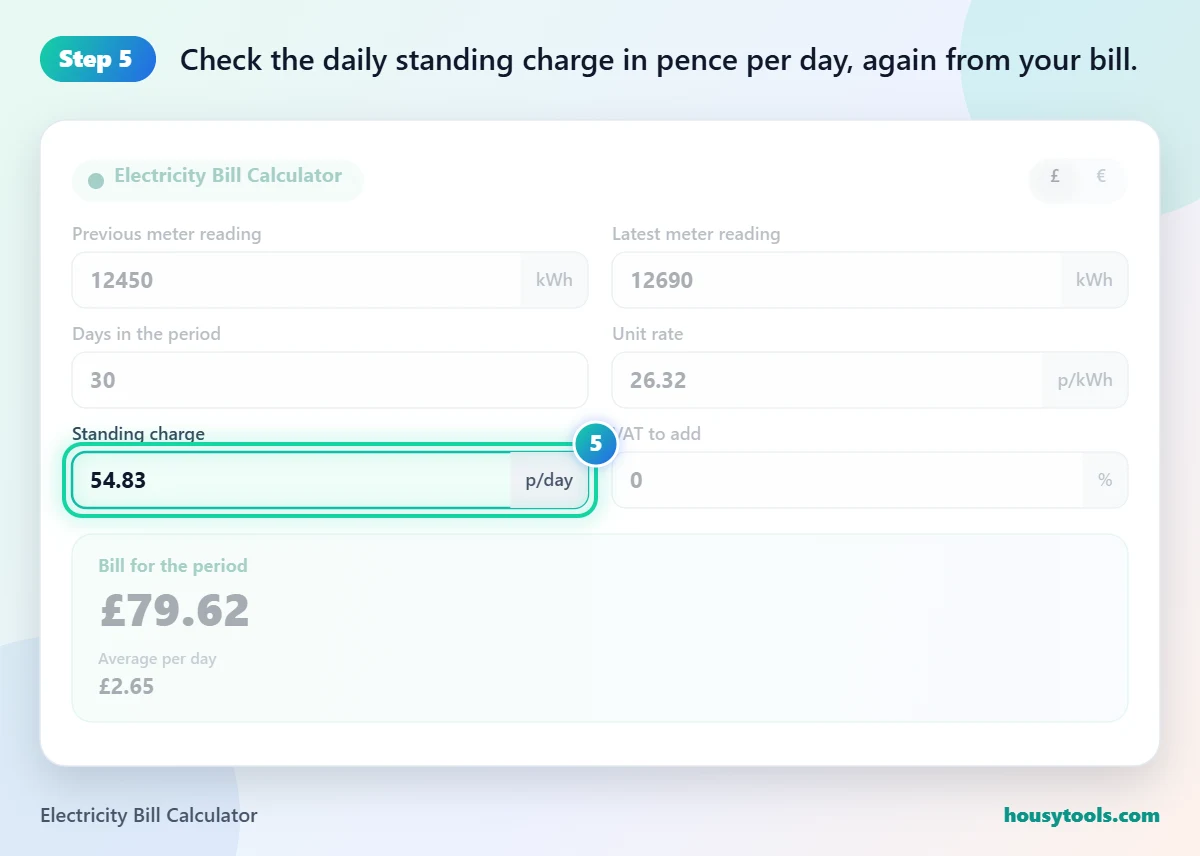
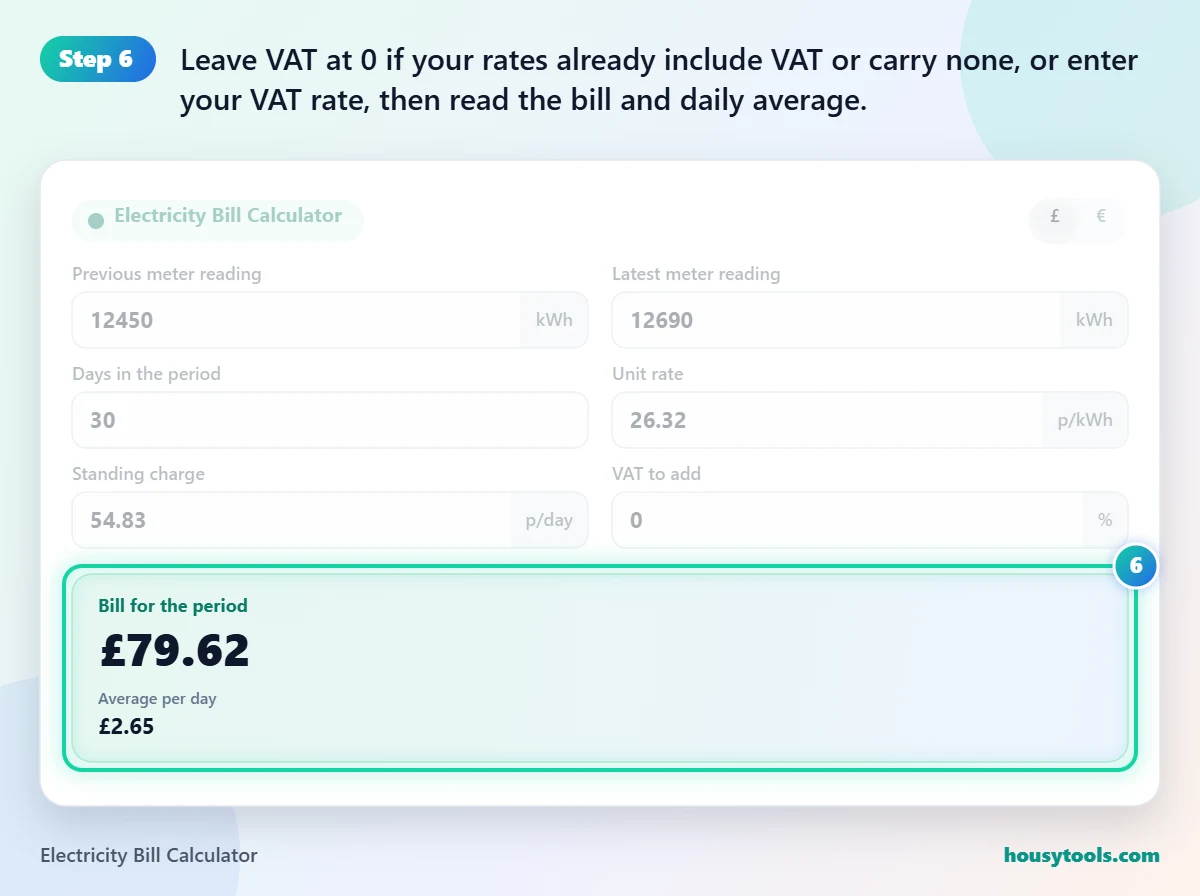
The electricity bill calculator updates as you type. If the latest reading is lower than the previous one, it asks you to check the numbers instead of showing a wrong bill.
How Is My Electricity Bill Calculated?
Your bill is the kWh you used multiplied by your unit rate, plus a fixed standing charge for every day of the period, plus any VAT. Under the GB price cap for 1 October to 31 December 2026 the average Direct Debit rates are 26.32p per kWh and 54.83p a day.
Those averages come from Ofgem’s price cap page, which also says your own rates depend on your region and whether you pay by Direct Debit, standard credit or prepayment. That is why the electricity bill calculator lets you type in your own figures.
The standing charge covers the cost of supplying your home whether or not you use any power. At 54.83p a day it adds £200.13 to a year’s bills, even before you switch anything on.
Is There VAT on My Electricity Bill?
Not at the moment in Great Britain: domestic electricity is zero rated for VAT from 1 October 2026 to 31 March 2027, so leave the VAT box at 0 for that period.
The GOV.UK guidance on the temporary zero rate explains that it replaces the usual reduced rate of 5%, does not apply in Northern Ireland, and does not cover gas, which stays at 5%.
In Northern Ireland, or for bills before 1 October 2026, check whether your rates already include VAT. If they are quoted without it, enter 5% in the electricity bill calculator. EU prices published by Eurostat already include VAT and other taxes; if your supplier quotes rates before tax, enter your country’s VAT rate from your bill.
What Is the Average Electricity Bill in the UK?
A home using Ofgem’s medium figure of 2,500 kWh a year would pay about £858 a year, or £2.35 a day, at the October to December 2026 cap rates.
| Yearly use | Energy charge | Standing charge | Yearly bill | Per day |
|---|---|---|---|---|
| 1,000 kWh | £263.20 | £200.13 | £463.33 | £1.27 |
| 1,600 kWh (Ofgem low) | £421.12 | £200.13 | £621.25 | £1.70 |
| 2,500 kWh (Ofgem medium) | £658.00 | £200.13 | £858.13 | £2.35 |
| 3,800 kWh (Ofgem high) | £1,000.16 | £200.13 | £1,200.29 | £3.29 |
| 5,000 kWh | £1,316.00 | £200.13 | £1,516.13 | £4.15 |
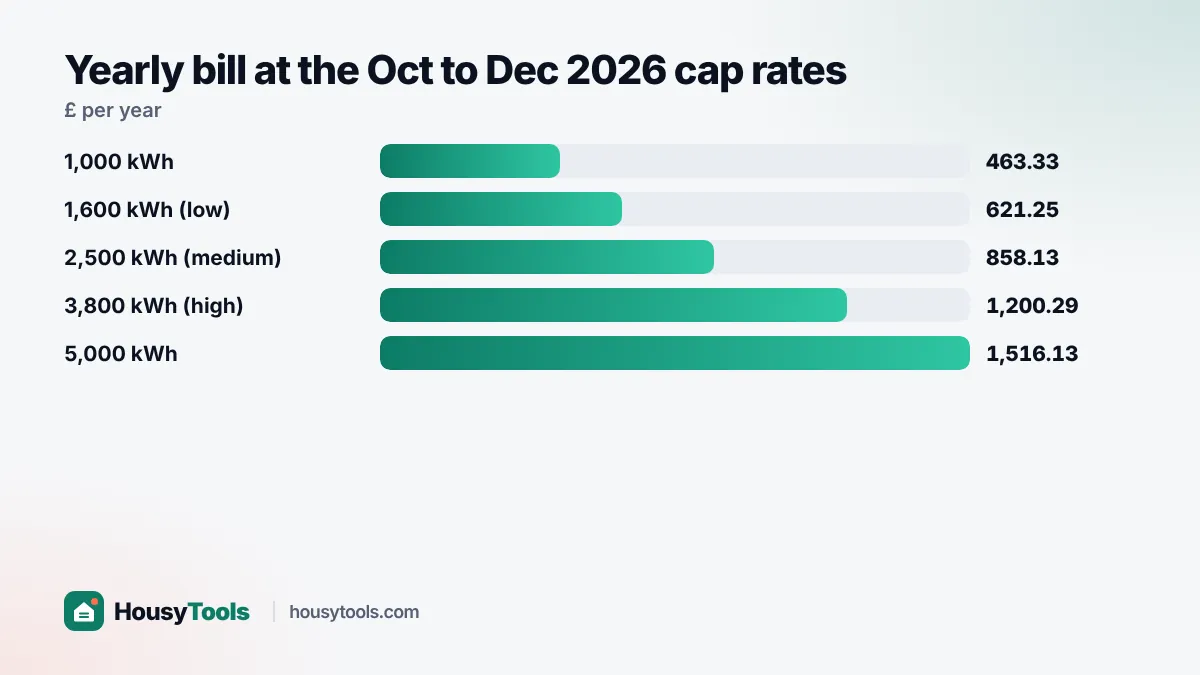
The low, medium and high levels are Ofgem’s typical domestic consumption values, updated from 1 July 2026. Notice that the standing charge is almost a third of the low use bill but only about a sixth of the high use bill.
How Do I Read My Electricity Meter?
On a digital meter, write down the numbers from left to right and ignore any digits after a decimal point or shown in red; on a smart meter, step through the display until you reach the total kWh import reading, or take it from your supplier’s app.
If your meter shows two registers, such as day and night, you are on a two rate tariff. Each register has its own rate, so this single rate electricity bill calculator will not fit; use our Economy 7 calculator instead.
Never open the meter case or break its seals; the meter belongs to your supplier or meter operator. Any wiring work after the meter, such as a new circuit, must be done by a qualified electrician, and in England and Wales it falls under Part P of the Building Regulations.
Worked Example: Callum’s October Bill
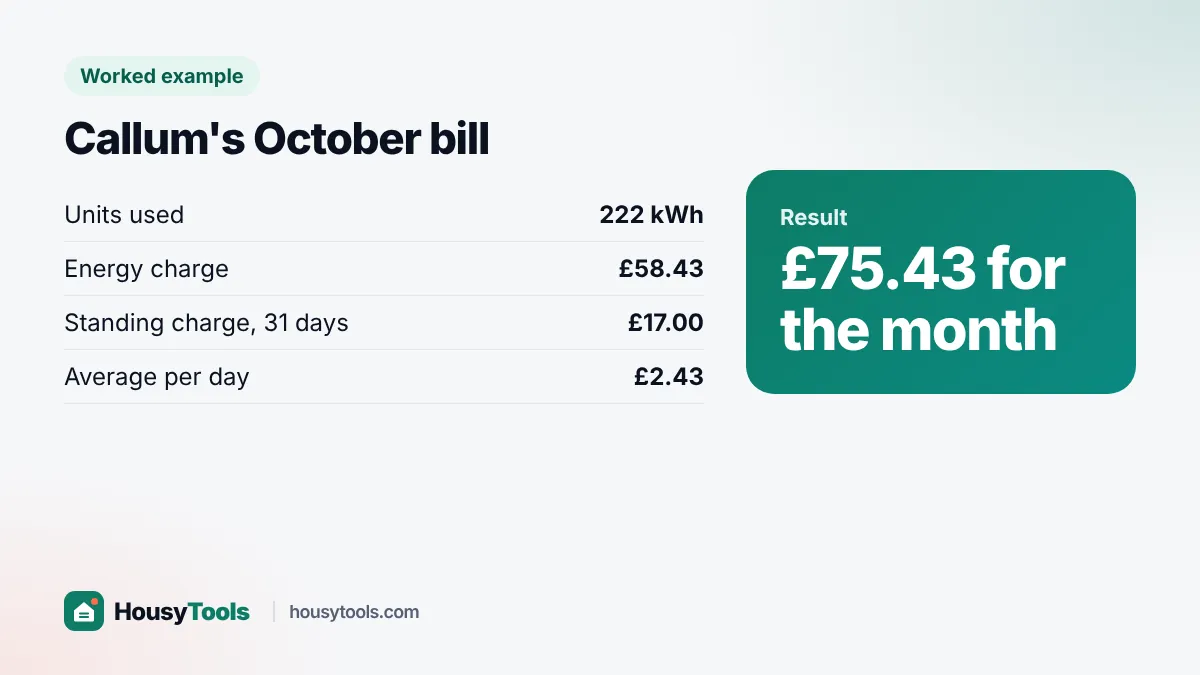
Callum lives in a two bedroom flat in Newcastle and pays by Direct Debit on the price cap. He reads his meter on 1 October (48215) and again on 1 November (48437), 31 days later.
- Units: 48437 minus 48215 = 222 kWh
- Energy: 222 x 26.32p = £58.43
- Standing: 31 days x 54.83p = £17.00
- VAT: 0% under the temporary zero rate, so £0.00
- Bill: £75.43, or £2.43 a day on average
The electricity bill calculator’s yearly estimate at this rate is £888.10, but October is not a typical month, so Callum treats that as a guide only. His supplier’s bill shows the same £75.43, so he knows it was based on his real readings rather than an estimate.
Why Is My Electricity Bill Higher Than Expected?
- Estimated readings. If the supplier guessed high, submit an actual reading and ask for a corrected bill.
- A longer period. A 35 day bill has five more days of standing charge than a 30 day bill.
- A rate change. Cap rates change each quarter, so a bill that spans two periods uses two sets of rates.
- Seasonal use. Lighting, heating and tumble drying all rise in winter.
- A new appliance. Check what it costs with our electricity cost calculator.
If your bill spans a rate change, split it into two runs of the electricity bill calculator, one for each set of rates, and add the totals. For gas, use the matching gas bill calculator.
A Direct Debit is usually a fixed monthly amount based on your expected yearly use, so it will not match each month’s real bill. Run the electricity bill calculator with readings a year apart and divide by 12 to see whether your Direct Debit is set at a sensible level, then ask your supplier to review it if the gap is large.
Electricity Bill Calculator FAQs
How much is the electricity standing charge in 2026?
Under the price cap from 1 October to 31 December 2026, the GB average Direct Debit electricity standing charge is 54.83p a day, or about £200 a year. Your own charge depends on your region and payment method, so check your bill.
How many kWh does an average UK home use?
Ofgem’s typical domestic consumption values, used from 1 July 2026, are 1,600 kWh a year for low use, 2,500 kWh for medium and 3,800 kWh for high use on a single rate electricity meter.
Does the price cap limit my total bill?
No. The price cap limits the unit rate and standing charge a supplier can charge on a default tariff, not your total bill. The more kWh you use, the more you pay, as the electricity bill calculator shows.
Can I use the electricity bill calculator with a smart meter?
Yes. Take the kWh reading from the smart meter display or your supplier’s app at the start and end of the period, count the days, and enter them. A smart meter on a single rate tariff works exactly like a digital meter.
What if my bill covers two price cap periods?
Split it at the change date. Use a reading as close as possible to that date, run the electricity bill calculator once for each part with its own rates, and add the two totals together for the full bill.
How can I check if my bill is estimated?
Look for an “E” or the word estimated next to the reading on your bill. Compare it with your own meter reading. If the supplier’s figure is higher, submit your actual reading and ask them to reissue the bill.
Checked October 2026. Sources: Ofgem (price cap rates, typical domestic consumption values), GOV.UK (HMRC temporary zero rate of VAT).