
Show the formula and working
This energy price cap calculator works out what your gas and electricity will cost over a year and per month at the Ofgem price cap rates, for households in England, Scotland and Wales on a standard variable tariff. Enter your own yearly kWh from your statement, and it shows the unit costs, the standing charges and the monthly average, and compares the result with a fixed deal if you have a quote.
Quick answer: From 1 October to 31 December 2026 the cap is 26.32p per kWh and 54.83p a day for electricity, and 7.97p per kWh and 29.68p a day for gas. An energy price cap calculator gives £1,723.61 a year, about £143.63 a month, for 2,500 kWh of electricity and 9,500 kWh of gas.
What Is an Energy Price Cap Calculator?
An energy price cap calculator is a tool that applies the Ofgem cap unit rates and standing charges to your own energy use to estimate your bill. In plain words: the yearly electricity cost equals the kWh you use multiplied by the unit rate, plus 365 days multiplied by the daily standing charge. Gas is worked out the same way, and the two are added for the yearly total, which is then divided by 12 for a monthly average.
The price cap limits the unit rate and standing charge a supplier can charge on a standard variable tariff. It does not limit the total bill, so a home that uses more energy pays more. The rates in the tool are the averages for Direct Debit published on the Ofgem price cap rates page, and they include VAT where it applies.
How Do You Use the Energy Price Cap Calculator?
- Tick or untick Home has mains gas. Untick it for an all electric home.
- Enter Electricity used per year and Gas used per year in kWh from your annual statement or your supplier’s app.
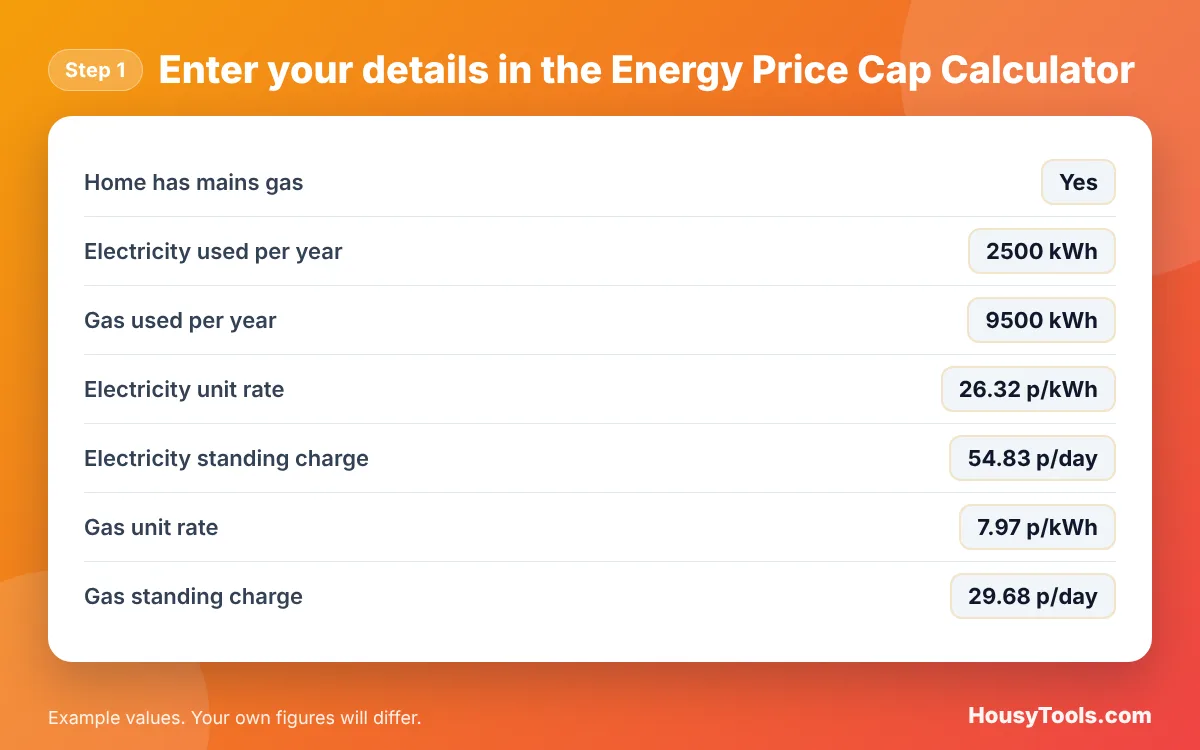
- Keep the cap averages in Electricity unit rate, Electricity standing charge, Gas unit rate and Gas standing charge, or replace them with the rates on your bill or for your region.
- If you have a fixed tariff quote, enter its yearly estimate in Fixed deal yearly cost to compare.
- Read the yearly bill, the monthly average and the split between electricity and gas, then open “Show the formula and working” to see each step.
What Is the Energy Price Cap From October 2026?
From 1 October to 31 December 2026 the cap for Direct Debit customers averages 26.32p per kWh and 54.83p a day for electricity, and 7.97p per kWh and 29.68p a day for gas. Ofgem says this works out at £1,723 a year for a typical household, 4% more than the previous period. Ofgem also notes there is no VAT on electricity from 1 October 2026 to 31 March 2027, so the electricity figures have no VAT added, while the gas figures include it.
Does the Price Cap Limit How Much I Pay?
No, the price cap limits the price of each kWh and the daily standing charge, not your total bill. A home using twice the typical amount pays close to twice the unit costs. The headline £1,723 is only an example for a household using 2,500 kWh of electricity and 9,500 kWh of gas a year. Your own yearly kWh, from your statement, gives a far better estimate, and the electricity bill calculator and gas bill calculator help when you only have meter readings.
Why Do Price Cap Rates Differ by Region and Payment Method?
Cap rates differ because network costs vary across the 14 electricity regions of Great Britain and because paying by Direct Debit, standard credit or prepayment costs suppliers different amounts. Standard credit, where you pay after each bill, usually costs more than Direct Debit. Look up your region on the Ofgem page or copy the rates from your latest bill into the four rate fields. The cap does not apply in Northern Ireland, where prices are overseen by the Utility Regulator.
How Much Is the Standing Charge per Year?
At the October to December 2026 cap averages, standing charges cost £308.46 a year for a dual fuel home: £200.13 for electricity and £108.33 for gas. You pay them every day you are connected, even if you use no energy, which is why they make up a larger share of the bill in small or very efficient homes. For an all electric home only the electricity standing charge applies.
Price Cap Bills at Different Usage Levels
Bills at the October to December 2026 Direct Debit averages, worked out by this calculator. Usage levels are examples.
| Electricity per year | Gas per year | Yearly bill | Monthly average |
|---|---|---|---|
| 1,800 kWh | None | £673.89 | £56.16 |
| 2,500 kWh | None | £858.13 | £71.51 |
| 3,500 kWh | None | £1,121.33 | £93.44 |
| 1,800 kWh | 7,000 kWh | £1,340.12 | £111.68 |
| 2,500 kWh | 9,500 kWh | £1,723.61 | £143.63 |
| 3,500 kWh | 12,000 kWh | £2,186.06 | £182.17 |
| 4,500 kWh | 15,000 kWh | £2,688.36 | £224.03 |
Worked Example: A Typical Dual Fuel Home
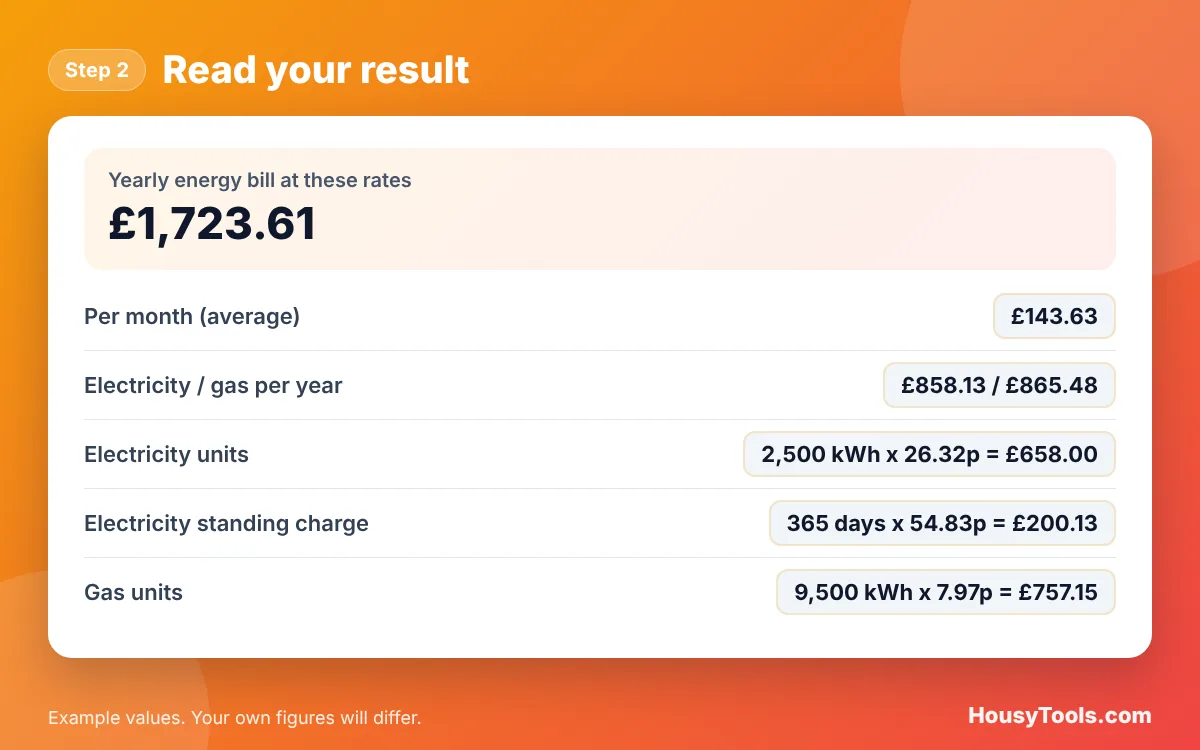
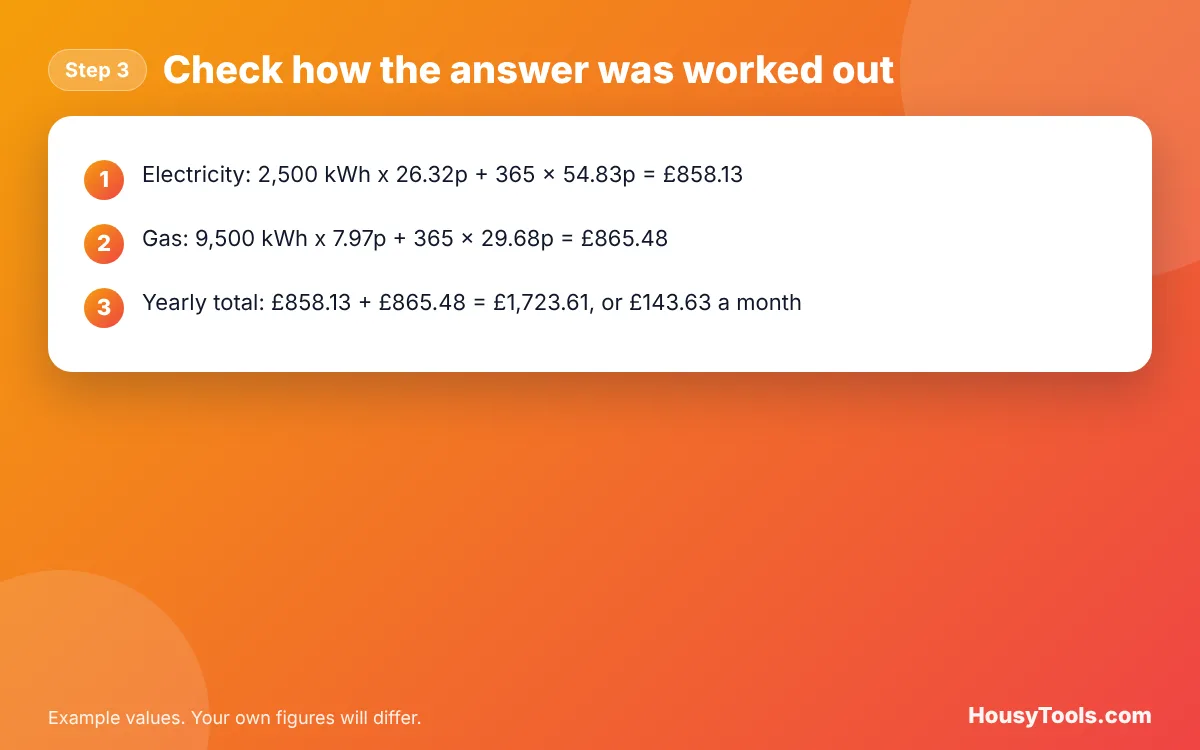
Example: a home with mains gas uses 2,500 kWh of electricity and 9,500 kWh of gas a year and pays by Direct Debit at the cap averages. Electricity units cost 2,500 x 26.32p = £658.00, and the electricity standing charge costs 365 x 54.83p = £200.13, so electricity totals £858.13. Gas units cost 9,500 x 7.97p = £757.15, and the gas standing charge costs 365 x 29.68p = £108.33, so gas totals £865.48.
The yearly total is £1,723.61, or £143.63 a month on average, which matches Ofgem’s typical figure of £1,723. If a fixed deal is quoted at £1,650 a year, entering it shows the fixed deal saves £73.61 a year compared with the cap at today’s rates, although the cap can rise or fall each quarter. Monthly payments are usually spread evenly, so you build credit in summer and use it in winter. To cut the bill itself, see our energy bill calculators for individual appliances.
Energy Price Cap Calculator FAQs
How often does the energy price cap change?
Ofgem sets the price cap every three months, for periods starting on 1 January, 1 April, 1 July and 1 October. The new level is announced several weeks before it starts. Update the four rate fields when a new period begins to keep your estimate current.
Does the price cap apply to fixed tariffs?
No. The cap applies to standard variable and default tariffs. A fixed tariff keeps the rates in your contract for its full term, whether the cap goes up or down. Compare a fixed quote with the cap estimate using the optional comparison field.
What does a typical household use under the price cap?
Ofgem’s typical household uses 2,500 kWh of electricity and 9,500 kWh of gas a year, which gives £1,723 at the October to December 2026 cap. Real homes vary widely with size, insulation, heating and the number of people, so use your own statement figures.
Where do I find my yearly kWh?
Your supplier’s annual statement shows your estimated yearly use in kWh for each fuel, and most apps show it too. You can also take two meter readings a year apart. Gas meters read in cubic metres or cubic feet, so convert the reading to kWh first.
Is prepayment cheaper than Direct Debit under the cap?
Prepayment and Direct Debit cap levels are set separately and differ slightly, while standard credit is usually the most expensive way to pay. Ofgem publishes the rates for each payment method and region, so enter the ones that match your account.
Is VAT included in the price cap rates?
Yes, the published cap rates are the prices you pay. For 1 October 2026 to 31 March 2027, Ofgem states there is no VAT on electricity, while gas rates include VAT. If you copy rates from a bill that shows VAT separately, add it before entering them.
Checked October 2026. Sources: Energy price cap standing charges and unit rates (Ofgem), Energy price cap explained (Ofgem).