
Show the formula and working
This generator size calculator works out how big a portable or standby generator needs to be, in kW and kVA, to run the appliances you choose at the same time, for homes, caravans and small sites in the UK, Ireland and the rest of Europe on 230 V. It allows for the start up surge of a motor appliance such as a fridge freezer or pump, adds spare capacity, and converts the answer into the kVA figure on generator listings.
Quick answer: A generator size calculator adds the running watts, then takes the larger of that total plus about 20% spare and the total plus the motor start up surge. A 2,500 W load with a 200 W fridge freezer needs a 3 kW generator, which is 3.75 kVA at a power factor of 0.8.
What Is a Generator Size Calculator?
A generator size calculator is a tool that estimates the minimum generator output needed to run a set of appliances together without overloading it. In plain words: add up the running watts of everything that will be on at once. Work out a continuous figure, that total plus a spare capacity margin, and a peak figure, that total plus the extra the biggest motor draws while it starts. The generator needs at least the larger of the two. Divide kW by the power factor, usually 0.8, to get kVA.
Generators are often sold by kVA, apparent power, rather than kW, real power. The difference is the power factor. Most generator ratings assume 0.8, so a 5 kVA generator delivers about 4 kW. Heaters, kettles and lights have a power factor close to 1, while motors and some electronics are lower.
How Do You Use the Generator Size Calculator?
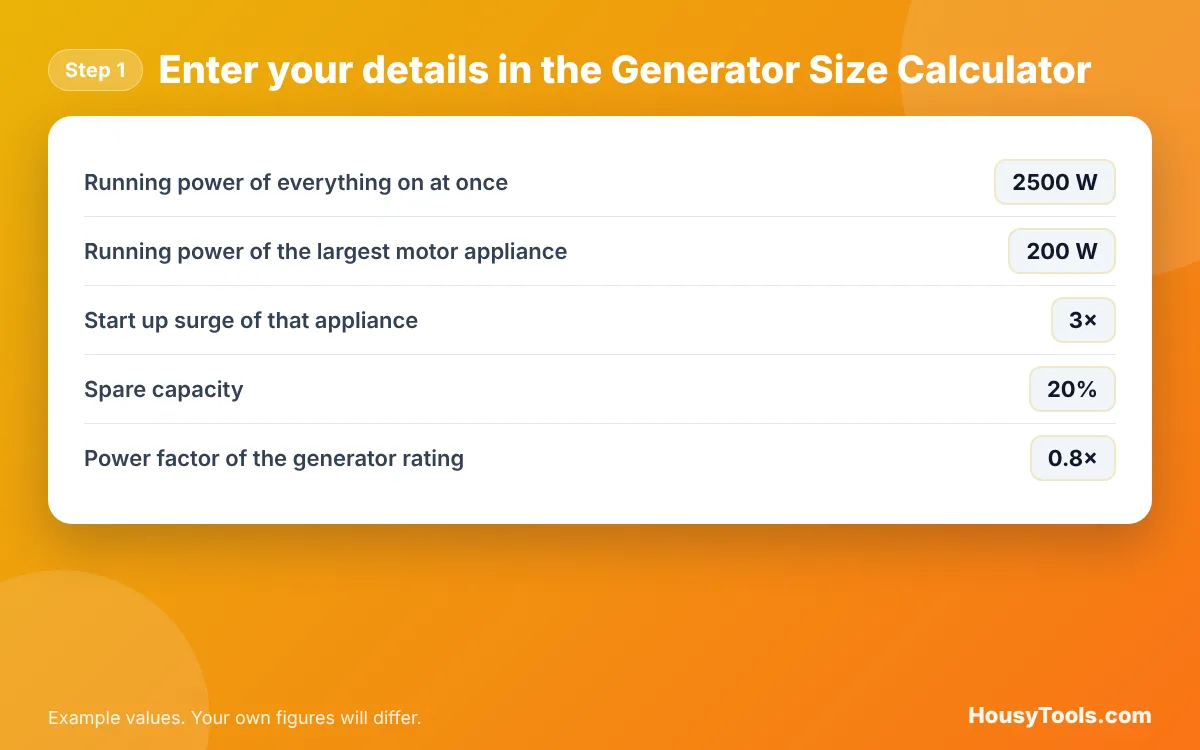
- List every appliance you will run at the same time and add their rated watts from the labels. Enter the total as Running power of everything on at once.
- Enter the Running power of the largest motor appliance, such as a fridge freezer, pump or compressor, or 0 if there is none.
- Set the Start up surge of that appliance from its manual, or keep the example of 3 times.
- Choose the Spare capacity and check the Power factor of the generator rating, usually 0.8.
- Read the size in kW and kVA, which limit it was sized by and the current, then open “Show the formula and working” to see each step.


What Size Generator Do I Need to Run a House?
To keep essentials such as a fridge freezer, lights, a boiler pump, broadband and phone chargers running, many homes need roughly 2 to 3.5 kW, while running electric heating, an oven or an electric shower needs far more. Add up your own appliances rather than relying on a typical figure, because one 2 kW heater or 3 kW kettle changes the answer completely. Spreading heavy loads, so the kettle and heater are not on together, keeps the generator smaller. Our watts to amps converter helps total a mix of appliances.
How Do You Connect a Generator to a House Safely?
The only safe way to power house circuits from a generator is through a changeover switch or approved inlet fitted by a qualified electrician. Never use a lead with plugs on both ends to feed power back through a socket: it can electrocute you or anyone touching the plug, and can send power back into the grid where network engineers may be working. For small needs, plug appliances directly into the generator’s own outlets with suitable outdoor extension leads.
Where Should a Generator Be Run?
Always run a petrol or diesel generator outdoors in the open air, well away from doors, windows and vents, because its exhaust contains carbon monoxide, a poisonous gas you cannot see or smell. Never run one in a garage, shed, porch or caravan, even with the door open. The NHS explains the symptoms of carbon monoxide poisoning, and a carbon monoxide alarm in the home is a sensible extra safeguard. Keep the generator dry and store fuel safely.
Generator Size by Total Load
With 20% spare capacity, no large motor and a power factor of 0.8, as the calculator works it out.
| Total running power | Generator kW | Generator kVA | Current at 230 V |
|---|---|---|---|
| 1,000 W | 1.2 kW | 1.5 kVA | 5.2 A |
| 2,000 W | 2.4 kW | 3.0 kVA | 10.4 A |
| 2,500 W | 3.0 kW | 3.75 kVA | 13.0 A |
| 4,000 W | 4.8 kW | 6.0 kVA | 20.9 A |
| 6,000 W | 7.2 kW | 9.0 kVA | 31.3 A |
| 8,000 W | 9.6 kW | 12.0 kVA | 41.7 A |
Worked Example: Essentials During a Power Cut
Example: during a power cut you want to run appliances totalling 2,500 W at once, including a fridge freezer rated at 200 W. With 20% spare capacity the continuous figure is 2,500 x 1.2 = 3,000 W. The fridge freezer may briefly draw about 3 times its running power when the compressor starts, so the peak is 2,500 + 200 x 2 = 2,900 W. The larger figure, 3,000 W, sets the size: a 3 kW generator, or 3.75 kVA at a power factor of 0.8, drawing 13 A at 230 V. These are the default inputs, so the calculator shows the same result.
If you swap the fridge freezer for a 1,000 W pump with the same surge and cut the total to 1,500 W, the peak of 3,500 W becomes the limit instead. For quiet backup of small loads, a home battery may suit better, and the solar battery size calculator sizes one.
Generator Size Calculator FAQs
What is the difference between kW and kVA on a generator?
kW is the real power appliances use, and kVA is the apparent power the generator supplies. kW equals kVA multiplied by the power factor, and most generators are rated at 0.8, so a 3.75 kVA generator supplies about 3 kW.
Will a 2 kW generator run a kettle?
Usually not. Most UK kettles are rated at about 2,000 to 3,000 W, so a 2 kW generator would be at or over its limit with nothing else running. Check the kettle’s rating plate and allow spare capacity, or boil water another way.
Why do motors need a bigger generator?
Electric motors draw a short surge of current while they start, which can be several times their running power. If the generator cannot supply it, the motor stalls or the generator’s breaker trips. The appliance manual or data plate may list starting watts.
Is an inverter generator safe for laptops and TVs?
Inverter generators produce a cleaner, steadier output than many basic open frame generators, which suits laptops, TVs, routers and chargers. Check the maker’s specification and use a surge protected extension lead rated for outdoor use where needed.
Can I run a generator in my garage?
No. Exhaust fumes contain carbon monoxide, which can build up to deadly levels in a garage, shed or porch even with the door open. Run generators outdoors only, well away from windows, doors and vents.
Do I need an electrician to install a standby generator?
Yes. Connecting any generator to a home’s fixed wiring needs a changeover switch and earthing arrangements designed and fitted by a qualified electrician, and the work must meet BS 7671 wiring rules. Fuel supply and exhaust also need proper siting.
Checked October 2026. Sources: Carbon monoxide poisoning (NHS), Power factor (Wikipedia), ISO 8528 generator ratings (rated power factor 0.8).