
Show the formula and working
This egg size converter tells home bakers in the UK, Ireland and Europe how many of their own eggs replace the eggs a recipe asks for, whether the recipe uses UK and EU sizes or American ones. Pick the recipe egg size, the number of eggs and your egg size, and it gives the number to use, the exact equivalent and the weight of beaten egg to measure out.
Quick answer: An egg size converter compares egg weights. UK and EU large eggs weigh 63 to 73 g and medium eggs 53 to 63 g, so 4 large eggs equal about 4.7 medium eggs: use 5. A US large egg averages at least 56.7 g, close to a UK medium, so US recipes work with UK medium eggs.
What Is an Egg Size Converter?
An egg size converter is a tool that swaps eggs of one size grade for another by matching the total egg weight a recipe needs. In plain words: eggs to use equal the number of recipe eggs multiplied by the recipe egg weight, divided by your egg weight. The beaten egg to weigh out equals the total weight minus the shell.
The weights come from the official grading rules. In the UK and EU, Regulation (EC) No 589/2008, Article 4 sets the bands: small under 53 g, medium 53 to 63 g, large 63 to 73 g and very large 73 g and over. The calculator uses the middle of each closed band, and assumes 48 g for small and 78 g for very large because those bands have no fixed end. In the US, the USDA sets a minimum net weight per dozen for each size, such as 24 ounces for large, and the calculator divides that by 12.
How Do You Use the Egg Size Converter?
- Choose the Recipe egg size. British recipes usually mean UK/EU medium or large, and American recipes usually mean US large.
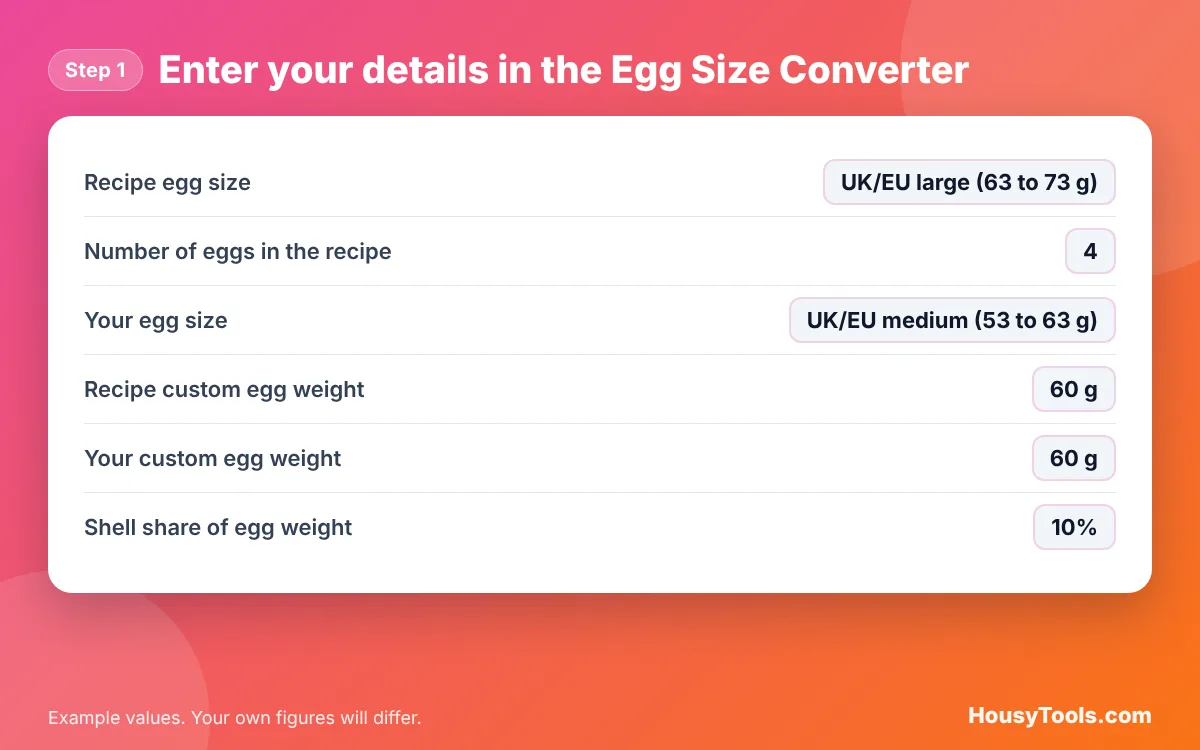
- Enter the Number of eggs in the recipe.
- Choose Your egg size from the box you have.
- If you weighed your eggs, pick Custom weight and enter Your custom egg weight, or use Recipe custom egg weight if the recipe gives a weight per egg.
- Leave the Shell share of egg weight at 10% unless you want to adjust it.
- Read the number of eggs to use, the exact equivalent and the beaten egg weight, then open “Show the formula and working” to see the sums.


How Many Medium Eggs Equal Large Eggs?
About 7 medium eggs replace 6 large eggs, because a typical large egg (68 g) is about 17% heavier than a typical medium egg (58 g). For small numbers the difference hardly matters: 1 or 2 large eggs can be swapped for the same number of medium eggs in most recipes. From 3 or 4 eggs upwards, add an extra medium egg, or beat the eggs and weigh the amount the converter shows.
Is a US Large Egg the Same as a UK Large Egg?
No, a US large egg is closer to a UK medium egg. The USDA large grade requires at least 24 ounces per dozen, which is 56.7 g per egg on average, while a UK large egg weighs 63 to 73 g. When an American recipe says large eggs, UK medium eggs are the closest match, and using UK large eggs adds roughly 20% more egg. A US extra large egg (63.8 g) sits at the bottom of the UK large band.
How Much Does an Egg Weigh Without the Shell?
An egg without its shell weighs about 90% of its whole weight, so a 68 g large egg gives about 61 g of beaten egg. Published figures for the shell run from about 8% to 12% of the egg’s weight, which is why the shell share is an editable field set to an example 10%. For precise baking, crack the eggs into a bowl, beat them and weigh out the amount the converter gives.
UK, EU and US Egg Sizes Compared
| Size | Official rule | Weight used per egg |
|---|---|---|
| UK/EU small | under 53 g | 48 g (assumed) |
| UK/EU medium | 53 to 63 g | 58 g |
| UK/EU large | 63 to 73 g | 68 g |
| UK/EU very large | 73 g and over | 78 g (assumed) |
| US peewee | 15 oz per dozen | 35.4 g |
| US small | 18 oz per dozen | 42.5 g |
| US medium | 21 oz per dozen | 49.6 g |
| US large | 24 oz per dozen | 56.7 g |
| US extra large | 27 oz per dozen | 63.8 g |
| US jumbo | 30 oz per dozen | 70.9 g |
US figures are minimum weights per dozen from the USDA shell egg standards, converted at 28.35 g per ounce. Weights are in the shell.
Worked Example: A Sponge With Medium Eggs
Example: a cake recipe asks for 4 large eggs, but the box to hand holds medium eggs. Set Recipe egg size to UK/EU large, enter 4, and set Your egg size to UK/EU medium. The converter works out 4 x 68 g = 272 g of egg in the shell, then 272 divided by 58 = 4.69 medium eggs, which rounds to 5. It also shows 245 g of beaten egg (272 g less 10% shell). Crack 5 medium eggs, beat them and pour off the extra so the bowl holds 245 g.
If you are also changing the cake tin, our home calculators include more everyday tools, and the electricity cost calculator shows what an hour of oven baking costs on your tariff.
Egg Size Converter FAQs
How much does a large egg weigh in the UK?
A UK large egg weighs 63 to 73 g in the shell, under the size grades in Regulation (EC) No 589/2008 that still apply in the UK. The converter uses 68 g, the middle of that band, as a typical large egg.
Can I use medium eggs instead of large?
Yes. For 1 or 2 eggs, swap them one for one. For 3 or more, add roughly one extra medium egg for every 6 large eggs, or weigh the beaten egg. Cakes and batters are more sensitive to the difference than omelettes or scrambled eggs.
What size egg do recipes use?
Most British recipes that do not say otherwise are written for medium or large eggs, and many state the size in the ingredient list. American recipes almost always mean US large, which is close to a UK medium egg.
How many grams is one egg for baking?
One UK medium egg gives about 52 g of beaten egg and one UK large egg about 61 g, assuming the shell is 10% of the weight. A US large egg gives about 51 g. Weighing is the most reliable way to match a recipe.
How do I convert half an egg?
Beat one egg and weigh it, then use half the weight. With a UK medium egg that is about 26 g of beaten egg. The converter’s beaten egg figure also helps when a scaled recipe ends in a fraction of an egg.
Why does the converter round the number of eggs?
You cannot crack part of an egg, so the main result rounds to the nearest whole egg. The exact equivalent and the beaten egg weight are shown as well, so you can weigh the precise amount when it matters.
Checked October 2026. Sources: Regulation (EC) No 589/2008, Article 4 (legislation.gov.uk), United States Standards, Grades, and Weight Classes for Shell Eggs (USDA AMS), Chicken egg sizes (Wikipedia), Eggs as food (Wikipedia).