
Show the formula and working
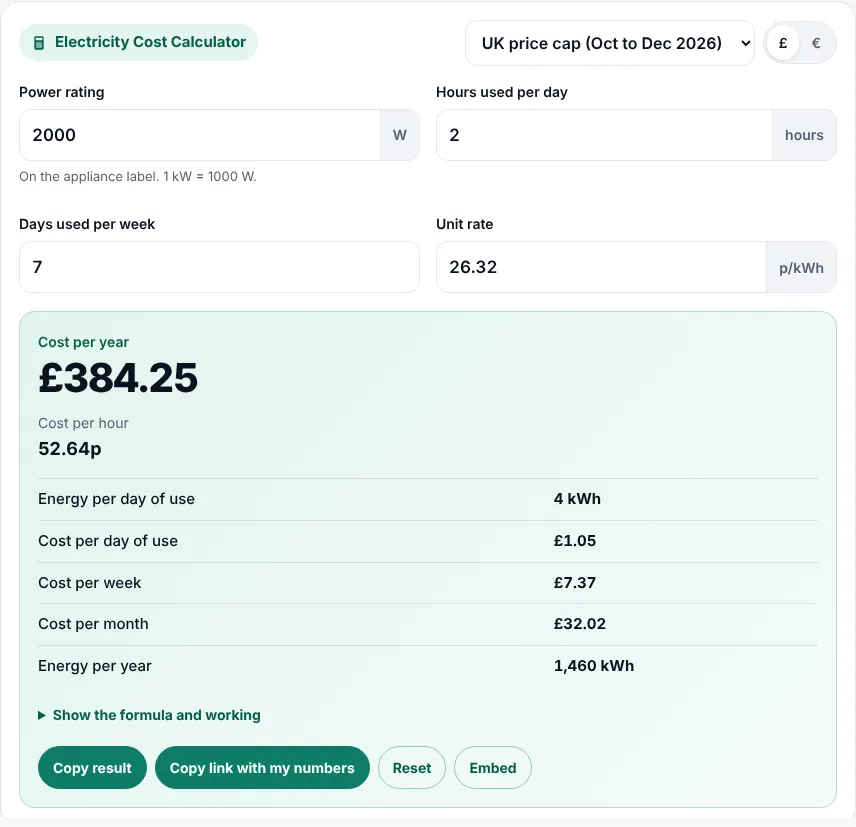
This electricity cost calculator shows how much any electrical appliance costs to run per hour, day, week, month and year, from its power rating, how long you use it and your unit rate. It is pre-filled with the UK price cap rate for October to December 2026 and has presets for EU average, German and Irish prices in euros.
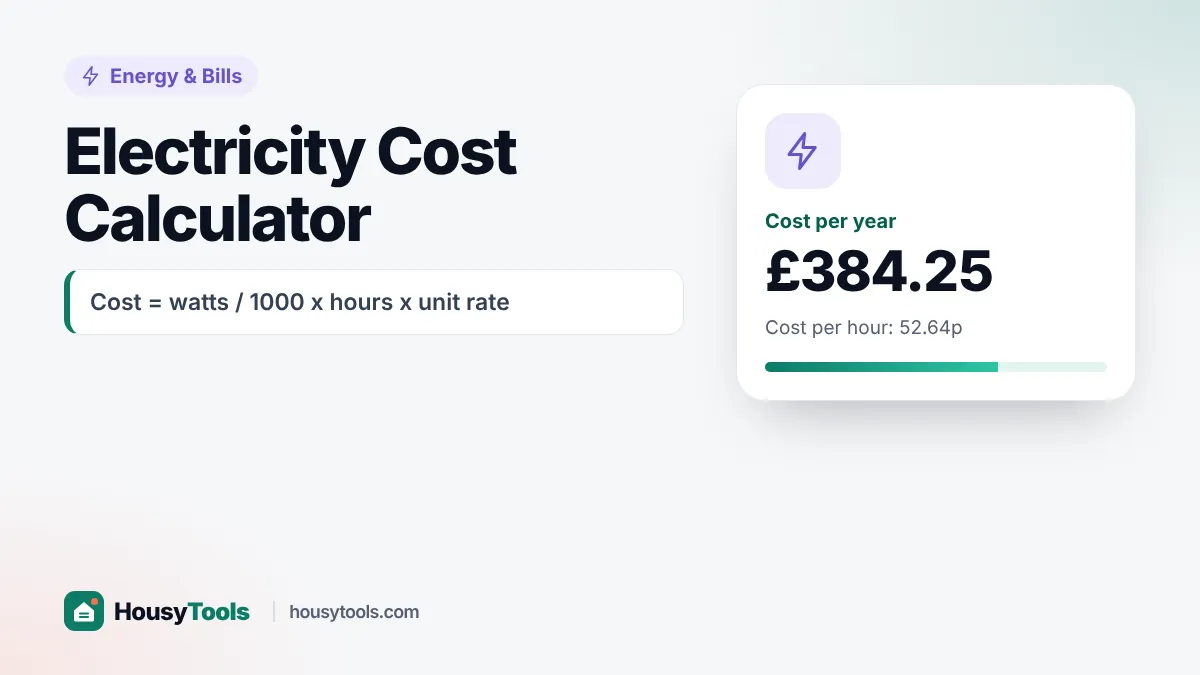
Quick answer: an electricity cost calculator divides an appliance’s watts by 1,000, multiplies by hours of use to get kWh, then multiplies by your unit rate. At the UK price cap rate of 26.32p per kWh, a 2,000 W heater costs 52.64p an hour and a 3,000 W kettle costs about 79p for every hour it boils.
What Is an Electricity Cost Calculator?
An electricity cost calculator is a tool that converts an appliance’s power rating and usage time into the energy it uses in kilowatt hours (kWh) and what that energy costs at your unit rate.
The formula has three steps. Energy per day = watts / 1,000 x hours per day. Cost per day = kWh x unit rate. Cost per year = cost per day x days used per week x 52.14 weeks. Monthly cost is the yearly figure divided by 12. The electricity cost calculator shows each step, so you can check the maths yourself.
One kWh is 1,000 watts used for one hour. That means a 100 W appliance takes 10 hours to use 1 kWh, while a 3,000 W kettle uses the same amount in 20 minutes.
How Do You Use the Electricity Cost Calculator?
- Choose your tariff: the UK price cap, the EU average, Germany, Ireland, or your own tariff.
- Find the power rating in watts on the appliance’s rating plate or in its manual, and enter it. If it shows kW, multiply by 1,000.
- Enter the hours you use it on a typical day. Use decimals for minutes: 15 minutes is 0.25 hours.
- Enter how many days a week you use it, from 1 to 7.
- Check the unit rate. Replace the preset with the rate on your bill for the most accurate result.
- Read the cost per hour, day, week, month and year, and the working underneath.
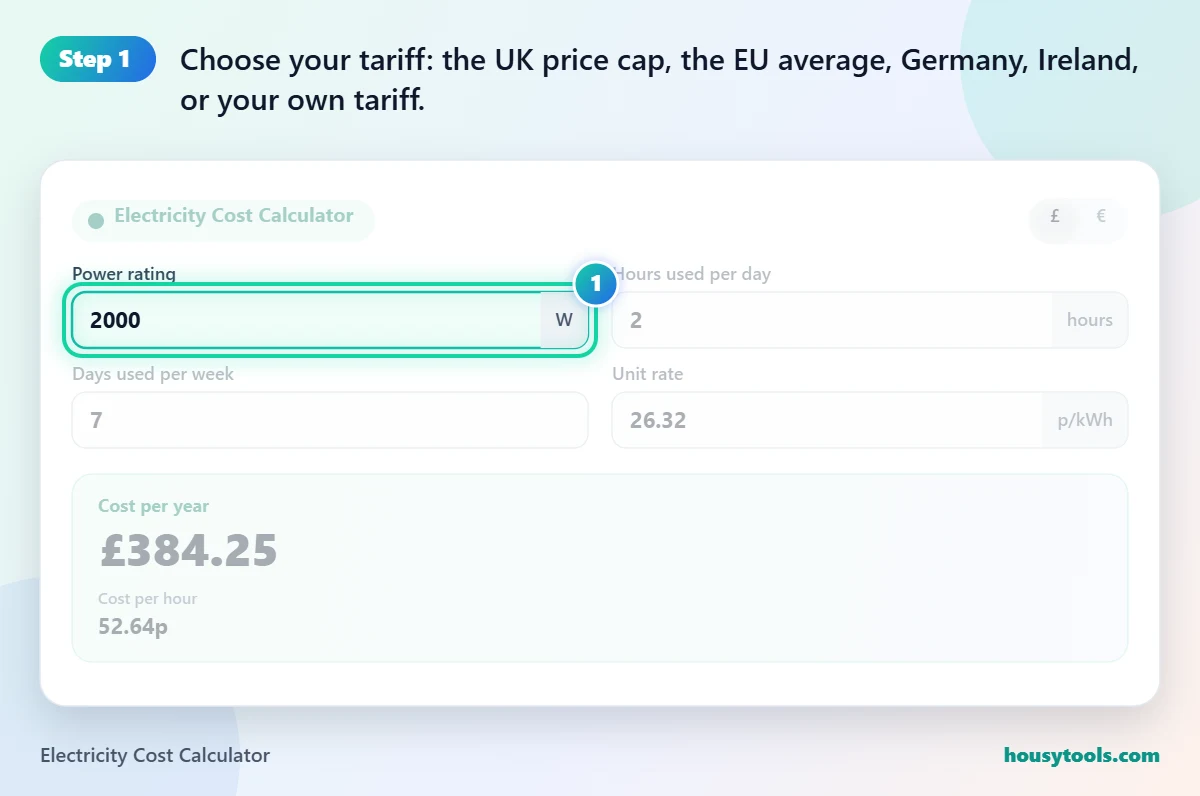
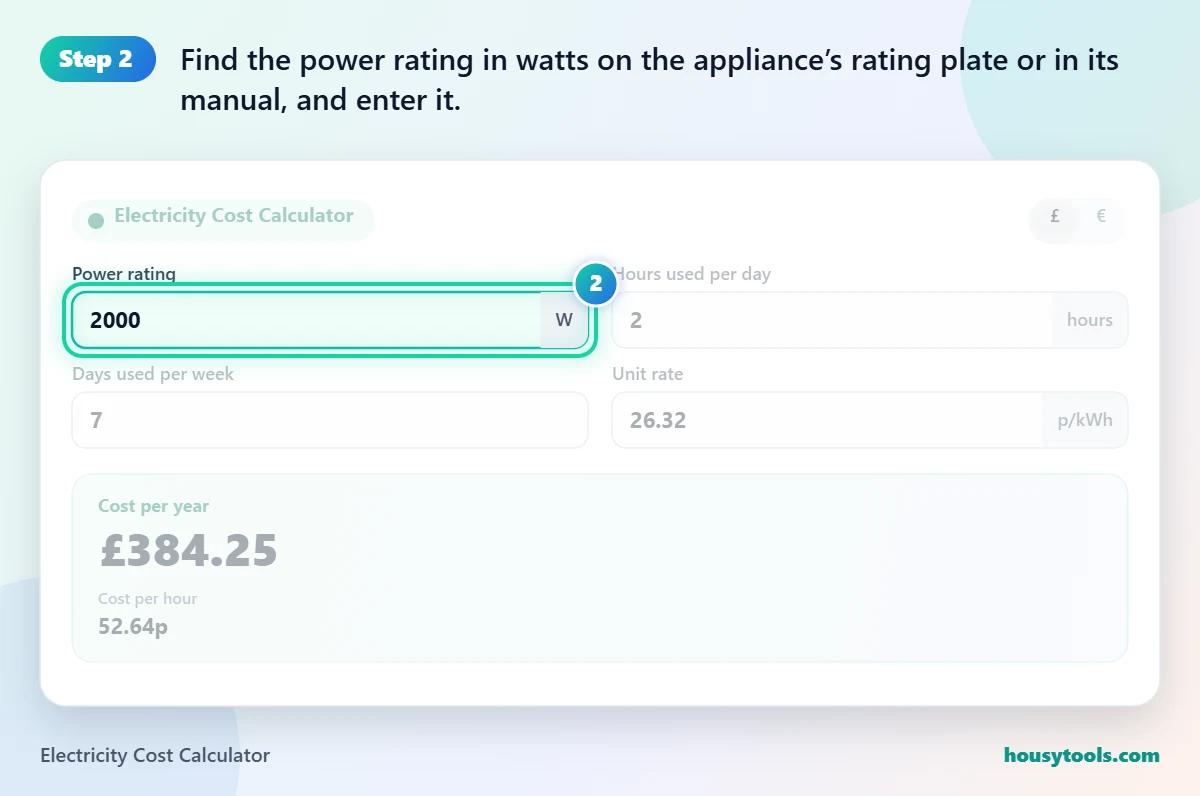
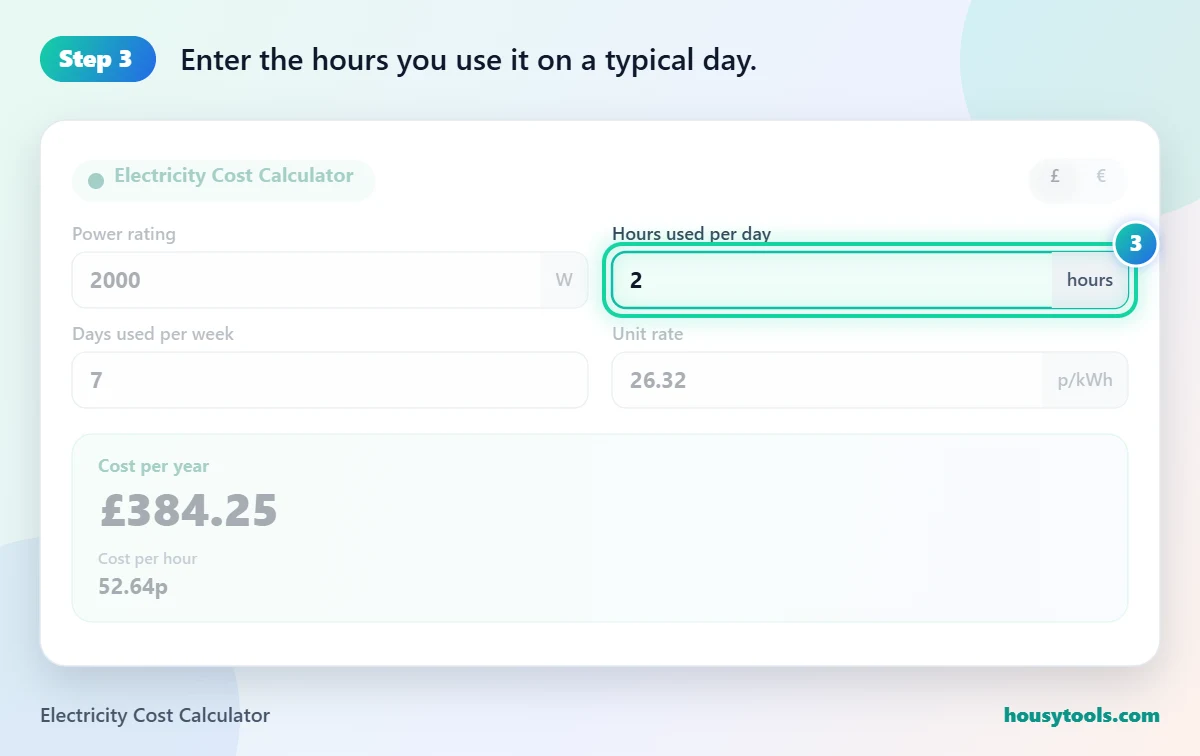
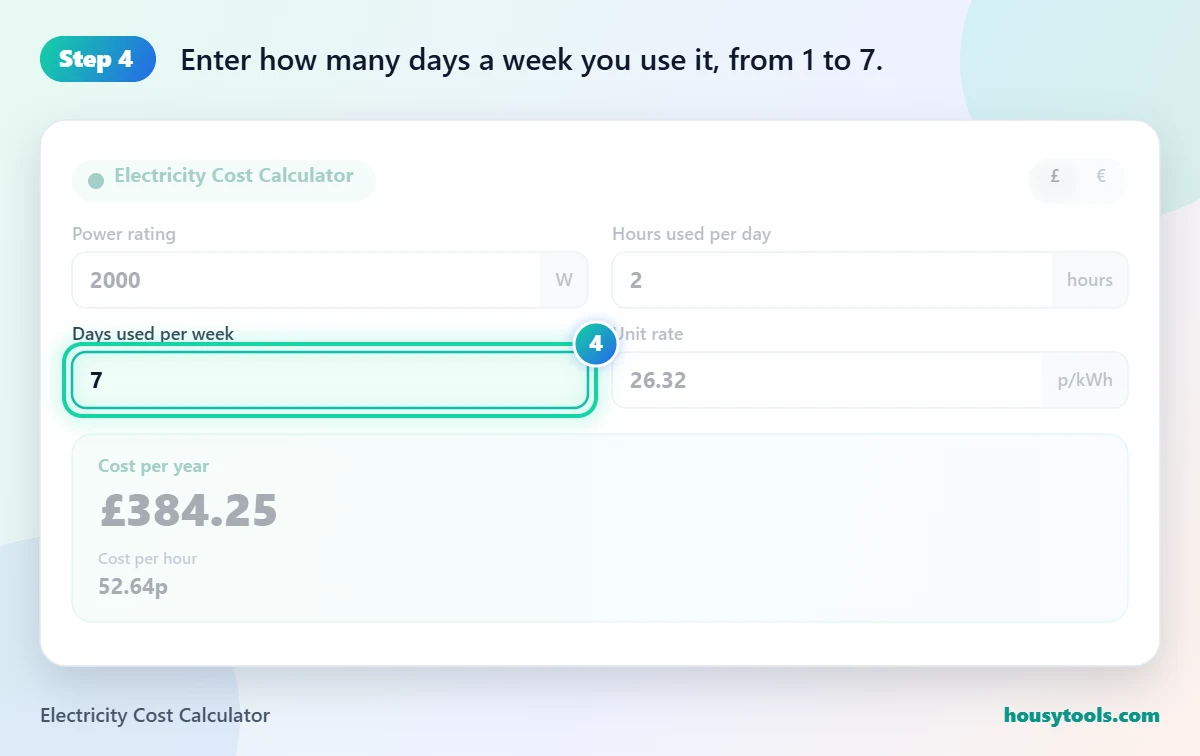
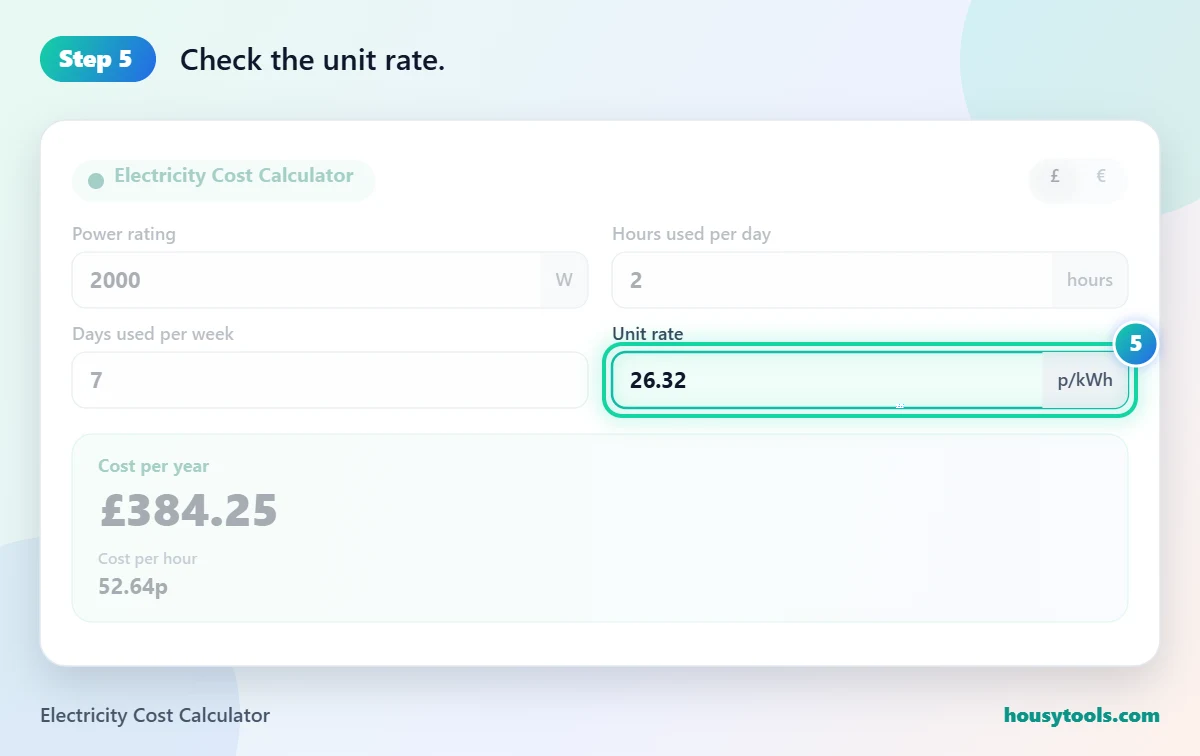
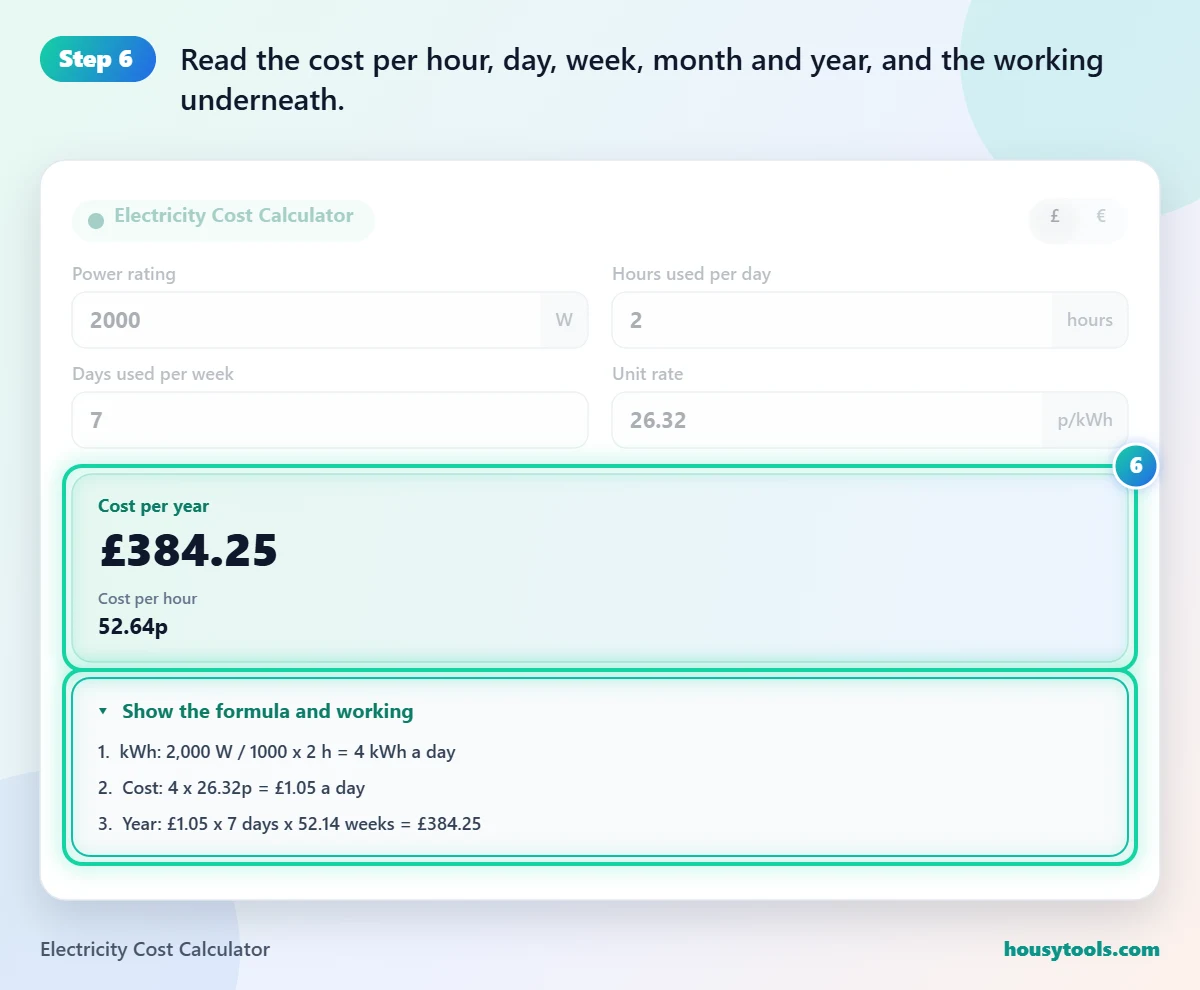
The electricity cost calculator updates as you type, so you can quickly compare two appliances or two ways of using the same one.
How Much Does Electricity Cost per kWh in 2026?
Under the UK price cap from 1 October to 31 December 2026, electricity costs 26.32p per kWh plus a standing charge of 54.83p a day, for a typical Direct Debit customer in Great Britain.
These are averages: Ofgem’s price cap rates differ by region and payment method, and fixed tariffs can be higher or lower. Ofgem also notes there is no VAT on domestic electricity from 1 October 2026 to 31 March 2027, so the 26.32p figure has no VAT in it.
In the EU, Eurostat’s household electricity prices for the second half of 2025 averaged €28.96 per 100 kWh, including taxes, with Germany at €38.69 and Ireland at €40.42. Pick the matching preset in the electricity cost calculator, or enter your own supplier’s rate.
How Much Does It Cost to Run Common Appliances?
| Appliance | Typical power (W) | Cost per hour at 26.32p |
|---|---|---|
| Electric shower | 9,000 | £2.37 |
| Kettle | 3,000 | 78.96p |
| Tumble dryer | 2,500 | 65.8p |
| Oven | 2,100 | 55.27p |
| Oil filled radiator | 2,000 | 52.64p |
| Microwave | 1,000 | 26.32p |
| Vacuum cleaner | 900 | 23.69p |
| Dehumidifier | 500 | 13.16p |
| LCD TV | 120 | 3.16p |
| Laptop | 50 | 1.32p |
| Broadband router | 10 | 0.26p |
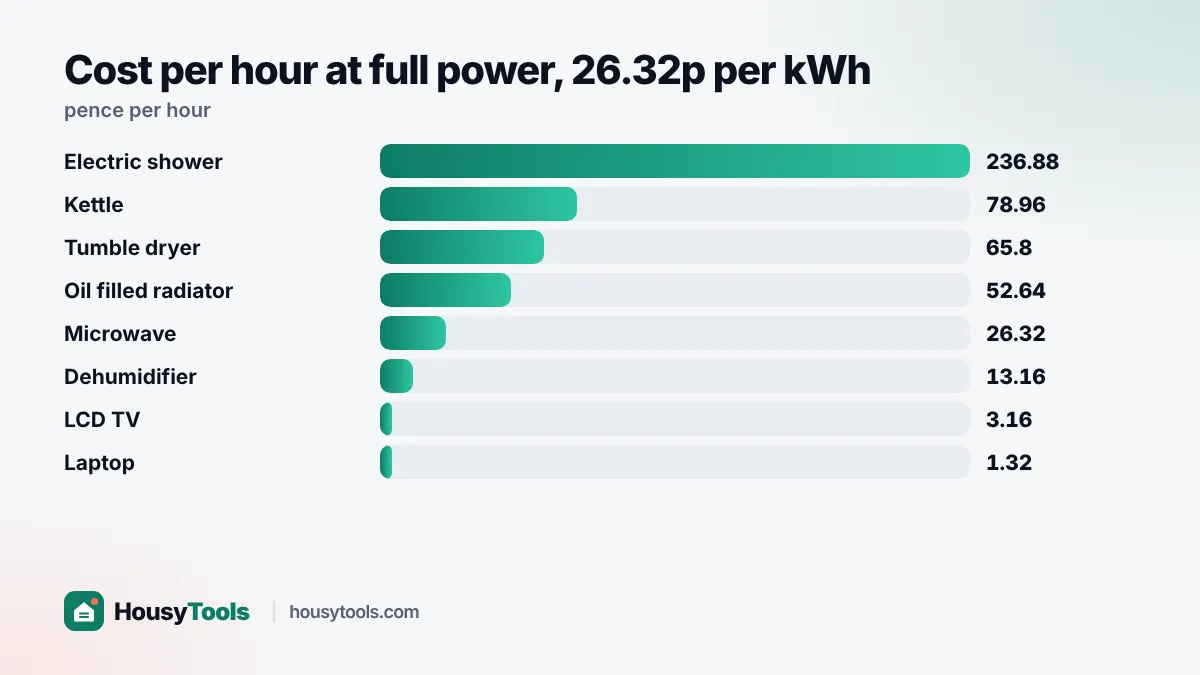
Wattages come from the Centre for Sustainable Energy’s appliance list. Your own model may differ, so use the figure on its rating plate. For showers, our electric shower cost calculator works per shower rather than per hour.
Why Is My Appliance Cheaper to Run Than the Calculator Shows?
Many appliances only draw full power part of the time, so the label wattage overstates their real use. A fridge compressor switches on and off, a washing machine heats water only at the start of a cycle, and a heater with a thermostat cuts out once the room is warm.
For these, enter the hours the appliance is actually drawing power, not the hours it is switched on. A plug-in energy monitor, sold cheaply by many retailers, measures real kWh over a day or a week. Enter that figure as hours at 1,000 W, and the electricity cost calculator gives you the true cost.
Plug-in monitors are only for appliances with a normal plug. Hard wired items such as electric showers, immersion heaters and cookers on their own circuit must never be opened or rewired by a homeowner. Any new circuit or fixed wiring work needs a qualified, registered electrician, and in England and Wales it falls under Part P of the Building Regulations.
Does the Electricity Cost Calculator Include the Standing Charge?
No. The electricity cost calculator shows the cost of the energy an appliance uses, because the standing charge of 54.83p a day under the current cap is paid whether the appliance is on or off.
To estimate your whole bill, including the standing charge, use our electricity bill calculator with two meter readings. If you are on a time of use tariff, run the electricity cost calculator twice, once with your peak rate and once with your off peak rate.
How Do Running Costs Compare Between the UK and the EU?
Running a 2,000 W appliance for one hour costs 52.64p at the UK cap rate, 57.92c at the EU average, 77.38c in Germany and 80.84c in Ireland, using the latest official rates in the electricity cost calculator.
Pounds and euros are different currencies, so compare these figures with care; the point is how much the rate drives the result. The same habit, such as running a tumble dryer every day, can cost very different amounts depending on where you live and which tariff you are on.
Across Europe, many suppliers also offer cheaper night or dynamic rates. If you have one, enter that rate for appliances you can time, such as dishwashers and washing machines. UK households on a two rate meter can compare the saving with our Economy 7 calculator.
Worked Example: Hannah’s Home Office Radiator
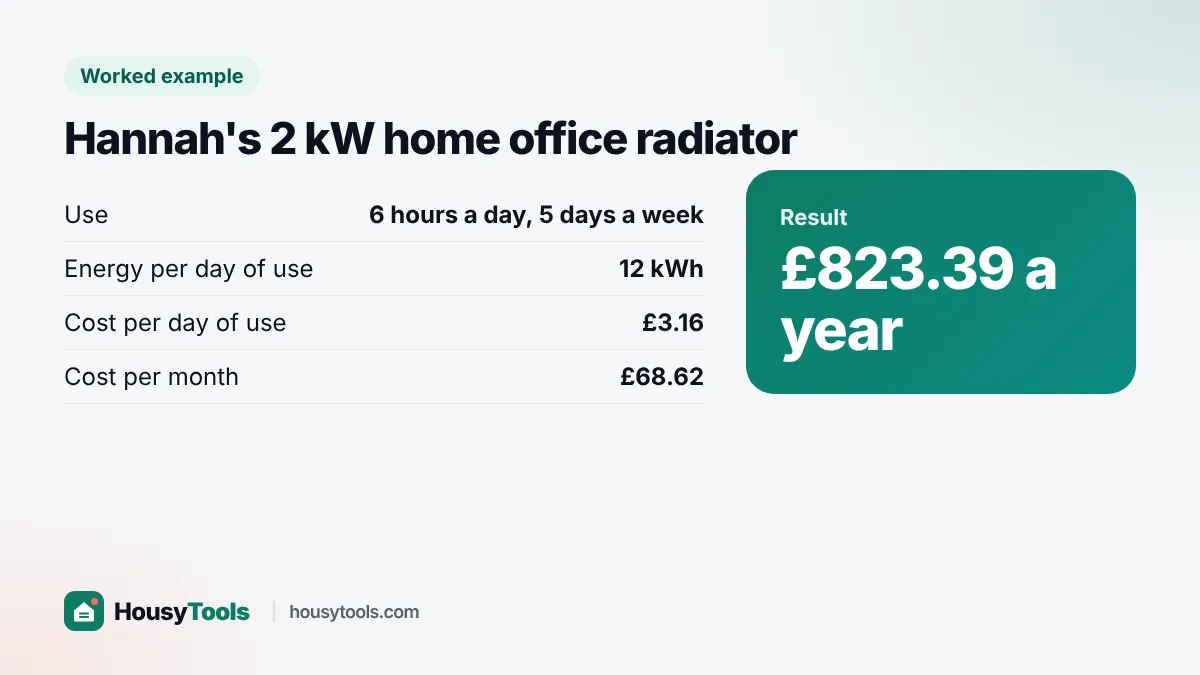
Hannah works from home in Cardiff and heats her small office with a 2,000 W oil filled radiator. It runs about 6 hours a day, 5 days a week. She pays the price cap rate of 26.32p per kWh.
- Energy: 2,000 W / 1,000 x 6 h = 12 kWh a day
- Cost per day of use: 12 x 26.32p = £3.16
- Cost per week: £15.79
- Cost per month: £68.62
- Cost per year: £3.16 x 5 days x 52.14 weeks = £823.39
That assumes the radiator draws full power all 6 hours. With its thermostat cutting in and out, the real cost is likely lower, and she only heats the room in colder months. At the German rate of 38.69c, the same use would cost €1,210.38 a year, and €905.98 at the EU average of 28.96c.
Common Mistakes When Working Out Running Costs
- Mixing up watts and kilowatts. 2 kW is 2,000 W; entering 2 gives a cost 1,000 times too low.
- Using an old unit rate. Rates change every quarter under the cap, so check your latest bill.
- Counting time switched on rather than time drawing power, for anything with a thermostat.
- Forgetting standby. Many devices draw a few watts all day, which adds up over 8,760 hours a year.
- Treating the yearly figure as exact. Seasonal use, such as heating, varies month to month.
For more ways to cut costs, browse the energy and bills calculators or see how our calculators work.
Electricity Cost Calculator FAQs
How much does it cost to boil a kettle in the UK?
A 3,000 W kettle that takes 3 minutes to boil uses 0.15 kWh, which costs about 3.9p at the price cap rate of 26.32p per kWh. Boiling only the water you need cuts the time and the cost.
How do I convert watts to kWh?
Divide watts by 1,000 and multiply by the hours of use. A 500 W dehumidifier running for 8 hours uses 500 / 1,000 x 8 = 4 kWh, which costs £1.05 at 26.32p per kWh.
Is there VAT on electricity in the UK right now?
No. The UK government has zero rated VAT on domestic electricity in Great Britain from 1 October 2026 to 31 March 2027. In Northern Ireland the rate stays unchanged, and gas still carries 5% VAT.
What is the cheapest way to heat one room?
Compare running costs with the electricity cost calculator, but also consider heat output. A heater’s watts equal its heat, so a 2 kW fan heater and a 2 kW oil radiator cost the same per hour at full power. Insulation and thermostats reduce hours.
How much does it cost to leave a TV on standby?
Check the standby wattage in the manual. A device drawing 1 W all year uses 8.76 kWh, which costs about £2.31 at 26.32p per kWh. Multiply by the number of devices left on standby.
Can I use the electricity cost calculator in euros?
Yes. Choose the EU average, Germany or Ireland preset to switch to euros and cents per kWh, or pick your own tariff and type in the rate from your supplier. The formula is the same everywhere.
Checked October 2026. Sources: Ofgem, GOV.UK (HMRC VAT zero rate), Eurostat, Centre for Sustainable Energy.