
Show the formula and working
This dehumidifier size calculator works out how many litres of water a day your dehumidifier should be able to remove, from the floor area it serves and how damp the space is, for homes in the UK, Ireland and northern Europe. It uses the capacity chart from AHAM, the appliance makers’ association, converts it to litres and explains how to compare it with the litres per day on UK and EU product labels.
Quick answer: A dehumidifier size calculator reads the needed capacity from floor area and dampness. An 80 m² home that always feels damp needs about 7.4 litres a day at 27 °C and 60% humidity. Labels quoted at 30 °C and 80% show bigger numbers, so a 10 to 12 litre model usually suits.
What Is a Dehumidifier Size Calculator?
A dehumidifier size calculator is a tool that recommends the water removal capacity, in litres per day, a dehumidifier needs for a given floor area and level of dampness. In plain words: convert the floor area to square feet, find the two nearest columns of the AHAM chart for your dampness level, read the capacity in pints between them, and multiply by 0.4732 to get litres per day.
The chart was published by ENERGY STAR on its dehumidifier guidance and is rated at the older AHAM test conditions of about 27 °C (80 °F) and 60% relative humidity. Many UK and EU brands quote capacity at 30 °C and 80% relative humidity instead, which is warmer and more humid than a typical British home, so the number on the box is higher than what the same machine removes in a cool damp house.
How Do You Use the Dehumidifier Size Calculator?
- Measure the rooms the dehumidifier will serve with the internal doors open, and enter the total as Floor area to dehumidify. Switch to feet if you prefer.
- Choose How damp it is, from moderately damp to extremely wet. Pick extremely wet if you dry laundry indoors.
- Read the suggested capacity in litres per day and US pints.
- Check the test conditions on the product you are looking at, and choose a bigger model if its litres are quoted at 30 °C and 80% humidity.
- Read the breakdown, then open “Show the formula and working” to see the chart figures and conversion.


What Size Dehumidifier Do I Need for a 2 or 3 Bedroom House?
A two or three bedroom house of 80 to 100 m² that feels damp needs about 7 to 8.5 litres a day at the AHAM conditions, which in practice means a 10 or 12 litre compressor model rated at 30 °C and 80% humidity. Meaco, a UK dehumidifier maker, suggests a 10 or 12 litre compressor unit or an 8 litre desiccant unit for a two bedroom house of 80 to 100 m². Go a size up if you dry laundry indoors or the house has visible condensation every morning.
Why Does the Rating Temperature Change the Litres per Day?
Warm, very humid air holds much more water, so a dehumidifier tested at 30 °C and 80% humidity extracts far more than it can at 20 °C and 60%, which is closer to a heated British home. Compare models only at the same test conditions. If one brand quotes 27 °C and 60% and another 30 °C and 80%, the first figure is the more realistic one, and the machine with the bigger box number is not always the stronger one.
Compressor or Desiccant: Which Dehumidifier Suits a Cold Room?
A desiccant dehumidifier usually works better in a cold room, garage or conservatory below about 15 °C, while a compressor model is more efficient in a normally heated home. Compressor units cool a coil to condense water and lose capacity as the air gets colder. Desiccant units use a drying wheel and a heater, so they keep working in the cold but use more power. Our dehumidifier running cost calculator shows what each type costs per day.
Dehumidifier Size Chart in Litres per Day
Capacity in litres per day at the AHAM conditions (about 27 °C, 60% humidity), worked out by this calculator from the chart.
| Floor area | Moderately damp | Very damp | Wet | Extremely wet |
|---|---|---|---|---|
| 50 m² | 4.9 L | 5.9 L | 6.8 L | 7.8 L |
| 75 m² | 5.9 L | 7.1 L | 8.4 L | 9.6 L |
| 100 m² | 6.9 L | 8.4 L | 9.9 L | 11.4 L |
| 150 m² | 9 L | 11 L | 13 L | 15 L |
| 200 m² | 11 L | 13.5 L | 16 L | 18.5 L |
Worked Example: An 80 m² Home That Always Feels Damp
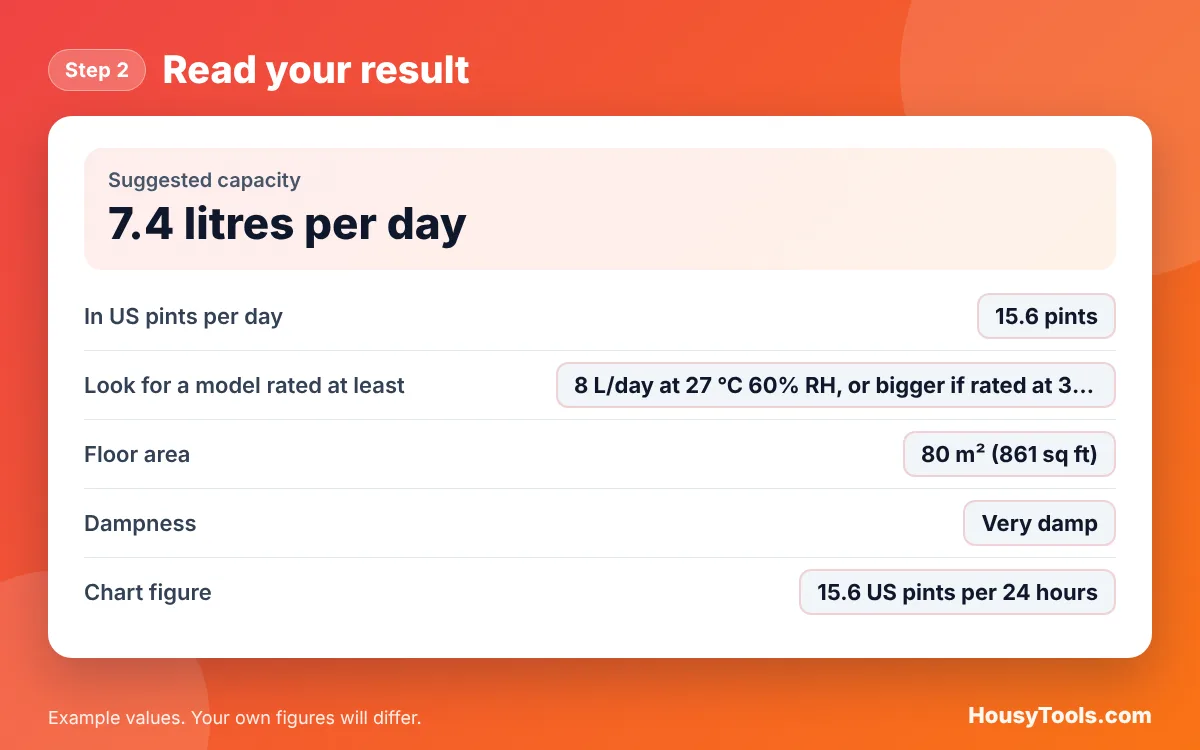
Example: a two bedroom home has 80 m² of floor area and always feels damp, with a musty smell and damp spots, so the dampness level is very damp. 80 m² x 10.7639 = 861 sq ft. On the very damp row the chart gives 12 pints at 500 sq ft and 17 pints at 1,000 sq ft, so 861 sq ft needs 12 + 361 / 500 x 5 = 15.6 pints a day. Multiplying by 0.4732 gives 7.4 litres a day, which is what the calculator shows with its default inputs.
The calculator suggests a model rated at least 8 litres a day at 27 °C and 60% humidity. Most UK listings quote 30 °C and 80%, so a 10 to 12 litre compressor model is a sensible choice for this home. To work out the floor area of an awkward layout, use the square metre calculator.
A dehumidifier treats the symptom, not the cause. Damp that keeps coming back can come from leaks, rising damp, blocked vents or poor ventilation, and the NHS explains how damp and mould affect health.
Dehumidifier Size Calculator FAQs
Is a 10 litre dehumidifier big enough?
A 10 litre model rated at 30 °C and 80% humidity usually suits a flat or a small two bedroom house that is moderately damp. For a larger house, a very damp space or indoor laundry drying, a 12 to 20 litre model works faster and more quietly at a lower fan speed.
Can a dehumidifier be too big?
Not in a harmful way. A larger dehumidifier reaches the target humidity sooner and then switches off on its humidistat, so it does not over dry the room. The downsides are a higher purchase price, more weight and sometimes more noise.
What humidity should I set my dehumidifier to?
Most homes are comfortable at about 40 to 60% relative humidity, and many people set around 50 to 55%. Keeping humidity below about 60% helps limit condensation and mould growth. Use a hygrometer to check the reading in the room rather than relying on feel.
Does one dehumidifier work for a whole house?
One unit can serve a small house if the internal doors stay open and it sits in a central spot such as a landing or hallway. Rooms with closed doors, or houses over about 150 m², are often better served by two smaller units placed where the damp is worst.
How many litres should a dehumidifier collect a day?
In a heated home it is common to collect well below the rated figure, often a few litres a day once the house has dried out. A full tank every day for weeks suggests a continuing moisture source, such as laundry, a leak or poor ventilation, that needs dealing with.
What does pints per day mean on a dehumidifier?
US brands rate capacity in US pints per 24 hours. One US pint is 0.4732 litres, so a 30 pint model removes about 14.2 litres a day at its test conditions. A UK pint is larger, 0.5683 litres, so check which pint is meant.
Checked October 2026. Sources: Dehumidifier Basics capacity chart (ENERGY STAR, based on AHAM), Dehumidifier guide for a two bedroom house (Meaco), Can damp and mould affect my health? (NHS), Pint (Wikipedia).