
Show the formula and working
This standby power cost calculator works out what TVs, set top boxes, games consoles, computers and other gadgets cost you while they sit on standby, for households in the UK, Ireland and the rest of Europe. Enter each device’s standby watts, the hours they wait idle and your unit rate to see the cost per day, month and year, and which device costs the most.
Quick answer: A standby power cost calculator multiplies the total standby watts by the hours on standby, divides by 1,000 and multiplies by your price per kWh. Each watt left on standby all year costs about £2.31 at 26.32p per kWh, so 22 W for 20 hours a day costs about £42.27 a year.
What Is a Standby Power Cost Calculator?
A standby power cost calculator is a tool that adds up the small amounts of electricity devices draw when they are switched off with a remote or left idle, and turns that into a yearly cost. In plain words: add up the standby watts, multiply by the hours a day on standby, divide by 1,000 to get kWh, multiply by 365 days, then multiply by your unit rate.
Standby power, sometimes called vampire or phantom load, is the power a device uses to keep a clock, a remote control receiver, a network connection or a quick start mode ready. One device rarely uses much, but a home can have a dozen or more, and they run almost every hour of the year.
How Do You Use the Standby Power Cost Calculator?
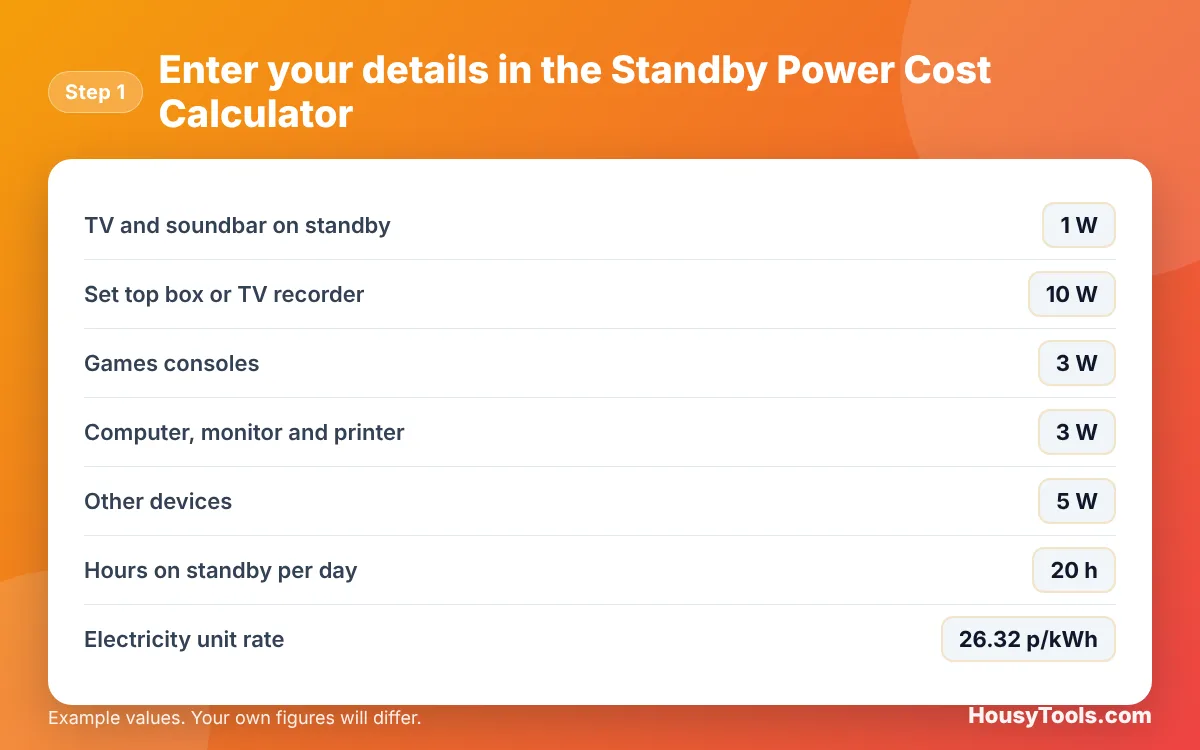
- Enter the TV and soundbar on standby watts. The manual often lists standby power, or you can measure it with a plug in energy monitor.
- Enter the Set top box or TV recorder and Games consoles watts. These can be the largest standby users.
- Enter the Computer, monitor and printer watts.
- Enter a total for Other devices such as chargers, smart speakers and appliance clocks.
- Set the Hours on standby per day, which is 24 minus the hours you actually use the devices.
- Check the Electricity unit rate against your bill, and switch to euros if you pay in cents.
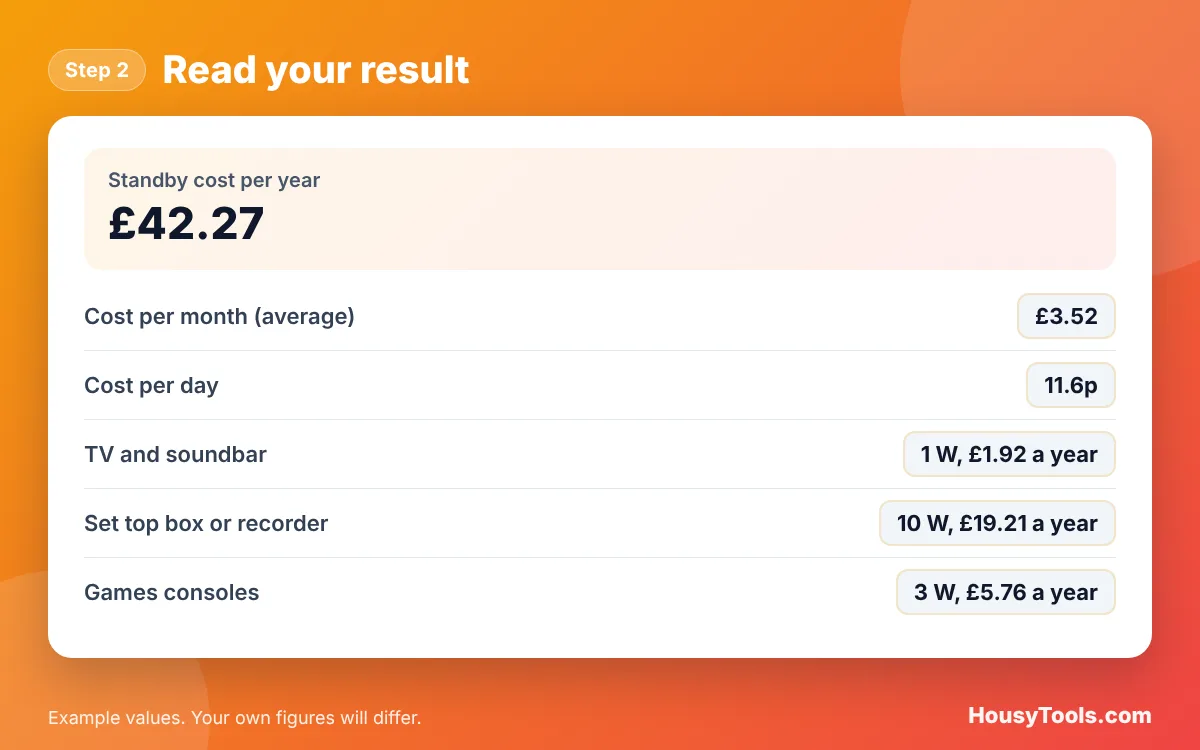
- Read the yearly, monthly and daily cost and the cost of each device, then open “Show the formula and working” to see the sums.

How Much Does Standby Cost per Year?
Each watt of standby power left on all year uses 8.76 kWh, which costs about £2.31 at 26.32p per kWh, the average rate under the Ofgem price cap for October to December 2026. The Energy Saving Trust estimates you can save around £45 a year in Great Britain by remembering to switch appliances off standby.
| Standby power | kWh per year (24 h a day) | Cost per year (24 h a day) | Cost per year (20 h a day) |
|---|---|---|---|
| 0.5 W | 4.38 | £1.15 | 96p |
| 1 W | 8.76 | £2.31 | £1.92 |
| 5 W | 43.8 | £11.53 | £9.61 |
| 10 W | 87.6 | £23.06 | £19.21 |
| 20 W | 175.2 | £46.11 | £38.43 |
| 50 W | 438 | £115.28 | £96.07 |
Which Devices Use the Most Standby Power?
Set top boxes, TV recorders and games consoles in instant on or rest mode are often the largest standby users, because they stay ready to download updates or record programmes. Older devices can draw 10 W or more, while a modern TV usually uses less than 1 W on standby. Wireless speakers, printers and computers left asleep add a few watts each.
The only reliable way to know is to measure. A plug in energy monitor between the socket and the device shows its standby watts after a minute or two. Enter what you find here, and the result shows which device is the biggest standby user so you know where to start.
Is There a Legal Limit on Standby Power?
Yes. Under EU ecodesign rules, most household devices sold since January 2013 must use no more than 0.5 W in off or standby mode, or 1 W when they show information such as a clock, as described in the Wikipedia standby power article. A newer EU regulation, 2023/826, has applied since 9 May 2025, and Great Britain has its own ecodesign rules. Devices with network connections are allowed more power in networked standby, which is why consoles and TV boxes can still draw several watts.
Does Switching Off at the Wall Save Money?
Yes: switching off at the wall cuts standby use to zero, so you save the full standby cost this calculator shows. A standby saver plug or smart plug on a timer makes it easy to switch a whole TV corner off at once. Leave on anything that must stay powered, such as a fridge, a freezer, a boiler, an alarm, a router you rely on or a recorder set to record.
To see how standby fits into your whole bill, use the electricity bill calculator, or check a single appliance with the electricity cost calculator.
Worked Example: A Living Room
Example: the living room devices are measured with a plug in monitor. The TV and soundbar use 1 W on standby, an older TV recorder 10 W, a games console in rest mode 3 W, the computer, monitor and printer 3 W, and other gadgets 5 W in total. They are on standby for 20 hours a day and the unit rate is 26.32p per kWh.
- Total standby power: 1 + 10 + 3 + 3 + 5 = 22 W
- Energy per day: 22 W x 20 h / 1,000 = 0.44 kWh
- Energy per year: 0.44 kWh x 365 = 160.6 kWh
- Cost per year: 160.6 kWh x 26.32p = £42.27, or about £3.52 a month
- Biggest standby user: the TV recorder, at £19.21 a year
A household in France with the same devices and an example rate of 35c per kWh would pay about €56.21 a year. More tools for household bills are in our energy bill calculators hub.
Standby Power Cost Calculator FAQs
How much does a TV on standby cost per year?
A modern TV using 0.5 W on standby around the clock costs about £1.15 a year at 26.32p per kWh. An older TV drawing several watts, or one with quick start switched on, can cost several times more.
Do phone chargers use electricity when nothing is plugged in?
Yes, but very little. Modern chargers usually draw well under half a watt with no phone attached, which costs pennies a year. Unplugging them is still a good habit, but consoles and TV boxes usually offer much bigger savings.
Is it safe to switch everything off at the wall?
For TVs, consoles, computers and chargers, yes. Some recorders and smart TVs need power to update or record, and should stay on when a recording is set. Never switch off fridges, freezers, alarms, medical devices or heating controls to save standby power.
How do I measure standby power?
Plug a plug in energy monitor into the socket, plug the device into the monitor, switch the device to standby and wait a minute for the reading to settle. Some smart plugs also report power use in their app.
Should I turn off my Wi-Fi router at night?
A router is not on standby: it works all day and typically draws a few watts. Switching it off overnight saves a little but can interrupt updates and connected devices. Many routers let you schedule the Wi-Fi to switch off instead.
Does instant on mode on a games console cost more?
Usually yes. Instant on or rest mode keeps the console ready to download and wake quickly, so it can draw several watts or more, while an energy saving or full shutdown setting draws well under 1 W. Check the console’s power settings.
Checked October 2026. Sources: Energy price cap unit rates and standing charges (Ofgem), Quick tips to save energy (Energy Saving Trust), Standby power (Wikipedia), Commission Regulation (EU) 2023/826 (EUR-Lex).