
Show the formula and working
This ballast calculator works out how many tonnes and bulk bags of all-in ballast, and how many bags of cement, you need to mix concrete for a base, path, slab or footing, for DIYers and builders in the UK, Ireland and the rest of Europe. Enter the length, width and depth in metres or feet, pick the cement to ballast mix, and adjust the density and bag sizes to match your merchant.
Quick answer: A ballast calculator multiplies the concrete volume by about 1.54 for dry materials, takes the ballast share of the mix and multiplies by about 1.6 tonnes per m³. A 3 m by 2 m base 100 mm deep in a 1:5 mix needs about 1.29 tonnes of ballast and 10 bags of cement.
What Is a Ballast Calculator?
A ballast calculator is a tool that estimates the weight of all-in ballast, the ready blended mix of sand and gravel sold for concrete, needed for a job of a given size and mix ratio. In plain words: concrete volume equals length x width x depth plus a waste allowance. Dry volume equals that multiplied by about 1.54, because the loose materials shrink when cement and water fill the gaps. In a 1:5 mix, ballast is 5 of the 6 parts, and its weight is that volume multiplied by the ballast’s bulk density.
Ballast is usually sold by weight, in bulk bags or small bags, while concrete is measured by volume, so the density is the link. Loose sand and gravel weigh roughly 1.6 tonnes per cubic metre, a figure that changes with grading and moisture: wet ballast after rain is noticeably heavier. That is why the density, bulk bag weight and dry factor are all editable.
How Do You Use the Ballast Calculator?
- Enter the Length, Width and Depth of the concrete. Switch to feet and inches if you prefer.
- Set the Extra for waste and uneven ground. 5% suits a level, well formed base.
- Choose the Mix (cement to ballast): 1:5 for general purpose concrete, 1:6 for many bases and footings.
- Check the Dry to wet volume factor, the Ballast bulk density and the Bulk bag weight from your supplier.
- Check the Cement bulk density and Cement bag size.
- Read the tonnes and bulk bags of ballast and the cement bags, then open “Show the formula and working” to see each step.
How Much Ballast Do I Need per Cubic Metre of Concrete?
A cubic metre of concrete in a 1:5 mix needs about 2.05 tonnes of ballast and about 14 bags of cement of 25 kg, using a 1.54 dry factor and 1.6 t/m³ ballast. A 1:6 mix needs about 2.11 tonnes of ballast and 12.3 bags of cement. One cubic metre is a 10 m² slab 100 mm thick, which is a handy way to picture it. For the concrete volume alone, try the concrete calculator.
What Is the Difference Between Ballast and Gravel?
All-in ballast is a blend of sharp sand and gravel, often up to about 20 mm, sold ready to mix with cement for concrete, while gravel on its own has no sand. Using ballast means you only need two ingredients, cement and ballast, instead of three. For decorative or drainage gravel use the gravel calculator instead, and to turn any tonnage into cubic metres, the tonnes to cubic metres converter helps.
Do I Need Permission for a Concrete Driveway?
In England, covering more than 5 m² of a front garden with a hard surface that does not let water through, such as plain concrete, normally needs planning permission unless rainwater drains to a lawn or border on your property. The gov.uk guidance on permeable surfacing of front gardens explains the rules. Bases for sheds and garden paths usually need no permission, but check local rules for listed buildings and conservation areas.
Ballast and Cement per Cubic Metre by Mix
For 1 m³ of finished concrete, with a 1.54 dry factor, 1.6 t/m³ ballast and 1,400 kg/m³ cement, before any waste allowance.
| Mix | Ballast | Cement | 25 kg cement bags |
|---|---|---|---|
| 1:4 | 1.97 tonnes | 431 kg | 17.2 |
| 1:5 | 2.05 tonnes | 359 kg | 14.4 |
| 1:6 | 2.11 tonnes | 308 kg | 12.3 |
| 1:8 | 2.19 tonnes | 240 kg | 9.6 |
Worked Example: A 3 m by 2 m Shed Base
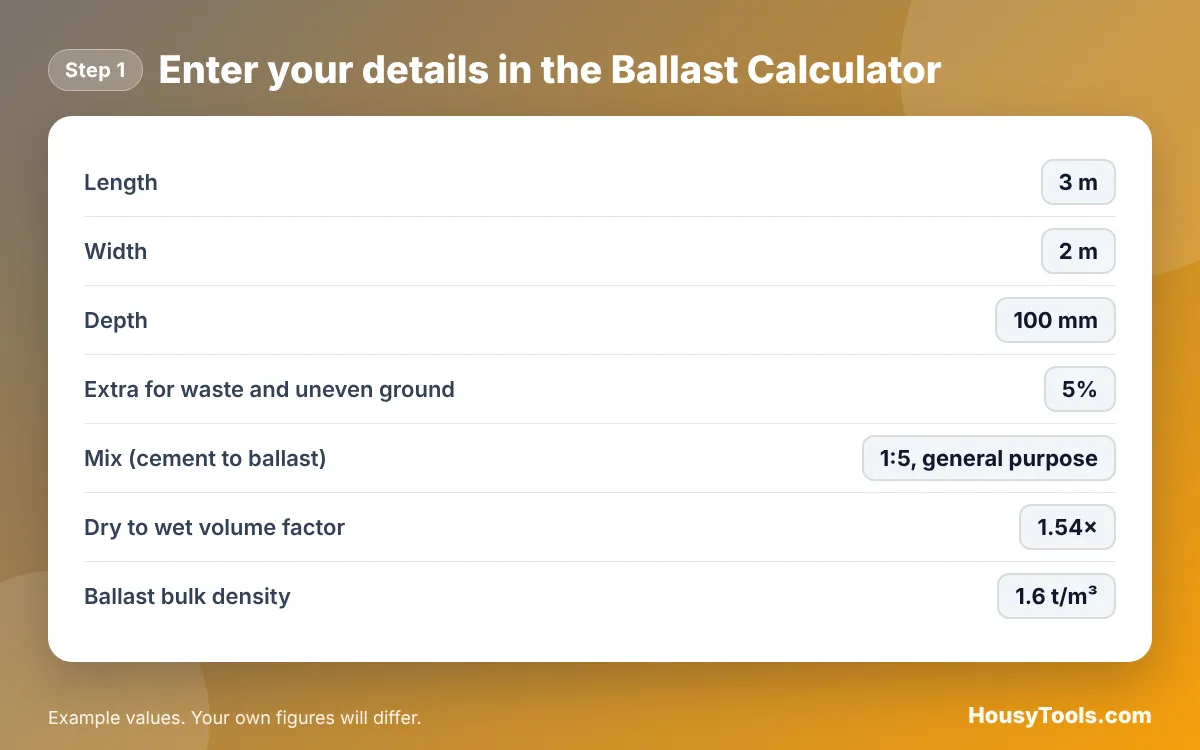
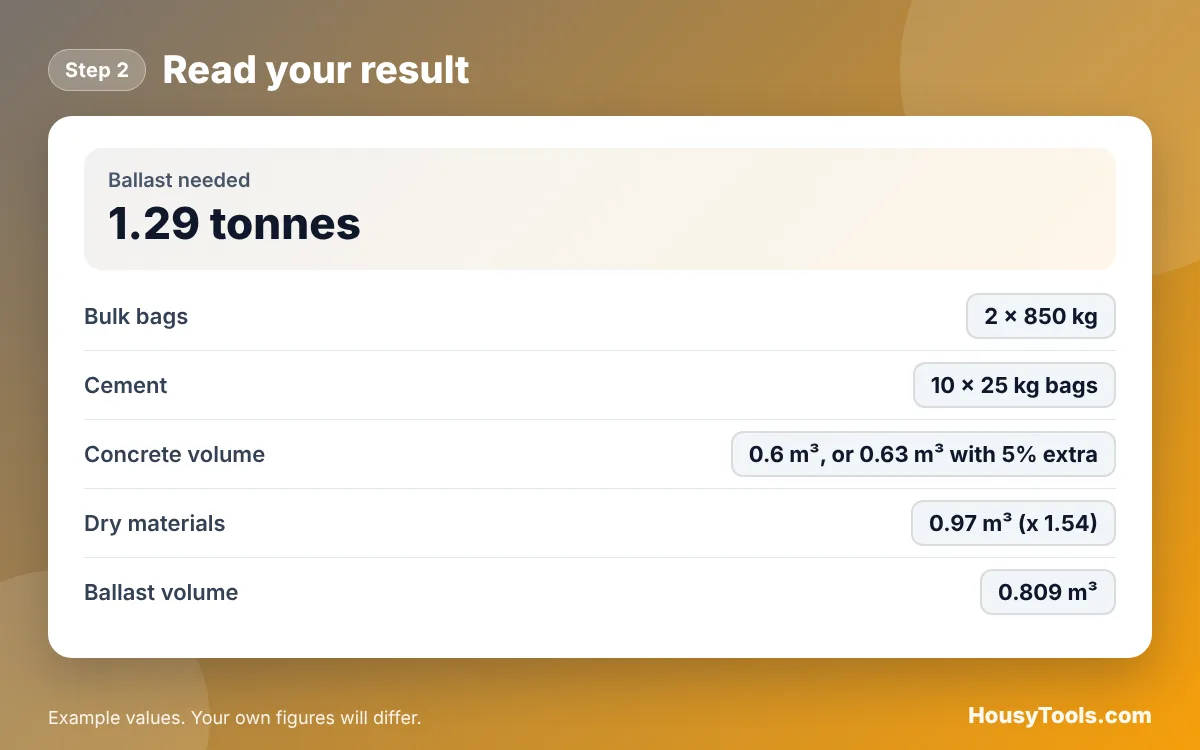
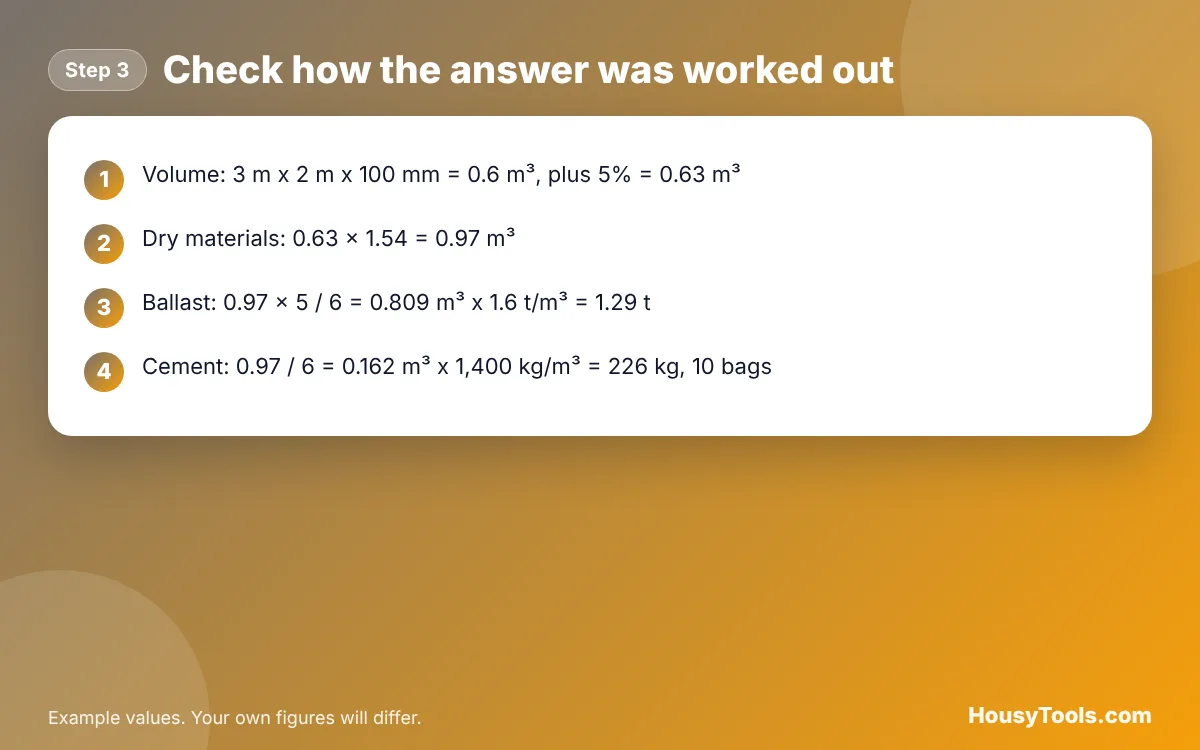
Example: a shed base is 3 m by 2 m and 100 mm deep, in a 1:5 mix with 5% extra. The concrete volume is 3 x 2 x 0.1 = 0.6 m³, or 0.63 m³ with waste. Dry materials are 0.63 x 1.54 = 0.970 m³. Ballast is 5 of 6 parts, 0.809 m³, which at 1.6 t/m³ weighs 1.29 tonnes: 2 bulk bags of 850 kg, or 52 small bags of 25 kg. Cement is 1 part, 0.162 m³, which at 1,400 kg/m³ is 226 kg, or 10 bags of 25 kg. These are the default inputs, so the calculator shows the same figures.
The second bulk bag will be partly left over, which is useful if the ground is uneven. Wet cement is strongly alkaline and can burn skin, so wear waterproof gloves, boots and eye protection while mixing, as the HSE advises for cement.
Ballast Calculator FAQs
How much does a bulk bag of ballast cover?
An 850 kg bulk bag of ballast at 1.6 t/m³ is about 0.53 m³ of loose ballast, which in a 1:5 mix makes roughly 0.41 m³ of concrete. That is about 4.1 m² of slab at 100 mm deep. Bag weights vary, so check yours.
What mix ratio should I use with ballast?
For general DIY concrete such as paths and shed bases, 1:5 cement to ballast is common, and 1:6 is often used for footings and bases that will be covered. Driveways and structural work need a stronger, specified mix. Always follow your designer or building control.
How many bags of cement per bulk bag of ballast?
In a 1:5 mix by volume, an 850 kg bulk bag of ballast needs about 149 kg of cement, or 6 bags of 25 kg. In a 1:6 mix it needs about 124 kg, or 5 bags. These figures use 1.6 t/m³ ballast and 1,400 kg/m³ cement.
Why multiply by 1.54?
Loose ballast contains air gaps that the cement paste fills, so the finished concrete takes up less space than the dry materials. About 1.54 m³ of dry materials makes 1 m³ of concrete as a long standing rule of thumb. Change it if your supplier gives a different yield.
Is ballast the same as hardcore?
No. Hardcore or Type 1 sub-base is crushed stone laid and compacted under the concrete as a firm base, while ballast is mixed into the concrete itself. Most bases need a compacted sub-base layer first, often around 75 to 100 mm thick.
Should I order ballast by the tonne or the bag?
For anything over about half a tonne, a bulk bag is usually cheaper and easier than many small bags. Small bags suit tiny jobs, awkward access through a house, or setting a few fence posts. Check delivery access before ordering bulk bags.
Checked October 2026. Sources: Permeable surfacing of front gardens (gov.uk), Cement (HSE), Designing Buildings Wiki bulk densities, Breedon Portland cement data sheet.