
Show the formula and working
This free rainwater harvesting calculator works out how much rainwater your roof can collect each year, how big a storage tank you need and how much mains water and money it could save, for homes in the UK, Ireland and Europe. It follows the simplified method used in British Standard guidance for rainwater systems.
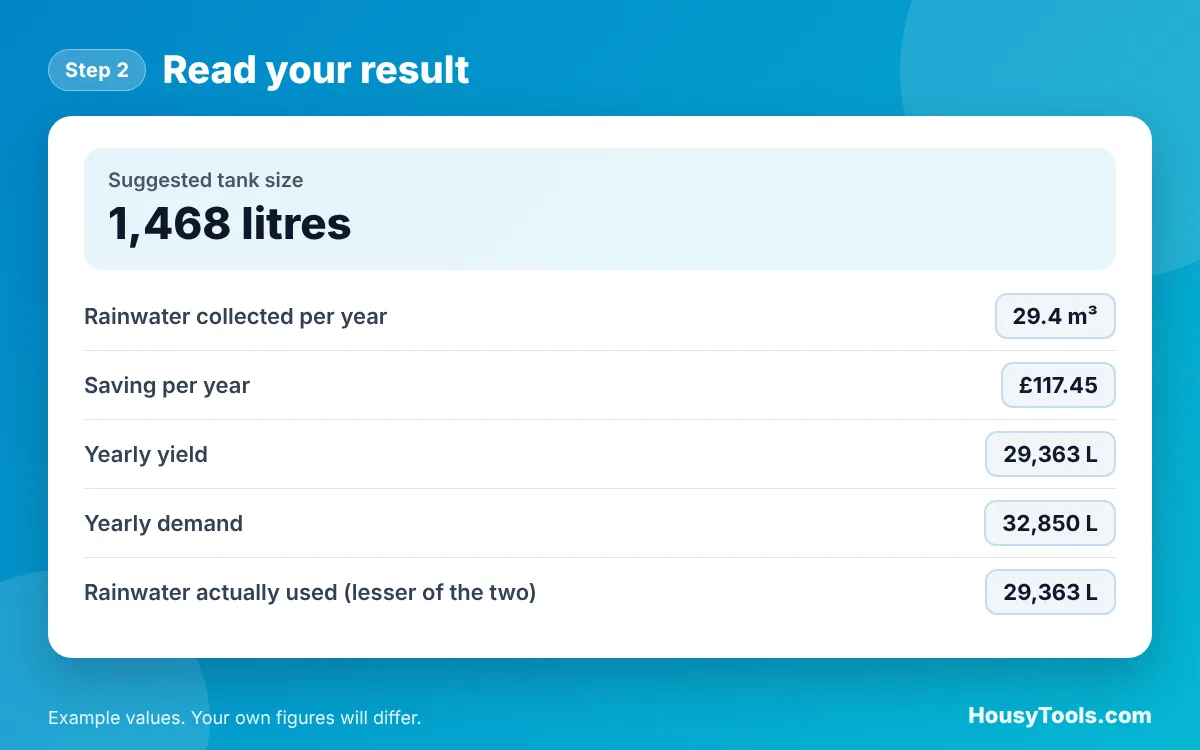
Quick answer: A rainwater harvesting calculator multiplies roof area by rainfall, a run-off coefficient and filter efficiency. A 50 m² pitched roof in England, with 870 mm of rain a year, yields about 29,400 litres. For three people using 30 litres a day each, the tank should hold about 1,470 litres, 5% of that yield.
What Is a Rainwater Harvesting Calculator?
A rainwater harvesting calculator is a tool that estimates the rainwater a roof can supply each year, compares it with what the household would use it for, and sizes a storage tank.
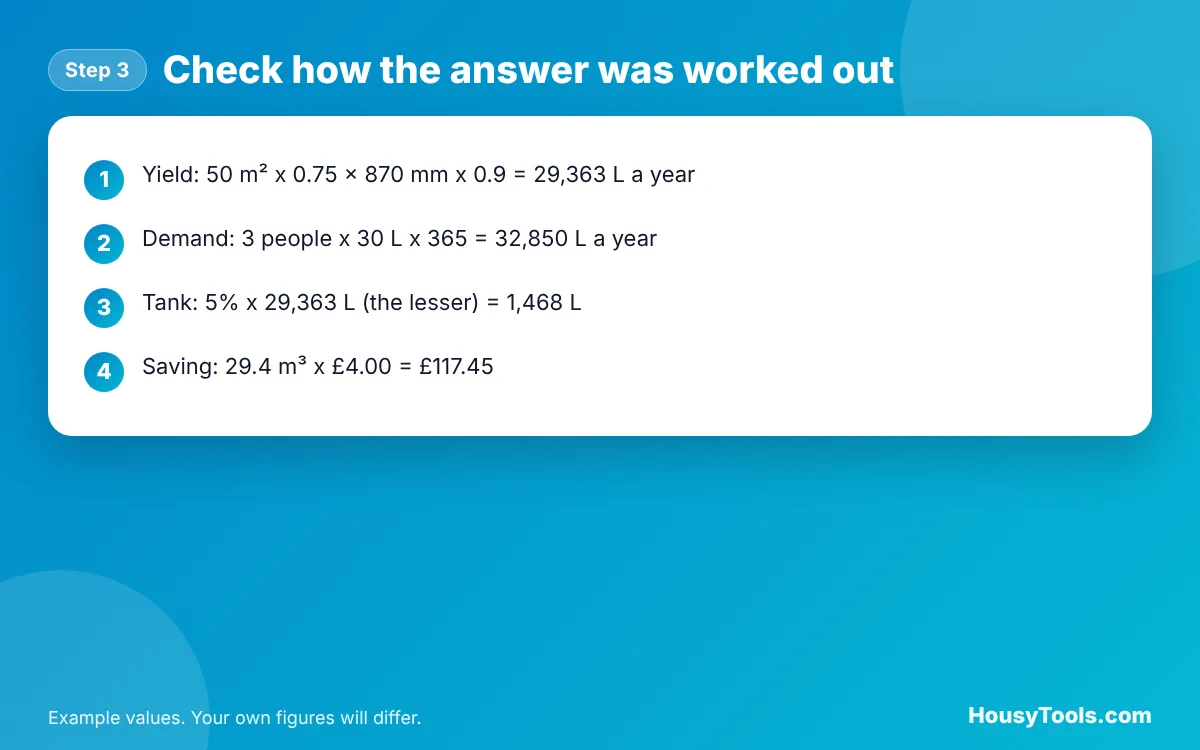
The formula in plain words: yearly yield in litres equals the roof area in square metres times the rainfall in millimetres times the run-off coefficient times the filter efficiency, since 1 mm of rain on 1 m² is 1 litre. Yearly demand equals the people times the litres each uses a day times 365. The tank size is 5% of whichever is smaller, which gives about 18 days of storage, and the saving is the water actually used times the price per cubic metre.
How Do You Use the Rainwater Harvesting Calculator?
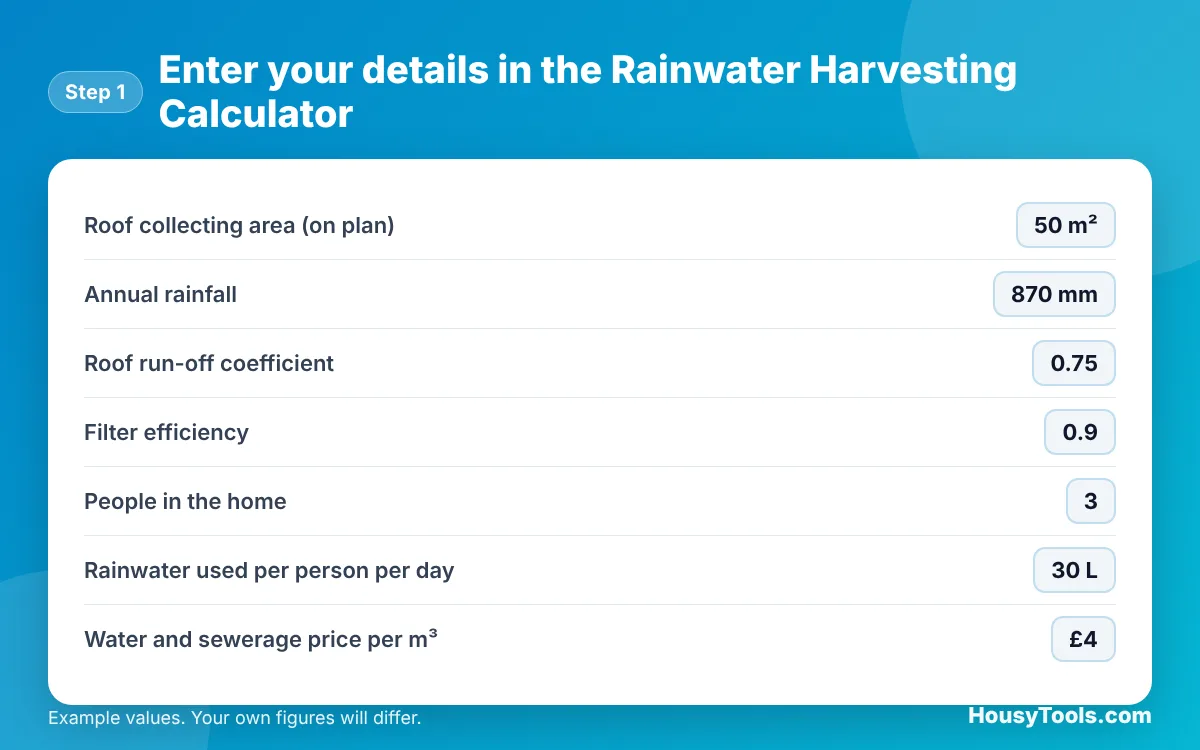
- Enter the Roof collecting area (on plan) that drains to the tank, measured flat, not along the slope.
- Enter the Annual rainfall for your area.
- Keep or change the Roof run-off coefficient and Filter efficiency.
- Enter the People in the home and the Rainwater used per person per day for toilets, laundry or garden.
- Enter your Water and sewerage price per m³ and choose pounds or euros.
- Read the tank size, yearly yield and saving, then open “Show the formula and working” to see each step.
How Much Rainwater Can My Roof Collect?
Each square metre of roof collects about 0.68 litres for every millimetre of rain once run-off and filter losses are taken off, at 0.75 and 0.9. A 50 m² roof in England, with an average of about 870 mm a year from 1991 to 2020, therefore yields about 29,400 litres. Rainfall varies a lot: Met Office averages listed on Wikipedia give about 1,157 mm for Northern Ireland, 1,465 mm for Wales and 1,574 mm for Scotland, while parts of south east England get under 700 mm.
What Size Rainwater Tank Do I Need?
Size the tank at 5% of the yearly yield or the yearly demand, whichever is smaller, which is about 18 days of storage. That simplified approach comes from BS 8515 and is explained, with its yield and demand formulas, in a University of the West of England paper on rainwater harvesting. A bigger tank rarely pays back, because it stays partly empty in summer and overflows in wet spells anyway.
What Can Harvested Rainwater Be Used For?
Harvested rainwater is used for toilet flushing, washing machines and the garden, not for drinking. Toilets are the best fit, because they use water every day all year: about 30 litres a day per person at five flushes of 6 litres. A system feeding toilets or a washing machine needs a pump, a filter, a mains top-up with a proper air gap, and clearly marked pipes, so use a competent installer. A simple water butt on a downpipe is enough for the garden.
Is Rainwater Harvesting Worth It?
On a water meter, rainwater for toilets can save tens of pounds to over £100 a year, about £117 for the example home at an example 4.00 per m³. A full system with a buried tank and pump costs far more than that each year saves, so it suits new builds and major renovations best. Without a water meter, your bill does not fall at all. The roof pitch calculator helps work out roof dimensions, and the square metre calculator adds up roof areas.
Rainwater Yield and Tank Size by Region
For a 50 m² roof (plan area), run-off 0.75, filter 0.9, three people using 30 litres a day each (32,850 litres a year), at an example 4.00 per m³. Rainfall is the 1991 to 2020 average.
| Area | Rainfall | Yearly yield | Demand covered | Tank (5%) | Saving |
|---|---|---|---|---|---|
| London (approx.) | 650 mm | 21,938 L | 67% | 1,097 L | £87.75 |
| England | 870 mm | 29,363 L | 89% | 1,468 L | £117.45 |
| Northern Ireland | 1,157 mm | 39,049 L | 100% | 1,643 L | £131.40 |
| Wales | 1,465 mm | 49,444 L | 100% | 1,643 L | £131.40 |
| Scotland | 1,574 mm | 53,123 L | 100% | 1,643 L | £131.40 |
Worked Example: Toilet Flushing for a Family of Three
Example: a 50 m² pitched tiled roof in England with 870 mm of rain a year, run-off 0.75, filter 0.9, three people using 30 litres each a day for toilet flushing, and an example water price of 4.00 per m³. These are the default inputs.
- Yield: 50 x 0.75 x 870 x 0.9 = 29,363 litres a year.
- Demand: 3 x 30 x 365 = 32,850 litres a year.
- Tank: 5% of the smaller figure, 29,363 litres, is 1,468 litres.
- Saving: 29.4 m³ x 4.00 = £117.45 a year on a meter.
The roof meets 89% of the flushing demand, so the mains top-up covers the rest, mostly in dry summers. A tank of about 1,500 litres is the practical choice.
Rainwater Harvesting Calculator FAQs
How much water does 1 mm of rain give on a roof?
One millimetre of rain on one square metre is exactly one litre. A 50 m² roof therefore receives 50 litres for every millimetre of rain, of which about 34 litres reach the tank after run-off and filter losses of 0.75 and 0.9.
Should I measure the roof along the slope?
No. Rain falls vertically, so use the roof’s plan area: the footprint measured flat, as if seen from above. A pitched roof’s sloping surface is bigger than its plan area but does not catch more rain on a still day.
What is a run-off coefficient?
It is the share of rain that runs off the roof into the gutter rather than evaporating, splashing or soaking in. Smooth pitched roofs shed most of it, while flat and green roofs keep more; a BS 8515 case study uses 0.5 for a flat roof.
Can I drink harvested rainwater?
Not without proper treatment and testing. Roof water picks up dirt, bird droppings and bacteria, so household systems are designed for toilets, laundry and gardens only, with pipes kept fully separate from the drinking supply.
How big is a water butt?
Garden water butts commonly hold about 100 to 300 litres. A 50 m² roof can fill a 200 litre butt with about 6 mm of rain, so in a wet spell it overflows quickly. Link two butts together for more storage.
Does rainwater harvesting reduce sewerage charges?
On a meter, using less mains water usually lowers the sewerage charge too, because it is based on water supplied. Some companies also discount surface water drainage if no roof water reaches the sewer, so ask your water company.
For more home and garden tools, see the building and DIY calculators.
Checked October 2026. Sources: Climate of the United Kingdom (Wikipedia, Met Office data), Rainwater harvesting and BS 8515 sizing (University of the West of England).