For most homes with an unshaded, roughly south facing roof, solar is worth it in northern Europe, from the UK and Ireland to Germany, Denmark and the Nordic countries. Panels there make about 60% of what they would in Madrid, but high electricity prices and cool temperatures still give paybacks of around a decade in many cases.
Quick answer: Usually yes, for an unshaded roof facing roughly south. EU PVGIS data gives about 900 to 1,050 kWh per kWp a year from Edinburgh to Copenhagen and Helsinki, around 60% of Madrid. UK paybacks are typically 9 to 12 years, but winter output is very low, so solar cuts summer bills far more than winter ones.
How Much Electricity Do Solar Panels Make in Northern Europe?
A well placed system in northern Europe makes roughly 900 to 1,050 kWh a year for every kWp of panels. We ran the European Commission’s PVGIS tool for ten cities with identical settings: 1 kWp of standard silicon panels, facing south at the best tilt for each place, with 14% system losses.
The result surprises many people. Latitude matters less than you might expect: Copenhagen, at 55.7°N, beats London, and Helsinki and Stockholm, near 60°N, both beat Edinburgh. Cloud cover matters as much as distance from the equator. The real gap is with southern Europe, where Madrid makes about 1,620 kWh per kWp.
A typical 4.3 kWp home system in these cities would therefore make about 3,900 to 4,500 kWh a year. Your own roof can differ, so run PVGIS for your address or ask an installer for a site specific estimate.
Solar Yield by City: PVGIS Results
| City | Latitude | Yearly yield (kWh per kWp) | December (kWh per kWp) | June (kWh per kWp) |
|---|---|---|---|---|
| Madrid (for comparison) | 40.4°N | 1,620 | 103 | 154 |
| London | 51.5°N | 1,023 | 38 | 120 |
| Amsterdam | 52.4°N | 1,027 | 29 | 126 |
| Dublin | 53.3°N | 988 | 37 | 114 |
| Hamburg | 53.6°N | 980 | 24 | 124 |
| Copenhagen | 55.7°N | 1,053 | 18 | 139 |
| Edinburgh | 56.0°N | 908 | 24 | 108 |
| Stockholm | 59.3°N | 989 | 13 | 139 |
| Oslo | 59.9°N | 960 | 12 | 132 |
| Helsinki | 60.2°N | 974 | 11 | 143 |
PVGIS v5.3, run 7 October 2026: 1 kWp crystalline silicon, optimal tilt facing south, 14% system loss. East or west roofs, shading or a shallow pitch will give less.
Do Solar Panels Work in Winter in Scandinavia and Scotland?
Yes, but December output is tiny: in Stockholm, Oslo and Helsinki a south facing system makes less than a tenth of its June output, at about 11 to 13 kWh per kWp for the whole month. Even London manages only about 38 kWh per kWp in December against 120 in June.
The flip side is the long northern summer. Helsinki’s June figure of 143 kWh per kWp is close to Madrid’s 154, because days are so long. That is the main reason yearly totals in the Nordics hold up so well.
The practical point is that solar in the north is a spring and summer resource. It will not heat your home in January, and if you plan to run a heat pump in winter, most of that electricity will still come from the grid. A study of solar plants in northern Sweden by Tobias Boström of the University of Tromsø makes the same point: the sun is plentiful over a year, but not evenly spread across it.
Does Cold Weather Make Solar Panels Less Efficient?
No, cold weather helps: silicon solar cells lose about 0.45% of their efficiency for every 1°C rise in cell temperature, so cool northern air keeps them working closer to their rating. Panels are rated at a cell temperature of 25°C, according to the overview of solar cell efficiency on Wikipedia.
On a bright spring day in Scotland or Finland, the panels may sit well below the temperature they reach on a Spanish roof in August, so they convert a larger share of the light they receive. Snow is a different matter. Snow lying on the panels blocks light until it slides off or melts, although bright snow on the ground can reflect extra light onto steeply tilted panels.
How Long Does Solar Take to Pay Back in the UK and Northern Europe?
In the UK, the Energy Saving Trust puts payback at 9 to 12 years for a typical 4.5 kWp system costing about £7,600. Its solar panels guide, updated 1 October 2026, gives 9 years in London, 10 to 11 years in Manchester and 11 to 12 years in Stirling, depending on how much time you spend at home.
Three things decide payback more than the weather:
- Your electricity price. Each kWh you use from your panels saves your full unit rate. The Ofgem price cap for October to December 2026 is 26.32p per kWh on direct debit. Eurostat puts the EU average household price at €0.2896 per kWh in the second half of 2025, with Ireland at €0.4042, Germany at €0.3869 and Denmark at €0.3312. Higher prices make each kWh more valuable.
- How much you use yourself. Exported power earns less. In Great Britain, the Energy Saving Trust says you typically get around 12p per exported kWh through the Smart Export Guarantee, and Ofgem requires SEG rates to be above zero.
- The installed price. In Great Britain, HMRC zero rates VAT on residential solar panels and batteries until 31 March 2027, with the 5% reduced rate applying from 1 April 2027.
Shifting the washing machine or dishwasher into sunny hours raises the share you use. Our guide on how to calculate appliance running costs shows how many kWh each appliance uses, so you can see what moving it to daytime is worth.
Is a Battery Worth It With Solar in the North?
A battery helps you use more of your own power, but at about £5,000 to £8,000, the Energy Saving Trust’s estimate, it can lengthen payback rather than shorten it. It only moves energy from the afternoon to the evening.
A home battery cannot store June sunshine for December. In the north, the summer surplus is large and the winter shortfall is large, so a battery is most useful from March to October. It makes more sense if you are out all day, have a time of use tariff, or charge an electric car. The EV charging cost calculator shows how much a car could absorb.
When Is Solar Not Worth It?
Solar rarely pays for itself on a roof that faces north, is heavily shaded, or is due for replacement within a few years. The Energy Saving Trust says east or west facing roofs make roughly 15 to 20% less than south facing ones, which still works, but shading from trees or neighbouring buildings can cut output far more.
It also pays back slowly if you use very little electricity and can only export at a low rate, or if you plan to move soon. Panels should last 25 years or more, according to the Energy Saving Trust, while the inverter usually needs replacing after about 12 years.
Worked Example: A Roof in Edinburgh
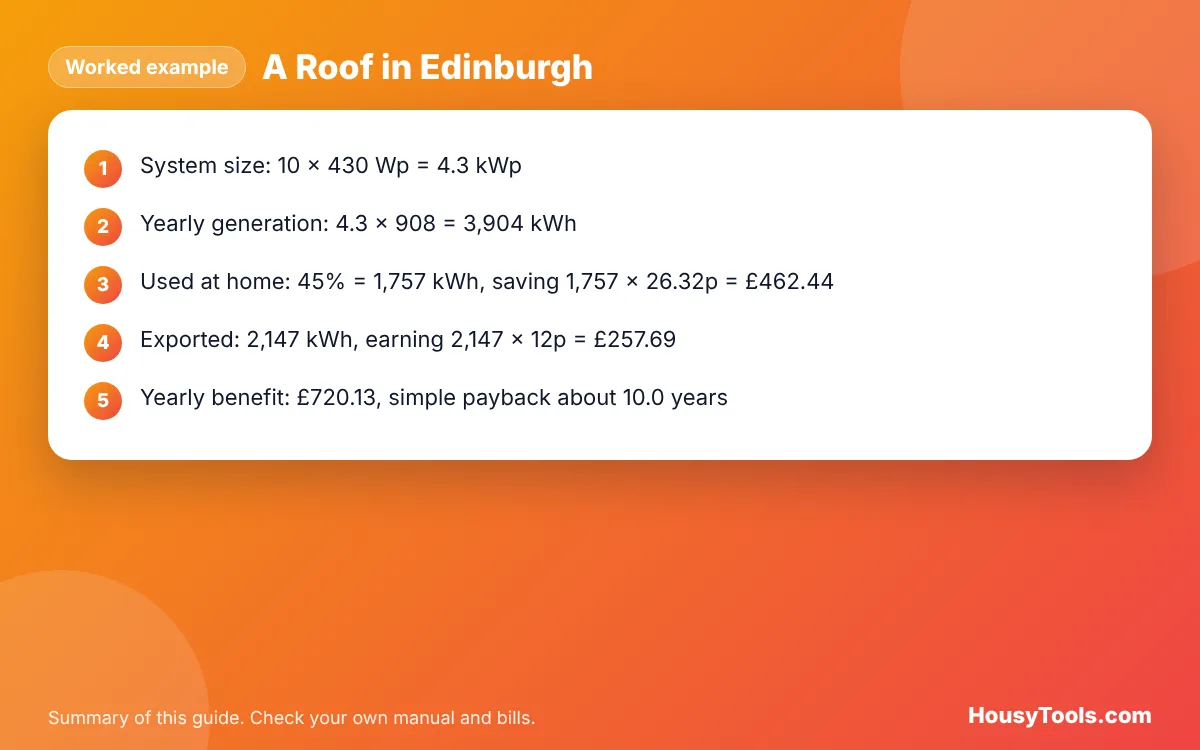
Example: a home in Edinburgh, where PVGIS gives 908 kWh per kWp for a south facing roof, has a quote for ten 430 Wp panels at £7,200 installed. The owner works from home some days, so expects to use 45% of the output, and pays the price cap rate of 26.32p with an export tariff of 12p.
- System size: 10 x 430 Wp = 4.3 kWp
- Yearly generation: 4.3 x 908 = 3,904 kWh
- Used at home: 45% = 1,757 kWh, saving 1,757 x 26.32p = £462.44
- Exported: 2,147 kWh, earning 2,147 x 12p = £257.69
- Yearly benefit: £720.13, simple payback about 10.0 years
If the same roof were in London, at 1,023 kWh per kWp, the yearly benefit would rise to about £811 and payback would fall to about 8.9 years. You can reproduce both results in the solar panel calculator by entering the panels, rating, yield, 45% self use, both tariffs and the price. Like any simple payback, it ignores panel ageing, inverter replacement and future price changes.
To see what your remaining grid electricity will cost, use the electricity cost calculator or browse the energy bill calculators.
Is Solar Worth It in Northern Europe FAQs
Is solar worth it in Scotland?
Often, yes. PVGIS gives about 908 kWh per kWp a year in Edinburgh, around 11% less than London. The Energy Saving Trust puts payback in Stirling at 11 to 12 years for a typical system, compared with 9 years in London.
Do solar panels work in Sweden, Norway and Finland?
Yes. PVGIS gives about 960 to 990 kWh per kWp a year for Oslo, Helsinki and Stockholm, similar to Dublin or Hamburg. Long summer days make up for very dark winters, when December output is only about 11 to 13 kWh per kWp.
How much less do panels produce in the north than in Spain?
About 35 to 45% less over a year. With the same PVGIS settings, Madrid gives about 1,620 kWh per kWp, against 908 in Edinburgh and 1,053 in Copenhagen. The gap is largest in winter and smallest in June.
Do solar panels work on cloudy days?
Yes, but output drops sharply under thick cloud. Yearly figures from PVGIS already include typical cloudy weather for each location, so a yield per kWp from PVGIS is a fair basis for estimating savings.
Does snow damage solar panels?
Snow mainly blocks light until it slides off or melts, so winter output falls further. Ask your installer to confirm that the panels, fixings and roof are suitable for local snow conditions.
Can solar power a heat pump in winter?
Only a little. Heat pumps use most electricity in December and January, when northern panels make the least. Solar helps more with hot water and spring and autumn heating, so most winter heat pump electricity still comes from the grid.
Checked October 2026. Sources: European Commission JRC, PVGIS, Energy Saving Trust, Solar panels, Ofgem, Energy price cap unit rates, Ofgem, Smart Export Guarantee, HMRC, VAT Notice 708/6, Eurostat, Electricity price statistics, Wikipedia, Solar cell efficiency.