
Show the formula and working
This recipe scaler multiplies every ingredient in a recipe so it feeds the number of people you are actually cooking for, whether you are doubling a Sunday traybake or halving a cake for two. It works with grams, millilitres or any other unit, and it tells you what to do with awkward fractions of an egg.
Quick answer: To scale a recipe, divide the servings you need by the servings the recipe makes, then multiply every ingredient by that number. A recipe for 4 made for 6 uses a factor of 1.5, so 250 g flour becomes 375 g. The recipe scaler does this for each ingredient and rounds eggs sensibly.
What Is a Recipe Scaler?
A recipe scaler is a calculator that changes every quantity in a recipe by the same proportion so the dish keeps its balance at a new size. The formula is simple: scale factor = servings you need / servings in the recipe. Each new amount is the original amount x the scale factor. If you already know you want to double, halve or triple, you can enter the multiplier directly instead.
Because every ingredient is multiplied by the same number, the ratios between flour, fat, sugar and liquid stay exactly as the recipe writer intended. What does not scale in a straight line is the equipment and the timing, which is covered further down.
How Do You Use the Recipe Scaler?
- Choose Scale by: “Number of servings” if you know how many people you are feeding, or “Multiplier” if you simply want to double or halve.
- Enter Servings in the recipe and Servings you need, or type your number into Multiplier (multiplier mode only).
- Type up to four quantities into Ingredient 1 amount to Ingredient 4 amount. Use any unit; the result comes back in the same unit.
- Enter the number in Eggs in the recipe to see how many whole eggs to use, or what share of a beaten egg to add.
- Read the scale factor and the scaled amounts, then open “Show the formula and working” to see each multiplication.


How Do You Scale a Recipe Up or Down?
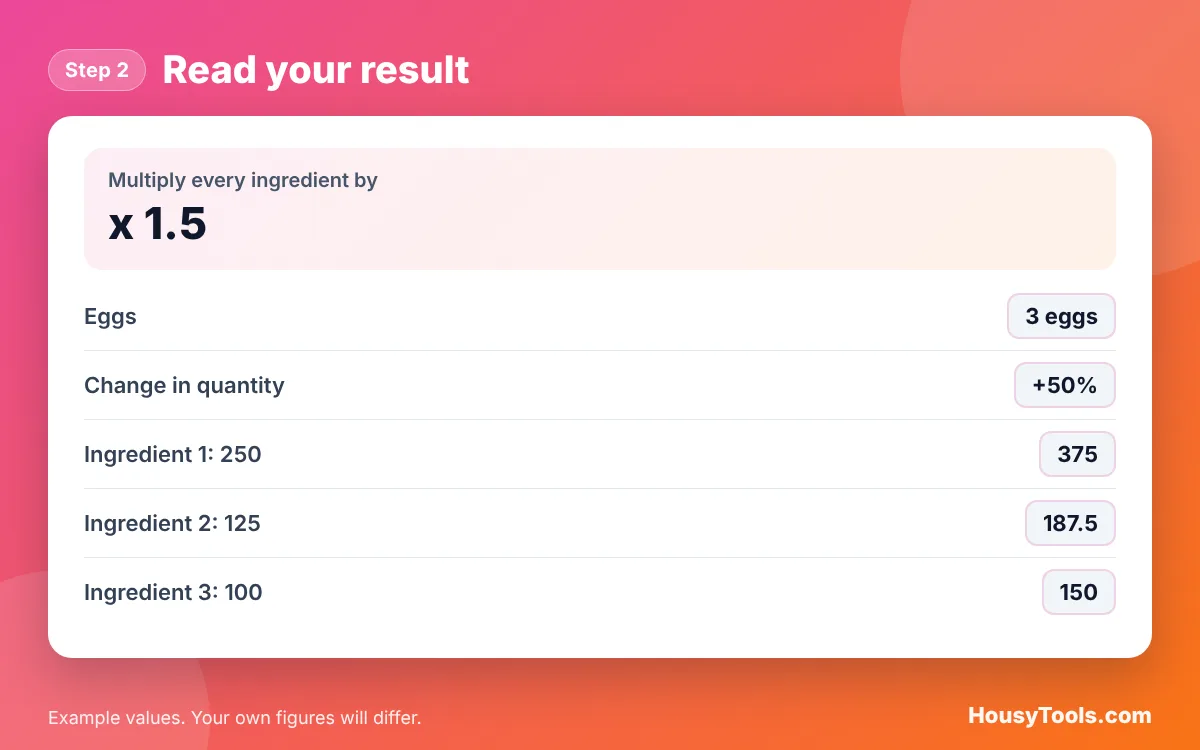
Divide the new number of servings by the original number and multiply every ingredient by the result. Going from 4 to 6 servings gives 6 / 4 = 1.5, going from 6 to 4 gives 4 / 6 = 0.667, and going from 8 to 2 gives 0.25. Keep the factor to at least two decimal places while you work, and only round the final amounts.
Weighing is far more reliable than cups or spoons once you start multiplying, because 1.5 cups of flour packed by one person can weigh noticeably more than the same volume scooped by another. Cup and spoon sizes also vary, and cooking weights and measures differ between the UK, Europe, the US and Australia. If your recipe is written in cups or ounces, convert it to grams first, then scale.
How Do You Halve an Egg in a Recipe?
Beat the egg in a cup, weigh it, and use half the weight, which is the most accurate way to use part of an egg. The recipe scaler rounds to a whole egg when the result is within 0.15 of one, so 2.9 eggs becomes 3. Anything in between is shown as whole eggs plus a percentage of a beaten egg, for example 1 whole plus 50% of a beaten egg.
Egg size matters too. Under the European egg size classes also used in the UK, a medium egg weighs 53 g to 63 g and a large egg 63 g to 73 g, so swapping sizes changes the liquid in a bake.
Does Cooking Time Change When You Double a Recipe?
Cooking time does not double when you double a recipe; it depends on how deep the food is in the tin or pan, not on the total amount. A doubled cake mix in a tin twice the area bakes in about the same time, while the same mix poured into the original tin will be deeper and needs much longer at a lower temperature. Check doneness early with a skewer or thermometer rather than multiplying the time.
Longer oven sessions also cost more to run. If you batch cook often, the electricity cost calculator shows what an extra hour of oven time adds to your bill.
Which Ingredients Should You Not Scale Exactly?
Salt, strong spices, chilli and raising agents are best scaled slightly under the exact figure when you more than double a recipe, then adjusted to taste. Baking powder and bicarbonate of soda react with the batter as a whole, so for very large batches many bakers mix two normal batches rather than one giant one. Liquids for simmering, such as stock in a stew, can also need less than the full multiple because a wider pan loses less to evaporation per portion.
| Recipe serves | You need | Scale factor | 250 g becomes | 3 eggs become |
|---|---|---|---|---|
| 4 | 2 | 0.5 | 125 g | 1.5 (1 whole plus 50%) |
| 4 | 6 | 1.5 | 375 g | 4.5 (4 whole plus 50%) |
| 4 | 8 | 2 | 500 g | 6 |
| 6 | 4 | 0.667 | 166.7 g | 2 |
| 6 | 10 | 1.667 | 416.7 g | 5 |
| 8 | 12 | 1.5 | 375 g | 4.5 (4 whole plus 50%) |
| 2 | 5 | 2.5 | 625 g | 7.5 (7 whole plus 50%) |
Worked Example: Scaling a Recipe for 4 to Serve 6
Example: a pancake recipe for 4 people uses 250 g plain flour, 125 g butter, 100 g sugar, 150 ml milk and 2 eggs. Six people are coming for breakfast. Leave Scale by on “Number of servings”, enter 4 and 6, and type the four amounts plus 2 eggs.
- Scale factor: 6 / 4 = 1.5
- Flour: 250 g x 1.5 = 375 g
- Butter: 125 g x 1.5 = 187.5 g
- Sugar: 100 g x 1.5 = 150 g
- Milk: 150 ml x 1.5 = 225 ml
- Eggs: 2 x 1.5 = 3 eggs
Rounding the butter to 190 g makes no noticeable difference in pancakes, and the extra batter can go in a second batch rather than making thicker pancakes. For more ideas on everyday sums around the house, browse the home calculators.
Recipe Scaler FAQs
How do I double a recipe?
Multiply every ingredient by 2, including eggs, liquids and seasoning, then use a pan or tin with roughly twice the base area so the food stays the same depth. Keep the oven temperature the same and start checking at the original time, as total time usually rises only a little.
How do I halve a recipe with 3 eggs?
Half of 3 eggs is 1.5 eggs. Use one whole egg, then beat a second egg, weigh it and add half of that weight. Keep the rest of the beaten egg covered in the fridge and use it within a day, for example in scrambled eggs.
Can I scale a recipe written in cups?
Yes. Enter the cup amounts as they are and read the results in cups, because the tool keeps whatever unit you type. For baking, converting cups to grams before scaling is more accurate, since the weight of a cup varies with how the ingredient is packed.
Do I need a bigger tin when I scale up a cake?
Usually yes. To keep the same baking time, the tin area should grow by the same factor as the ingredients. A 20 cm round tin has an area of about 314 cm², so a recipe scaled by 1.5 needs roughly 471 cm², which is close to a 24.5 cm round tin.
Should I scale salt and spices exactly?
For small changes, yes. When you more than double a recipe, add about three quarters of the scaled salt and spice, taste near the end, then add the rest if needed. Strong flavours can become dominant in big batches, and it is easier to add than to remove.
What is the scale factor for 6 servings to 4?
The scale factor is 4 / 6 = 0.667. Multiply every ingredient by 0.667, so 300 g becomes 200 g and 3 eggs become 2 eggs. The recipe scaler shows the factor to three decimal places so small rounding errors do not build up across ingredients.
Checked October 2026. Sources: Commission Regulation (EC) No 589/2008 on marketing standards for eggs, Wikipedia: Chicken egg sizes, Wikipedia: Cooking weights and measures.