
Show the formula and working
This free extension lead load calculator adds up the watts of everything plugged into an extension lead, converts the total to amps and checks it against the lead’s rating, for homes in the UK, Ireland and Europe on a 230 V supply. It flags overloads and high power appliances, shows the spare capacity left, and suggests the correct BS 1362 plug fuse for the largest appliance.
Quick answer: An extension lead load calculator divides the total watts by 230 V to get amps. A UK 13 A lead can carry about 2,990 W. A 2,000 W heater, 150 W games console, 100 W TV and 65 W laptop draw 2,315 W, or 10.07 A, which is 77% of the limit.

What Is an Extension Lead Load Calculator?
An extension lead load calculator is a tool that checks whether the appliances on one extension lead together draw more current than the lead, its plug and the wall socket are rated for.
The formula in plain words: add the power of every appliance in watts, then divide by the supply voltage, 230 V in the UK and most of Europe, to get the current in amps. Compare that with the lead’s rating. A UK extension lead has a BS 1363 plug with a 13 A fuse, so the whole lead, however many sockets it has, must not carry more than 13 A in total. At 230 V that is 13 x 230 = 2,990 W.
How Do You Use the Extension Lead Load Calculator?
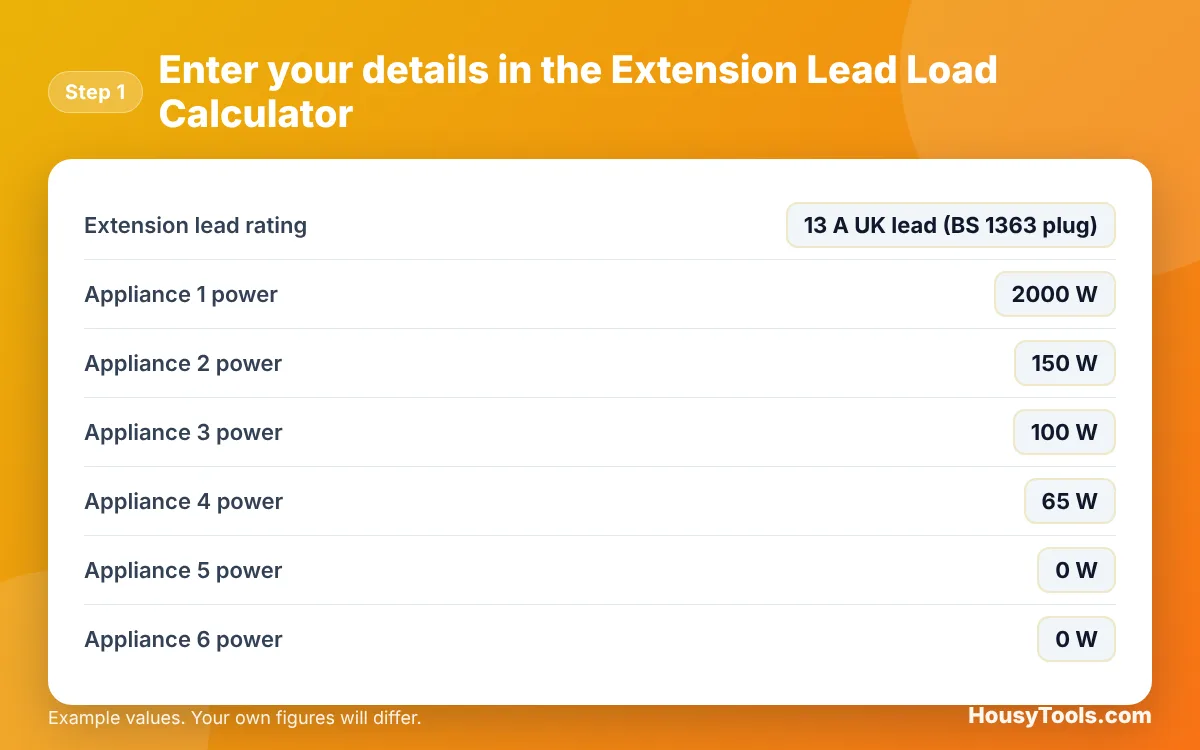
- Choose the Extension lead rating printed on the lead or its packaging.
- Enter Appliance 1 power to Appliance 6 power in watts from each rating plate. Leave unused ones at 0.
- Keep the Supply voltage at 230 V unless you know otherwise.
- Read the result and open “Show the formula and working” to see the current, percentage of the rating and spare capacity.


How Many Watts Can a 13 A Extension Lead Take?
A 13 A extension lead can take about 2,990 W at the UK’s nominal 230 V, which is why many leads are marked with a maximum of around 3,000 W. That limit applies to the whole lead, not to each socket. One kettle can use almost all of it on its own, so a kettle plus a heater on the same lead will overload it. Electrical Safety First publishes advice on avoiding overloaded sockets.
| Example appliance rating | Watts | Amps at 230 V | Share of a 13 A lead | Plug fuse |
|---|---|---|---|---|
| Kettle | 3,000 | 13.04 | 100% | 13 A |
| Fan heater | 2,000 | 8.70 | 67% | 13 A |
| Hair dryer | 1,800 | 7.83 | 60% | 13 A |
| Microwave | 1,200 | 5.22 | 40% | 13 A |
| Desktop computer | 300 | 1.30 | 10% | 3 A |
| Games console | 150 | 0.65 | 5% | 3 A |
| TV | 100 | 0.43 | 3% | 3 A |
| Laptop charger | 65 | 0.28 | 2% | 3 A |
Wattages are examples only. Read the rating plate on your own appliance, because models differ a lot. A 3,000 W kettle works out at just over 13 A at 230 V, so in practice it is the largest load a single 13 A plug is meant for.
What Fuse Does a Plug Need?
UK plugs commonly take a 3 A fuse for appliances up to about 700 W and a 13 A fuse for anything more powerful, with 5 A fuses used less often. The fuse protects the appliance’s flexible cable. Always fit the fuse rating the appliance maker states, and never replace a fuse with a higher one or with anything other than a BS 1362 fuse.
Is It Safe to Plug a Heater Into an Extension Lead?
It is safer to plug heaters, kettles and other high power appliances straight into a wall socket, because they use a large share of a lead’s 13 A on their own and run for long periods. If you must use a lead, plug nothing else high power into it and check the total with this calculator. Unwind cable reels fully, because a coiled reel can overheat. For running costs, see the electric heater running cost calculator.
What Are the Signs of an Overloaded Extension Lead?
Warning signs include a hot plug or lead, a burning or fishy smell, scorch marks, crackling sounds, flickering lights and fuses that blow often. Switch off and unplug the lead if you notice any of them. Never daisy chain one extension lead into another. If you keep running short of sockets, ask a qualified electrician to add more, as changes to fixed wiring are not a DIY job.
Worked Example: A Home Office With a Heater
Example: a 13 A extension lead powers a 2,000 W fan heater, a 150 W games console, a 100 W TV and a 65 W laptop charger on a 230 V supply. These are the tool’s default inputs.
- Total power: 2,000 + 150 + 100 + 65 = 2,315 W.
- Current: 2,315 / 230 = 10.07 A.
- Load: 10.07 / 13 = 77% of the rating, with 675 W spare.
- The heater alone takes 8.7 A, so the tool advises plugging it into a wall socket instead.
To convert any single appliance, use the watts to amps converter.
Extension Lead Load Calculator FAQs
How do I work out the load on an extension lead?
Add the watts of everything plugged in and divide by 230 to get amps. If the total is more than the lead’s rating, usually 13 A in the UK, the lead is overloaded. For example, 2,315 W is 10.07 A, which is within a 13 A limit.
Can I plug a kettle into an extension lead?
A 3,000 W kettle uses about 13 A on its own, the whole capacity of a UK extension lead. Anything else on the same lead would overload it, so plug a kettle straight into a wall socket.
Does a 4 way extension lead give 4 x 13 A?
No. The whole lead connects through one 13 A plug, so all four sockets together share 13 A, about 2,990 W at 230 V. More sockets on the lead does not mean more power.
Why does a cable reel have two ratings?
A cable wound on a reel cannot shed heat well, so the safe current is lower when coiled than when fully unwound. Always unwind a reel completely before plugging in high power tools or heaters, and follow the label.
Is it safe to daisy chain extension leads?
No. Plugging one extension lead into another makes overloading much easier and adds more connections that can overheat. Use one lead of the right length, or ask an electrician to fit more wall sockets.
What voltage should I use for the calculation?
Use 230 V, the nominal supply voltage in the UK and most of Europe. The real voltage varies a little, but 230 V gives a sound estimate of current and keeps the 13 A check on the safe side.
Checked October 2026. Sources: Wikipedia, BS 1363 (13 A plugs and BS 1362 fuses), Electrical Safety First.