
Show the formula and working
This EV charging cost calculator works out what it costs to charge an electric car at home, per charge, per mile or kilometre and per year, for drivers in the UK and Europe. Enter your battery size, the charge level you start and finish at, charging losses, your home unit rate, how far you drive and your car’s efficiency. It shows the energy drawn from the grid, the cost and the range you add.
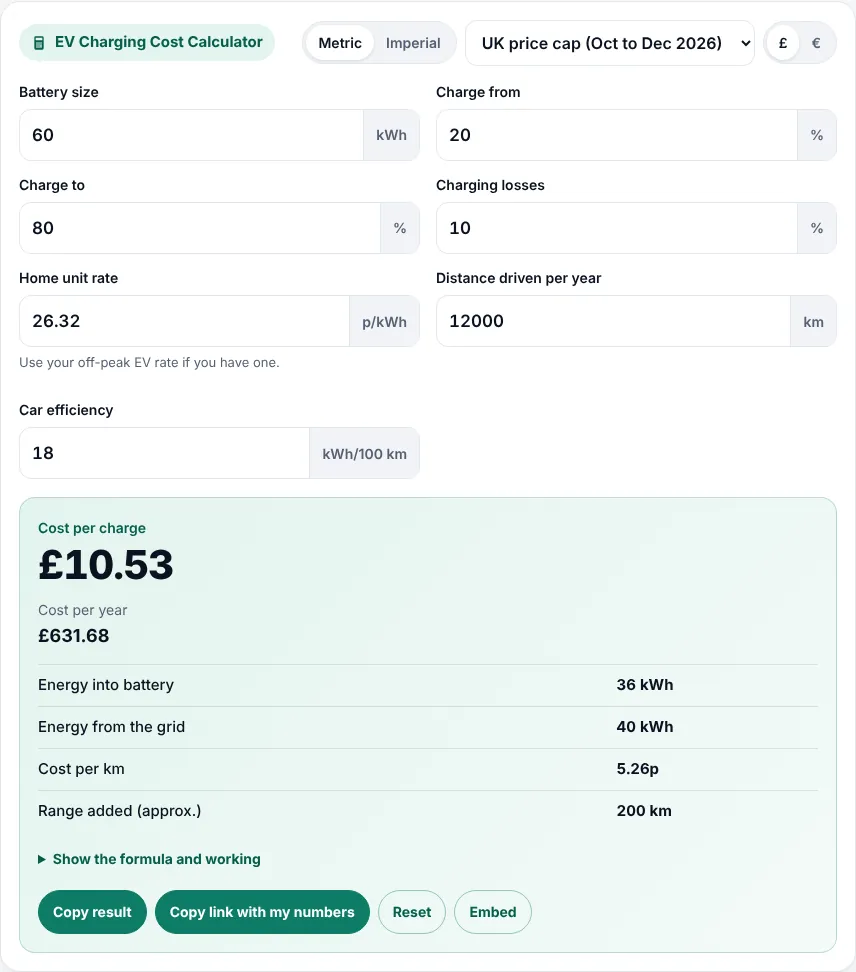
Quick answer: an EV charging cost calculator multiplies the kWh added to the battery, plus about 10% for losses, by your unit rate. Charging a 60 kWh battery from 20% to 80% draws 40 kWh: £10.53 at the October 2026 cap rate of 26.32p, or £2.80 at an example 7p off-peak rate.
What Is an EV Charging Cost Calculator?
An EV charging cost calculator is a tool that estimates the cost of putting energy into an electric car’s battery from your home supply, per charge and over a year.
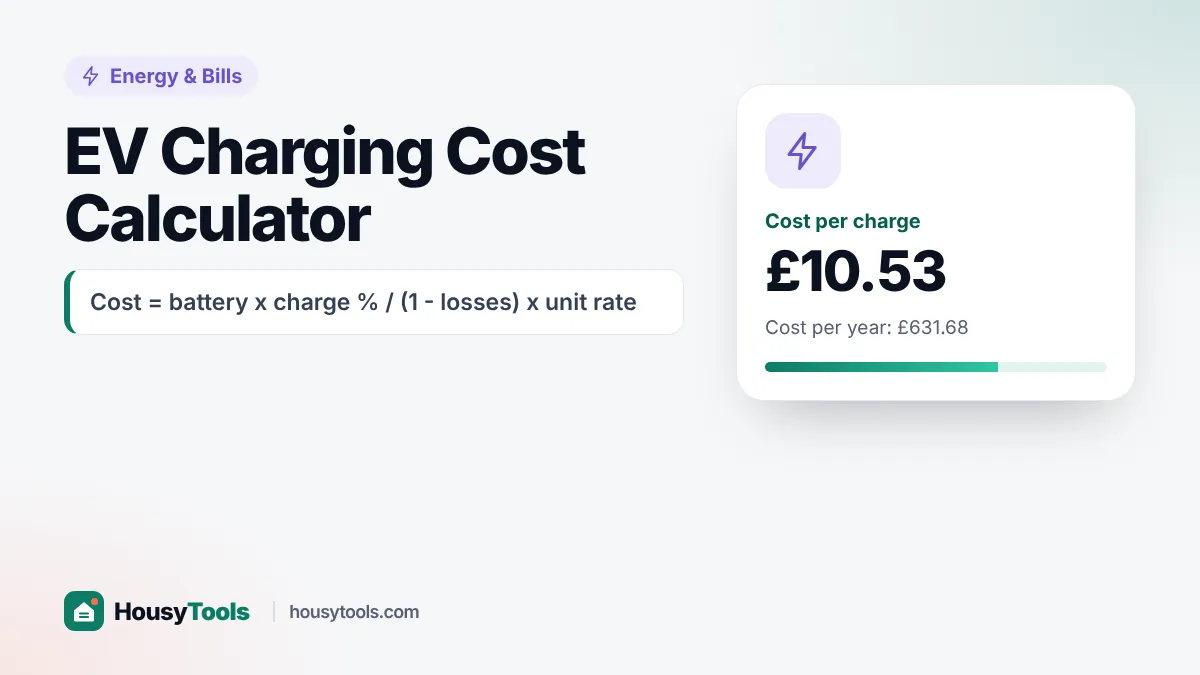
The formula in plain words: energy into the battery equals battery size times the percentage you add (charge to minus charge from). Some energy is lost as heat while charging, so energy from the grid equals battery energy divided by (1 minus the loss). Multiply that by your unit rate for the cost per charge. For a year, multiply the distance you drive by the car’s kWh per 100 km, divide by 100, allow for losses and multiply by the unit rate.
How Do You Use the EV Charging Cost Calculator?
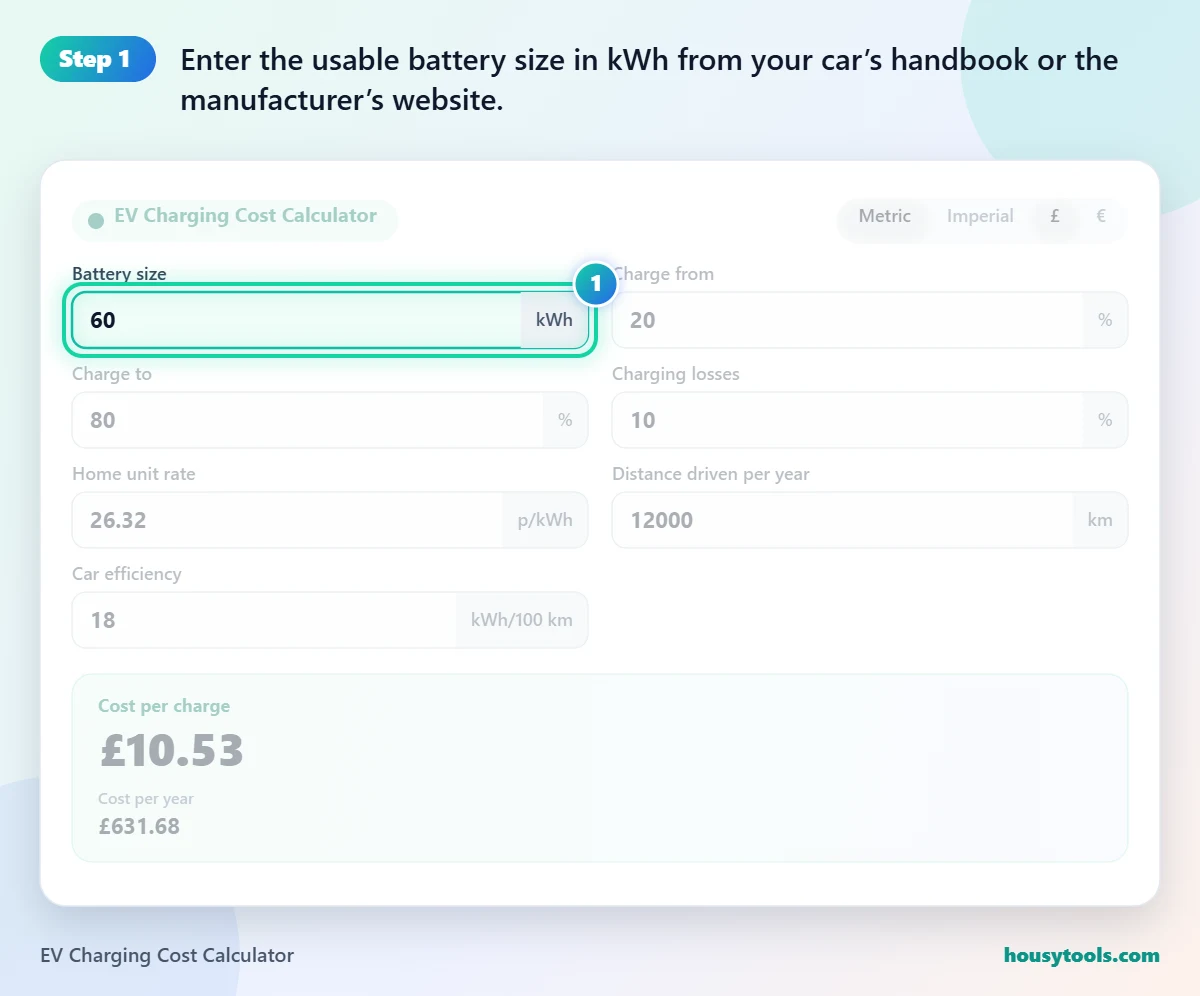
- Enter the usable battery size in kWh from your car’s handbook or the manufacturer’s website.
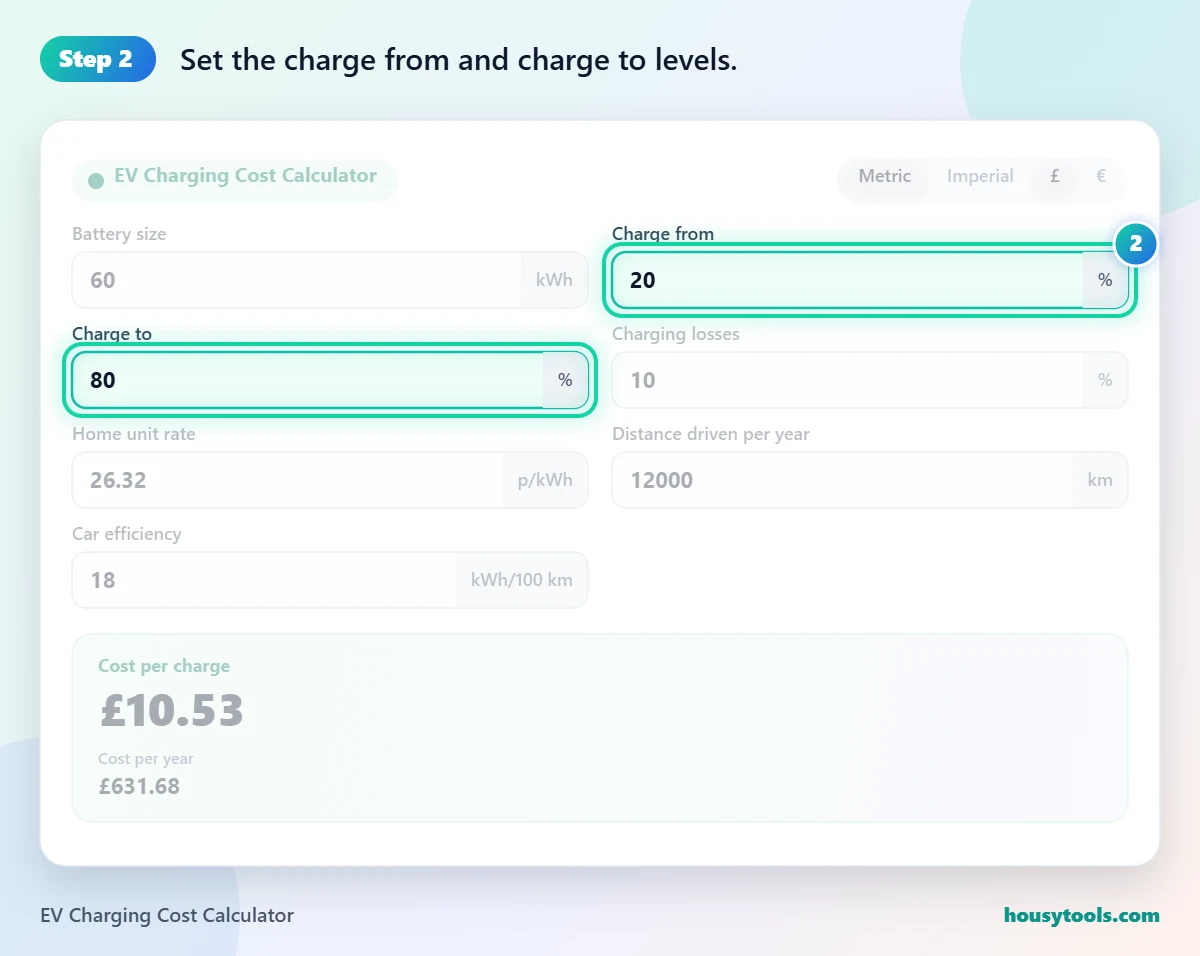
- Set the charge from and charge to levels. A typical home top up is 20% to 80%.
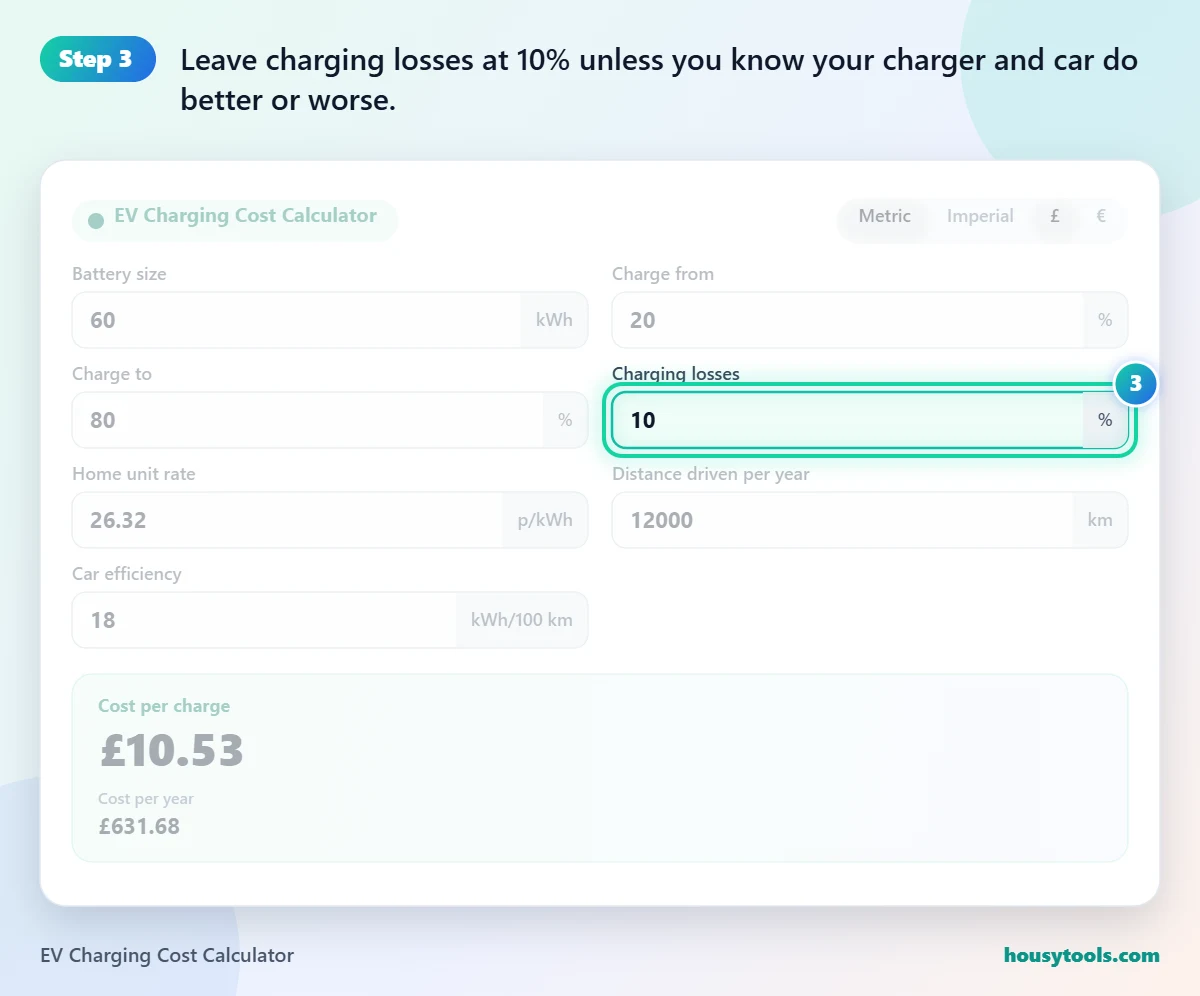
- Leave charging losses at 10% unless you know your charger and car do better or worse.
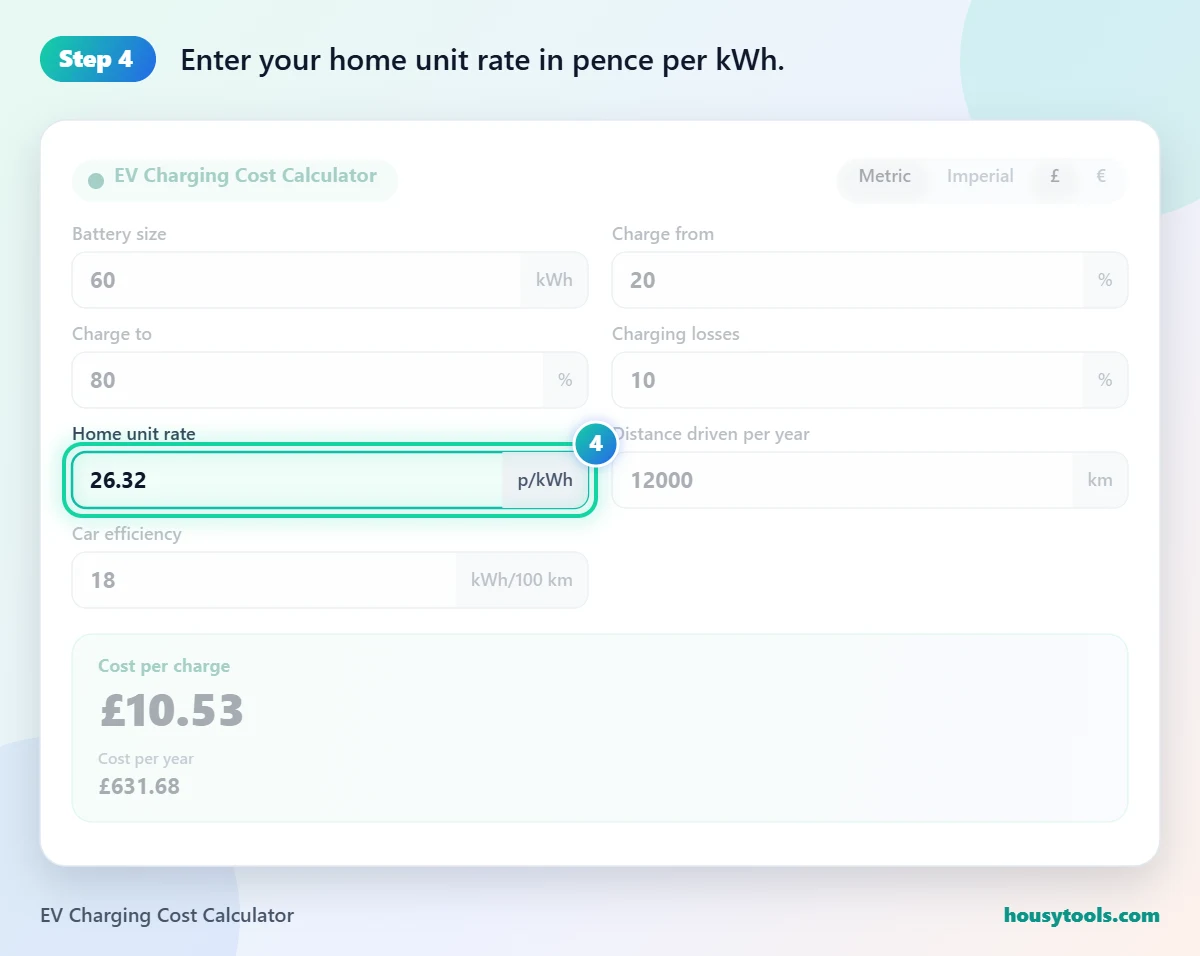
- Enter your home unit rate in pence per kWh. Use your off-peak EV rate if most charging happens at night.
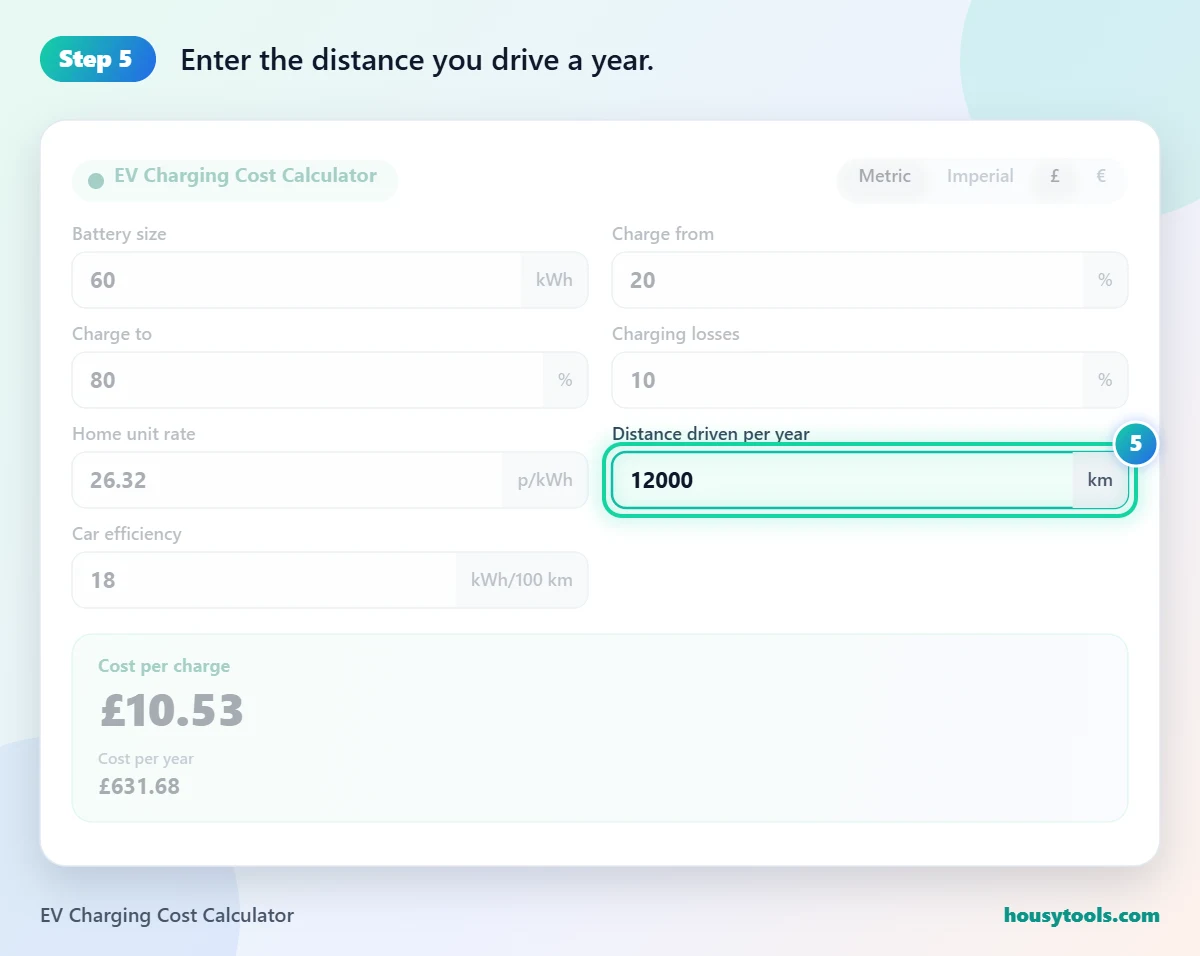
- Enter the distance you drive a year. Switch to imperial to use miles.
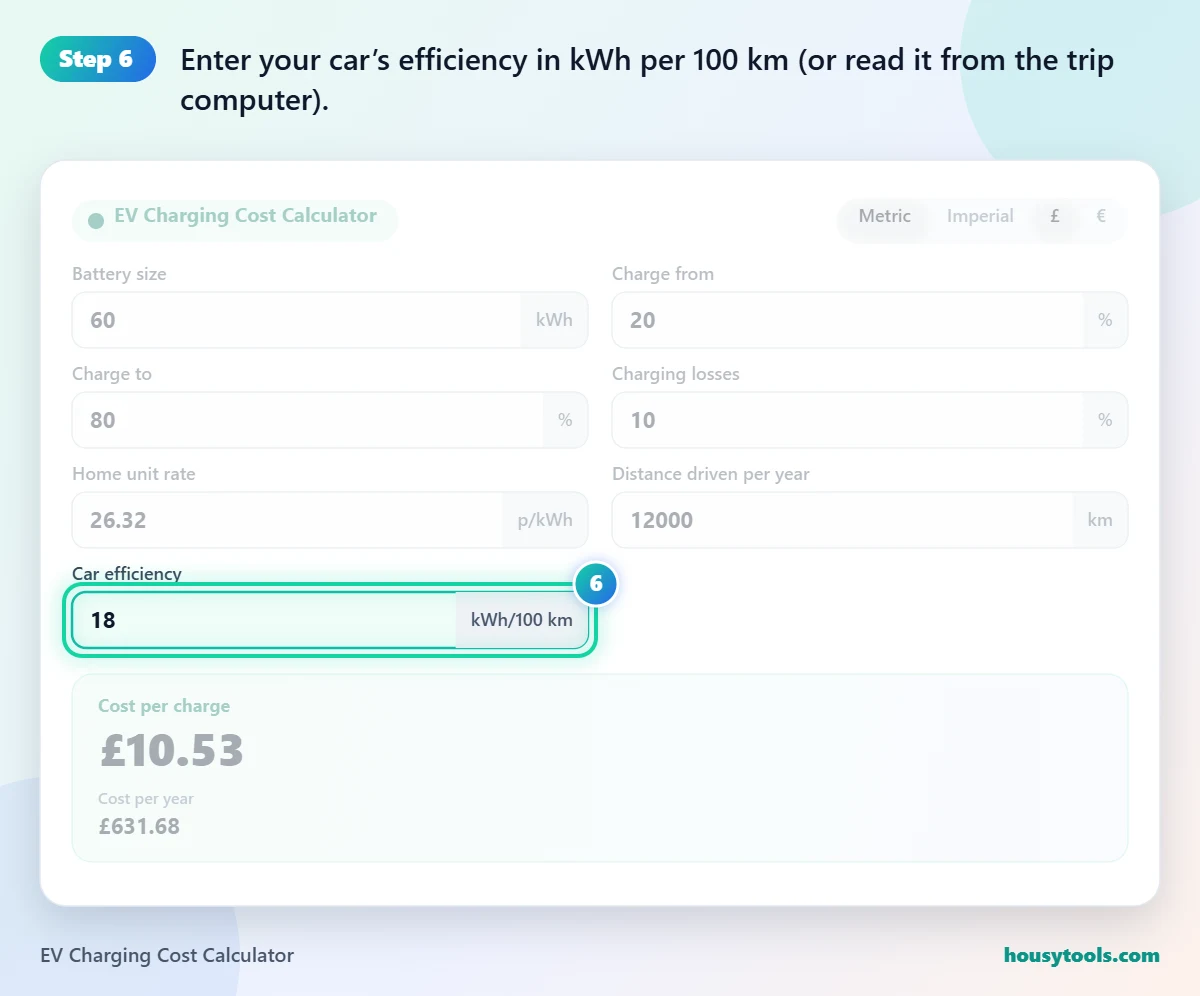
- Enter your car’s efficiency in kWh per 100 km (or read it from the trip computer).
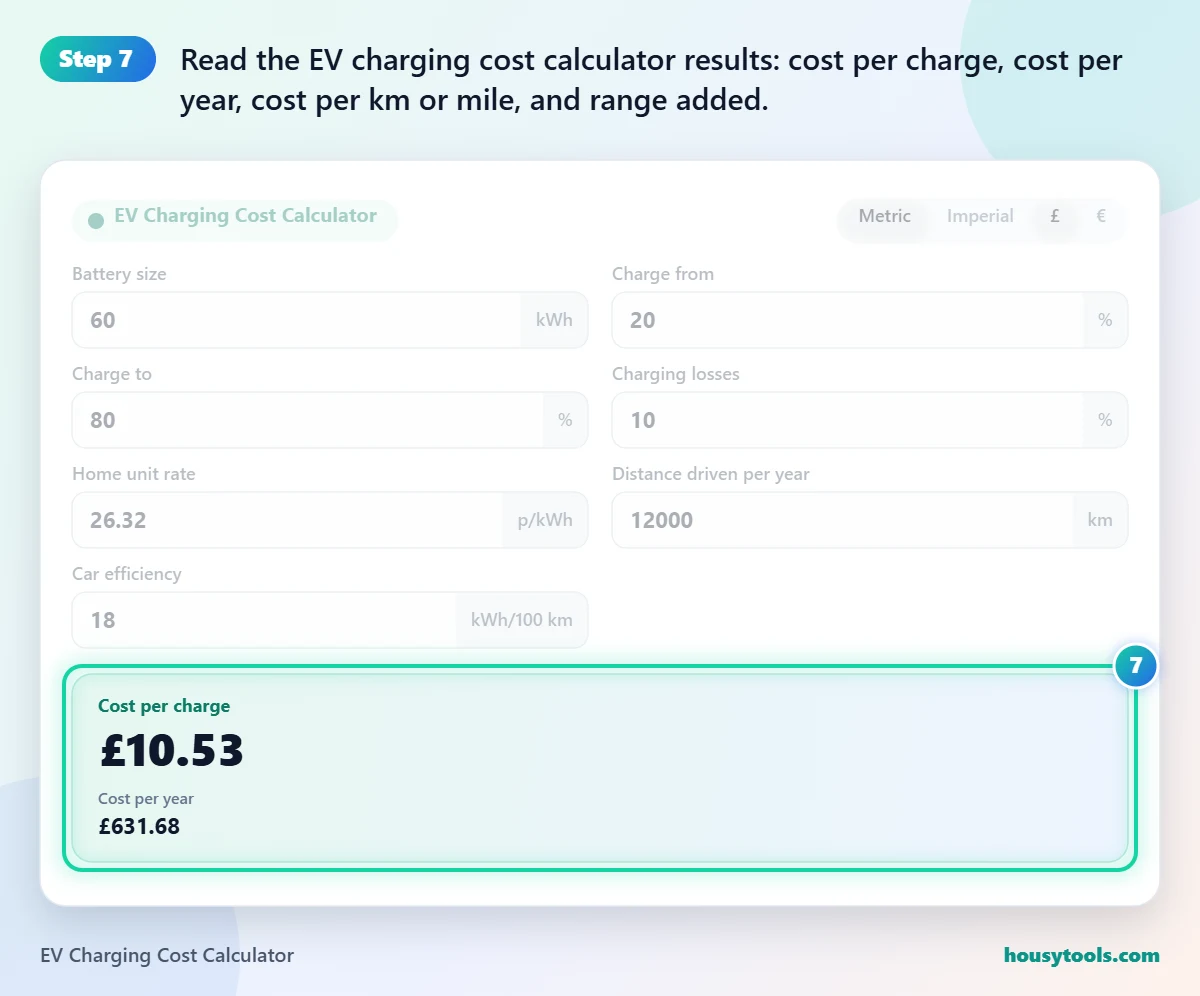
- Read the EV charging cost calculator results: cost per charge, cost per year, cost per km or mile, and range added.
How Much Does It Cost to Charge an Electric Car at Home in the UK?
At the Ofgem price cap of 26.32p per kWh for October to December 2026, a 20% to 80% charge of a 60 kWh battery costs £10.53 and driving 12,000 km a year costs about £632, or 8.47p per mile. These are the default results of the EV charging cost calculator.
The cap rate currently carries no VAT, because VAT on household electricity is 0% from 1 October 2026 to 31 March 2027, according to Ofgem’s price cap rates page. Your standing charge is paid whether or not you own an EV, so the EV charging cost calculator leaves it out.
How Much Cheaper Is Charging on an Off-Peak EV Tariff?
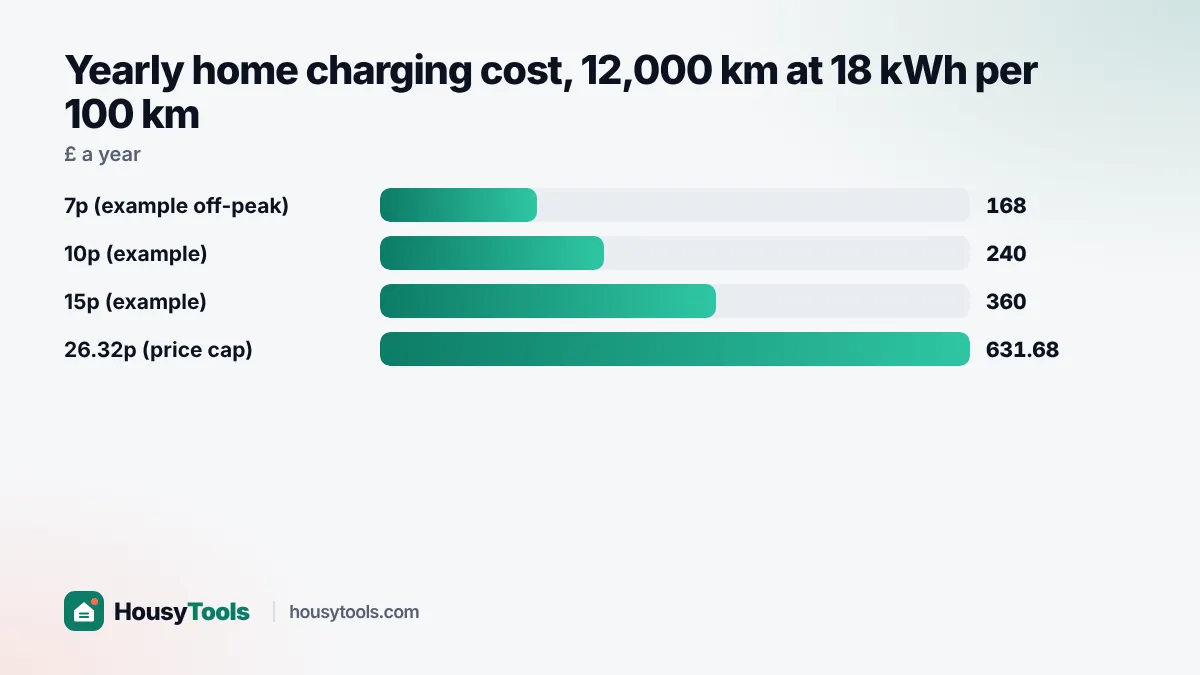
An off-peak EV tariff can cut home charging costs by well over half: at an example rate of 7p per kWh, the same 20% to 80% charge costs £2.80 instead of £10.53. Off-peak rates and hours vary by supplier, so the rates below are illustrations; enter your own.
| Unit rate | Cost per charge (20% to 80%, 60 kWh) | Cost per km | Cost per year (12,000 km) |
|---|---|---|---|
| 7p (example off-peak) | £2.80 | 1.4p | £168.00 |
| 10p (example) | £4.00 | 2p | £240.00 |
| 15p (example) | £6.00 | 3p | £360.00 |
| 26.32p (October 2026 cap) | £10.53 | 5.26p | £631.68 |
Most EV tariffs charge a higher rate outside the cheap window, so they suit drivers who can charge overnight. If your whole house moves to a time of use tariff, check the rest of your use with the Economy 7 calculator, which compares a two rate tariff with a single rate.
What Is the Cost per Mile of an Electric Car?
At 26.32p per kWh, a car using 18 kWh per 100 km costs about 8.5p per mile to charge at home including losses, falling to roughly 2.3p per mile at an example 7p off-peak rate. Efficient small cars use less than 18 kWh per 100 km, while large SUVs and winter driving use more.
To convert a trip computer reading in miles per kWh, divide 62.14 by it: 3.5 miles per kWh is about 17.8 kWh per 100 km. Enter that figure into the EV charging cost calculator for an accurate per mile cost.
Worked Example: Sofia’s Commuter EV
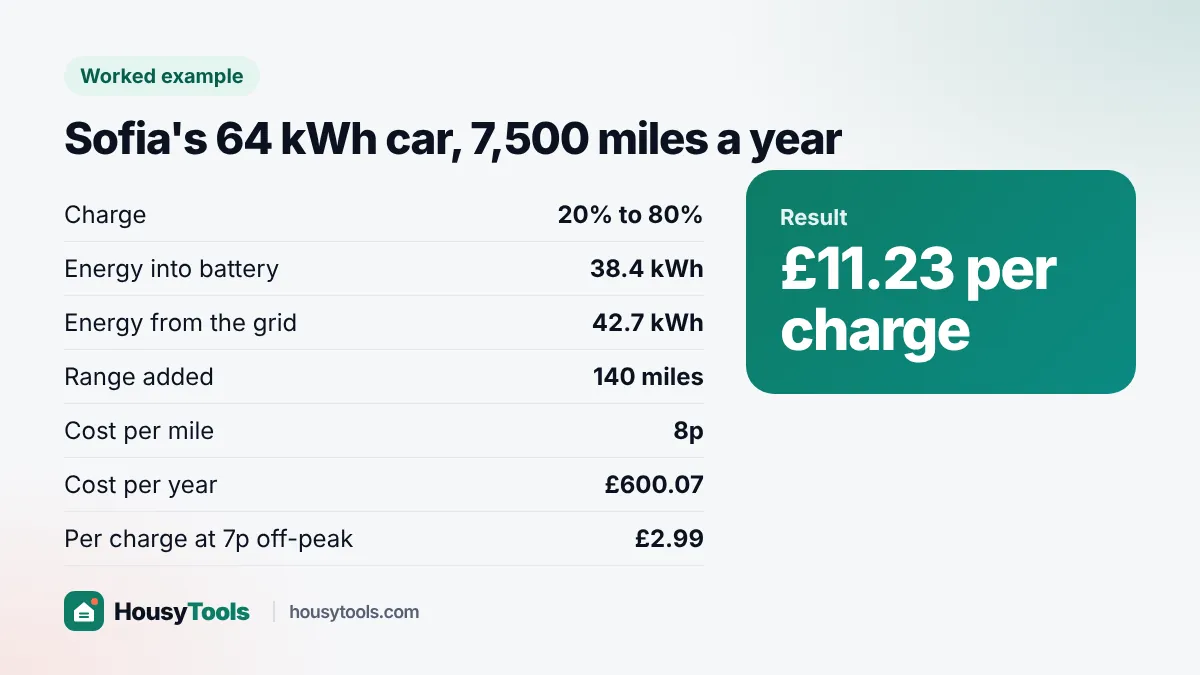
Sofia drives about 7,500 miles a year (12,070 km) in a car with a 64 kWh usable battery. Her trip computer averages 17 kWh per 100 km. She plugs in at 20% and stops at 80%, and pays the price cap rate of 26.32p for now.
- Battery: 64 kWh x 60% = 38.4 kWh
- Grid: 38.4 / 0.90 = 42.7 kWh
- Cost per charge: 42.7 x 26.32p = £11.23
- Range added: about 140 miles
- Cost per year: £600.07, about 8p per mile
Running the EV charging cost calculator again with an example 7p off-peak rate gives £2.99 per charge and £159.59 a year, a saving of £440.48 if all her charging moved into the cheap window.
Do You Need a Special Charger to Charge an EV at Home?
A dedicated home charge point is the safe, recommended way to charge regularly, and it must be fitted by a qualified electrician because it usually needs a new circuit, which is notifiable electrical work under Building Regulations in England.
Under the smart charge point regulations explained on GOV.UK, home charge points sold in Great Britain since 30 June 2022 must be smart, include pre-set off-peak default charging hours and a randomised delay, and let the owner accept, remove or change those hours. That makes it easy to line charging up with a cheap tariff. Do not run a car charger from an extension lead.
Common Mistakes When Working Out EV Charging Costs
- Using the full battery size when you only add 60% of it.
- Ignoring charging losses, which make the grid energy higher than the energy stored.
- Using the gross battery size from a brochure instead of the usable capacity.
- Assuming every kWh is off-peak when some charging happens in the day.
- Comparing home rates with public rapid charger prices, which are much higher.
A quick sense check: the energy from the grid should always be a little higher than the energy into the battery. If it is not, the losses box is set to 0. Run the EV charging cost calculator once with your standard rate and once with your off-peak rate to see what the tariff is worth to you. If you have solar panels, daytime charging can use your own output: the solar panel calculator shows how much you generate and export.
How Much Does It Cost to Charge an EV in Ireland and the EU?
Using Eurostat’s household electricity prices for the second half of 2025, the EV charging cost calculator gives €11.58 for a 40 kWh draw at the EU average of €28.96 per 100 kWh, €15.48 in Germany at €38.69 and €16.17 in Ireland at €40.42. Over 12,000 km that is €695.04, €928.56 and €970.08 a year.
Night rates are common in Ireland and parts of the EU, so select your country, then type your own off-peak price into the EV charging cost calculator. Browse more tools in the energy and bills hub.
EV Charging Cost Calculator FAQs
How much does a full charge of an electric car cost at home?
Multiply the usable battery size by your unit rate and add about 10% for losses. A full 0% to 100% charge of a 60 kWh battery draws about 66.7 kWh, roughly £17.55 at 26.32p per kWh.
Is it cheaper to charge an EV at night?
Usually yes, if you are on an EV or time of use tariff with a cheap overnight rate. On a standard single rate tariff the price is the same at any hour, so night charging alone saves nothing.
How many kWh does it take to charge an electric car?
It depends on how much you add. A 20% to 80% charge of a 60 kWh battery puts 36 kWh into the battery and draws about 40 kWh from the grid once 10% charging losses are included.
Should I charge my EV to 100% every time?
Follow your car’s handbook, which states the daily charge limit the maker recommends; many cars let you set one in the app. The EV charging cost calculator lets you set any start and finish percentage to match.
Does a home charger have to be smart in the UK?
Yes. Under the smart charge point regulations, home charge points sold in Great Britain since 30 June 2022 must be smart, with pre-set off-peak default hours and a randomised delay that the owner can change.
Is charging an EV at home cheaper than petrol?
Work it out per mile. Take the cost per mile from the EV charging cost calculator, then for petrol divide the price per litre by miles per litre (mpg divided by 4.546). The lower figure wins for your own car and tariff.
Checked October 2026. Sources: Ofgem energy price cap, GOV.UK electric vehicle smart charge points regulations, GOV.UK Approved Document P, Eurostat.