
Show the formula and working
This dining table size calculator works out how big a table you need for the number of people you want to seat, and the largest table your dining room or kitchen can take while still leaving room to pull out chairs and walk around. It works in metres for UK and European homes, with a feet switch for anyone measuring in imperial, and it handles rectangular, round and square tables.
Quick answer: Allow about 60 cm of table edge per diner and about 90 cm of clearance from the table edge to each wall. Six people need a rectangular table of about 1.8 m by 0.9 m, which needs a room of at least 3.6 m by 2.7 m. The dining table size calculator checks both numbers for your room.
What Is a Dining Table Size Calculator?
A dining table size calculator is a tool that turns a number of diners and a room size into a recommended table size and a check that it fits. It uses two simple measurements. The first is the length of table edge each person needs to eat comfortably, which sets the table size. The second is the clearance between the table edge and the walls, which sets how much of the room the table can use.
In plain words: for a rectangular table, length = diners per long side x edge per diner. For a round table, diameter = diners x edge per diner / 3.1416. The space left for a table is the room length and width minus twice the clearance. If the table is smaller than that space in both directions, it fits.
How Do You Use the Dining Table Size Calculator?
- Measure the room wall to wall and enter Room length and Room width. If one side has a fixed sideboard or radiator, measure from its front instead.
- Enter the Number of diners you want to seat on a normal day, not the rare big gathering.
- Pick the Table shape. For a rectangular table, set Table width (rectangular only) and tick Seat diners at the ends (rectangular only) if people will sit at the short ends.
- Leave Table edge per diner at 0.6 m, or raise it for carver chairs and more elbow room.
- Set Clearance from table edge to wall: about 0.8 m where nobody walks behind, 0.9 m to squeeze past and 1.1 m for a walkway.
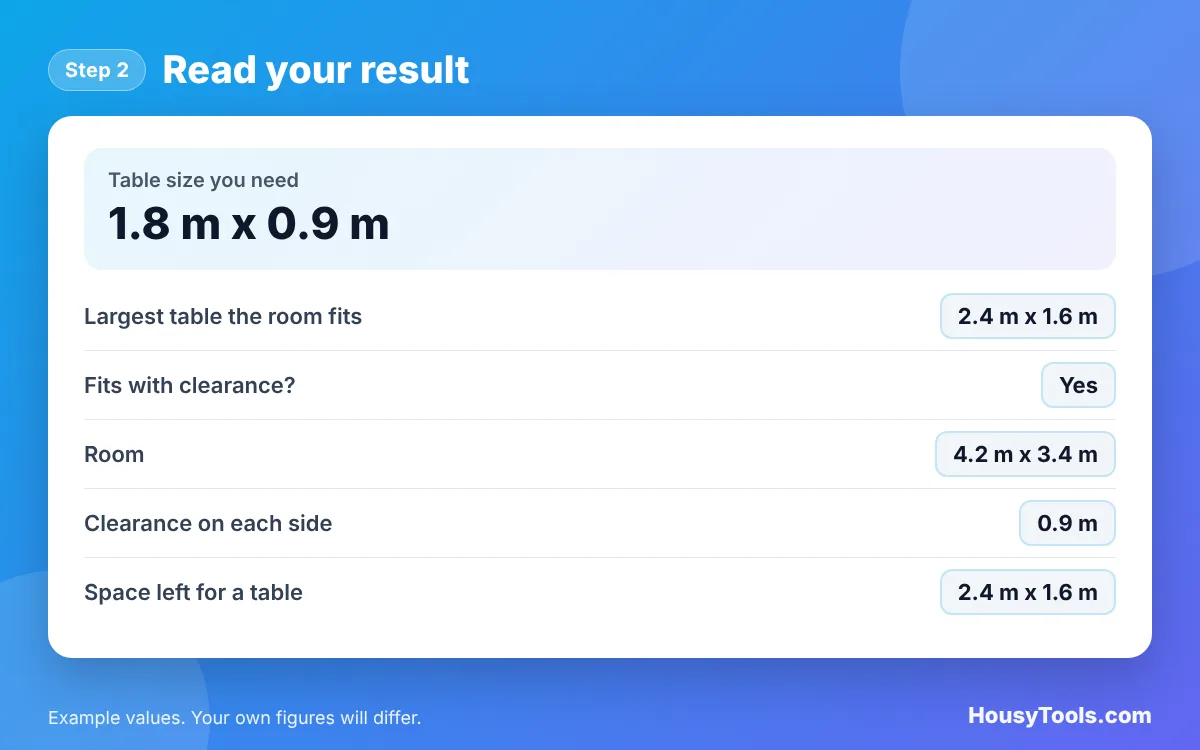
- Read the table size you need, the largest table the room fits and whether it fits, then open “Show the formula and working” to see each step.

How Much Space Does Each Person Need at a Dining Table?
Each person needs about 60 cm of table edge to eat without bumping elbows, and about 45 cm of table depth in front of them for a place setting. The US based National Kitchen and Bath Association uses 610 mm wide by 457 mm deep per seated diner in its Kitchen Planning Guidelines, and these figures are widely used by designers in the UK and Europe too.
The depth figure is why the calculator never suggests a round or square table narrower than about 0.91 m: two people sitting opposite each other need 2 x 457 mm of table between them. Armchairs with arms, or chairs wider than 55 cm, need more than 60 cm each, so increase the edge per diner to 0.65 or 0.7 m if your chairs are generous.
How Much Room Do You Need Around a Dining Table?
Leave at least 80 cm between the table edge and a wall where nobody walks behind the chairs, and 90 cm to 110 cm where people need to pass. The NKBA guidance gives 813 mm with no traffic, 914 mm for someone to edge past a seated diner and 1,118 mm to walk past comfortably.
That means a dining room has to be roughly 1.8 m longer and 1.8 m wider than the table itself at the 0.9 m setting. In a kitchen diner, measure the clearance to the nearest worktop or island edge rather than the wall. If you are planning flooring at the same time, our laminate flooring calculator uses the same room measurements.
Is a Round or Rectangular Dining Table Better for a Small Room?
A round table usually seats four people in less space than a rectangle, because a 0.91 m round table needs a room of only about 2.7 m by 2.7 m at 0.9 m clearance. It also has no corners to walk around, which helps in tight spaces and square rooms.
Rectangular tables suit long, narrow rooms and larger groups. Beyond eight people a round table gets so wide that diners cannot reach the middle or talk across it, so a long rectangle or an extending table is more practical. Seating someone at each end adds two places without making the table longer, as long as the table is at least 0.9 m wide.
What Size Dining Table Seats 4, 6, 8 or 10 People?
A table for six is about 1.8 m by 0.9 m with nobody at the ends, or about 1.2 m by 0.9 m if one person sits at each end. The table below uses 60 cm of edge per diner and 0.9 m clearance, exactly as the calculator does.
| Diners | Rectangular, 0.9 m wide, no end seats | Rectangular, one at each end | Round diameter | Smallest room for the rectangle with no end seats |
|---|---|---|---|---|
| 4 | 1.2 m x 0.9 m | 0.9 m x 0.9 m | 0.91 m | 3.0 m x 2.7 m |
| 6 | 1.8 m x 0.9 m | 1.2 m x 0.9 m | 1.15 m | 3.6 m x 2.7 m |
| 8 | 2.4 m x 0.9 m | 1.8 m x 0.9 m | 1.53 m | 4.2 m x 2.7 m |
| 10 | 3.0 m x 0.9 m | 2.4 m x 0.9 m | 1.91 m | 4.8 m x 2.7 m |
| 12 | 3.6 m x 0.9 m | 3.0 m x 0.9 m | 2.29 m | 5.4 m x 2.7 m |
Sizes with end seats are the tight minimum, because people at the corners share leg room. If you entertain often, choose the no end seats size or an extending table that covers both.
Worked Example: A Dining Room
Example: a dining room of 4.2 m by 3.4 m needs a rectangular table, 0.9 m wide, that seats six people with nobody at the ends. Keep 0.6 m of edge per diner and 0.9 m clearance so people can edge past.
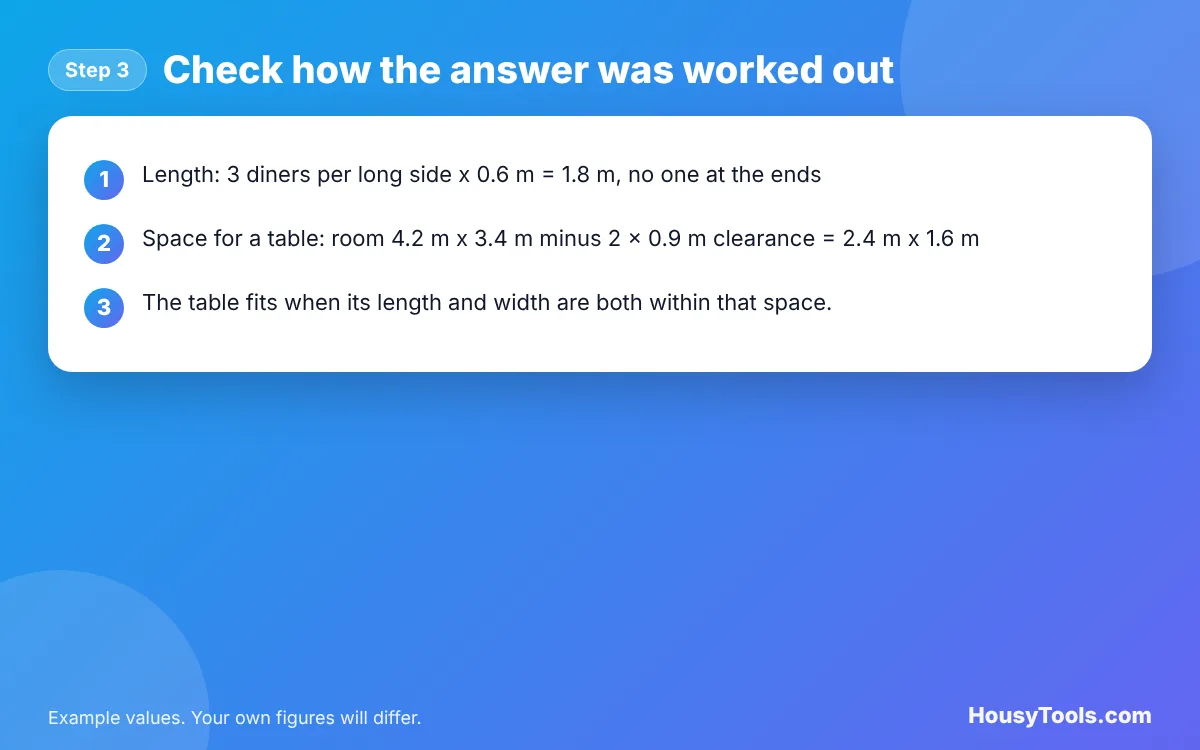
- Six diners with no end seats means three per long side: 3 x 0.6 m = 1.8 m. The table needs to be 1.8 m x 0.9 m.
- Space for a table: 4.2 m minus 2 x 0.9 m = 2.4 m, and 3.4 m minus 2 x 0.9 m = 1.6 m.
- 1.8 m x 0.9 m sits inside 2.4 m x 1.6 m, so it fits. The room could take a table up to 2.4 m long, enough for eight people.
You can enter the same room into our carpet calculator if you are replacing the floor, and the other home calculators cover the rest of the room.
Dining Table Size Calculator FAQs
What is the standard size of a 6 seater dining table?
A 6 seater rectangular table needs to be about 1.8 m long and 0.9 m wide when three people sit along each side, at 60 cm per diner. Shorter 6 seater tables, around 1.2 m, put one person at each end, which works but is tighter at the corners.
What is the standard height of a dining table?
The usual dining table height is about 76 cm, which is 30 inches and the top of the common range given in the Wikipedia article on tables. The NKBA guidelines use a 30 inch high table when setting out the 610 mm by 457 mm space each diner needs.
How wide should a dining table be?
A dining table should be at least about 0.8 m wide, and 0.9 m to 1 m is more comfortable. Each diner needs roughly 45 cm of depth for a place setting, so two people facing each other use about 0.9 m, leaving a little room for serving dishes.
How big a dining table fits in a 3 m by 3 m room?
With 0.9 m clearance on every side, a 3 m by 3 m room leaves 1.2 m by 1.2 m for a table. That fits a round table of up to 1.2 m, which seats six at 60 cm each, or a 1.2 m square table for four to eight people.
How many people fit around a round table?
Divide the table’s circumference by 60 cm. A 1.2 m round table has a circumference of about 3.77 m, so it seats six comfortably. A 0.9 m table seats four and a 1.5 m table seats seven.
Should I size my table for everyday use or for guests?
Size the table for everyday use and the room clearance first, then choose an extending table for guests. A table that fills the room every day makes it hard to move around. Run the calculator twice, once for daily diners and once for guests, and check both fit.
Checked October 2026. Sources: NKBA Kitchen Planning Guidelines (seating clearances, guidelines 8 and 9), Wikipedia: Table (furniture).