
What is Delta T? On a radiator, Delta T is the difference between the average temperature of the water inside the radiator and the temperature of the room. It matters because radiator outputs in catalogues are quoted at one fixed Delta T, and if your boiler or heat pump runs cooler than that, the radiator gives out much less heat than the label suggests.
Quick answer: Delta T is the average radiator water temperature minus the room temperature. Radiators are rated at Delta T 50, roughly 70°C water in a 20°C room. Run the same radiator at Delta T 25 to 30, typical of a heat pump, and it gives only about 40% to 50% of its rated output, so it may need to be bigger.

What Is Delta T on a Radiator?
Delta T is mean water temperature minus room temperature, so 70°C water in a 20°C room gives Delta T 50. The word “delta” is the Greek letter used in science for a difference, and the “T” stands for temperature. Because it is a difference between two temperatures, it is often written in kelvin (K), but 1 K of difference is exactly the same size as 1°C of difference.
The water entering a radiator (the flow) is hotter than the water leaving it (the return), so the mean water temperature is the average of the two. Radiator maker Zehnder sets out the formula as:
- Delta T = (flow temperature + return temperature) ÷ 2, minus room temperature
Radiators sold in the UK and Europe are tested under the standard EN 442. Purmo describes the test condition as 75°C flow, 65°C return and a 20°C room: the mean water temperature is 70°C, so the result is Delta T 50. That is why almost every UK radiator data sheet now quotes output “at Delta T 50” or “ΔT50”.
Why Does Delta T Matter for Radiator Output?
A radiator running at Delta T 30 gives about 52% of its Delta T 50 output, and at Delta T 40 about 75%. Heat output does not fall in a straight line as the water cools. It follows a curve described by a radiator exponent, usually written as n. Zehnder’s correction calculator uses n = 1.3, which it says represents most radiators, and the correction factor is:
- Correction factor = (your Delta T ÷ 50) to the power of 1.3
- Real output = rated output at Delta T 50 × correction factor
This is the single most common reason a newly fitted radiator feels “underpowered”. The radiator is fine; it is simply running at a lower Delta T than the one printed on the box.
Delta T Correction Factors at a Glance
The table uses n = 1.3 and a 20°C room. Mean water temperature is room temperature plus Delta T. Check your radiator’s own data sheet, because some models use a slightly different exponent.
| Delta T | Mean water temperature (20°C room) | Correction factor | Output of a radiator rated 1,000 W at Delta T 50 |
|---|---|---|---|
| 20 | 40°C | 0.30 | 304 W |
| 25 | 45°C | 0.41 | 406 W |
| 30 | 50°C | 0.52 | 515 W |
| 35 | 55°C | 0.63 | 629 W |
| 40 | 60°C | 0.75 | 748 W |
| 45 | 65°C | 0.87 | 872 W |
| 50 (EN 442 rating) | 70°C | 1.00 | 1,000 W |
| 60 (older catalogues) | 80°C | 1.27 | 1,267 W |
What Is the Difference Between Delta T 50 and Delta T 60?
A Delta T 60 figure is about 27% higher than the Delta T 50 figure for the same radiator, so multiply a Delta T 60 output by about 0.79 to compare it fairly. Stelrad explains that Delta T 50 is the current standard for modern boilers, while Delta T 60 is linked with older, hotter systems. Some retailers and older catalogues still list Delta T 60 or even Delta T 70 outputs, which makes a radiator look more powerful than a rival quoted at Delta T 50.
Before you compare two radiators, check which Delta T each output uses. If one says 1,500 W at Delta T 60 and another says 1,250 W at Delta T 50, they are almost identical: 1,500 × 0.79 is about 1,185 W at Delta T 50.
What Delta T Does a Heat Pump Need?
With water at about 45°C, typical of a heat pump, Delta T in a 20°C room is about 25, so each radiator gives only about 40% of its rated output. The Energy Saving Trust notes that water in a heat pump system typically reaches about 45°C, compared with about 75°C from a traditional boiler, and that a room will not get warm if its radiator is not big enough. Stelrad describes low temperature systems as running anywhere between 35°C and 55°C.
This is why heat pump installers often replace some radiators with larger double or triple panel models. A heat pump installed under MCS needs a room by room heat loss survey by the installer, and the radiator sizes should be checked against the real Delta T of the design, not the Delta T 50 label.
What Is Flow and Return Delta T on a Boiler?
Heating engineers also use Delta T for a second figure: the drop between the flow temperature leaving the boiler and the return temperature coming back, which was 10 K (75°C to 65°C) in the EN 442 test. This drop matters for efficiency. A condensing gas boiler only recovers extra heat from its flue gases when the returning water is cool enough, which is around 55°C or below; Viessmann gives the same 55°C dew point figure.
The design flow and return temperatures of your system are set by the installer and vary by boiler and heat pump model, so check your manual or commissioning paperwork. As a homeowner you can change the flow temperature on the boiler’s user controls if the manual allows it, but leave pump speeds, internal settings and anything behind the casing to an engineer.
Safety: Only use the controls your boiler manual tells you to use. Any work inside a gas boiler, on its gas valve, flue or electrics must be done by a Gas Safe registered engineer, and heat pump settings beyond the user menu should be changed by your installer.
How Do You Work Out Your Own Delta T?
You need three numbers, and the calculation takes under a minute.
- Find the flow temperature. This is the radiator temperature set on your boiler or heat pump controller.
- Find the return temperature. Your commissioning sheet or installer can tell you the design figure. If you do not know it, the EN 442 test used a return 10 K below flow, but real systems vary.
- Average the two to get the mean water temperature.
- Subtract the room temperature you want, for example 21°C for a living room.
- Apply the correction factor from the table, or let our radiator output calculator do the maths.
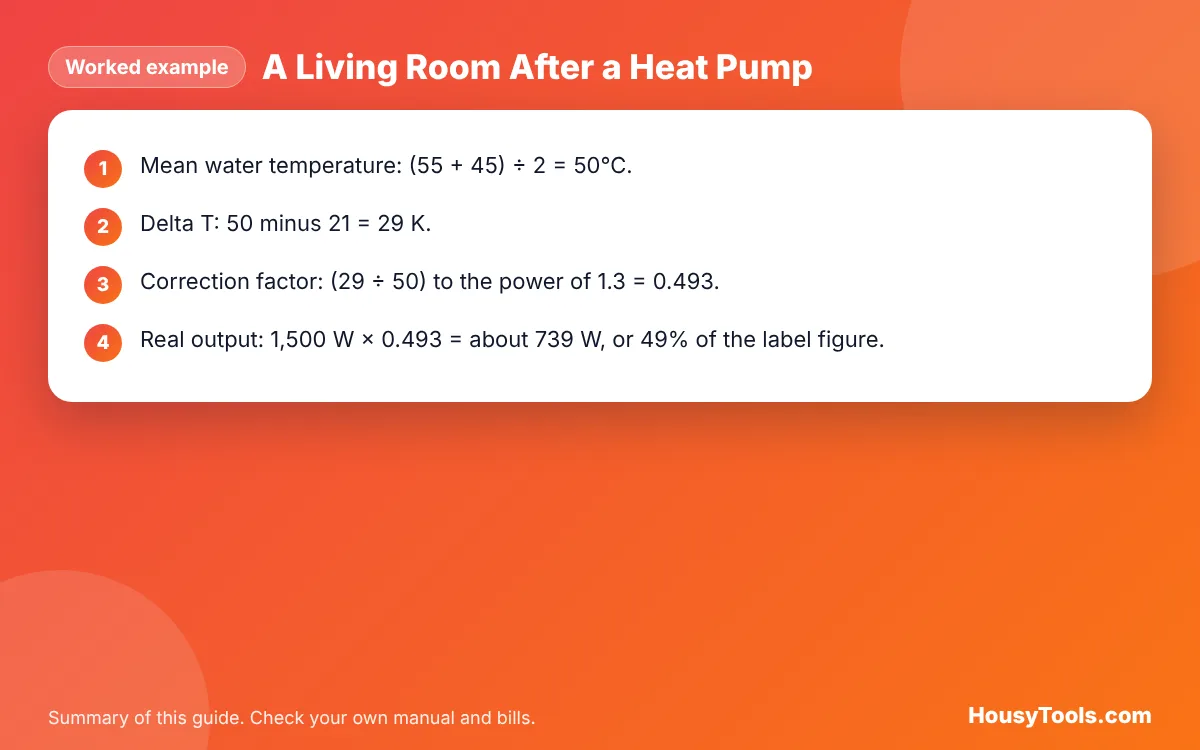
Worked Example: A Living Room After a Heat Pump
Example: a living room radiator is rated at 1,500 W at Delta T 50. The new heat pump runs at 55°C flow and 45°C return, and the room should be at 21°C.
- Mean water temperature: (55 + 45) ÷ 2 = 50°C.
- Delta T: 50 minus 21 = 29 K.
- Correction factor: (29 ÷ 50) to the power of 1.3 = 0.493.
- Real output: 1,500 W × 0.493 = about 739 W, or 49% of the label figure.
If the room needs 900 W on a cold day, the radiator is too small. To deliver 900 W at Delta T 29, you need a radiator rated at about 900 ÷ 0.493 = 1,830 W at Delta T 50. You can reproduce these numbers by entering 1,500 W, 55°C, 45°C, 21°C and n = 1.3 in the radiator output calculator, then adding 900 W as the heat the room needs. To find that heat need in the first place, use the radiator size calculator or read our guide on what size radiator you need.
Delta T FAQs
What does Delta T 50 mean on a radiator?
Delta T 50 means the radiator’s output was measured with the water on average 50°C hotter than the room, typically 70°C water in a 20°C room under the EN 442 test. If your system runs cooler, the radiator gives less heat than the quoted figure.
How do I convert Delta T 60 to Delta T 50?
Multiply the Delta T 60 output by about 0.79. For example, a radiator listed at 1,000 W at Delta T 60 gives about 790 W at Delta T 50. Going the other way, multiply a Delta T 50 figure by about 1.27.
Is a higher or lower Delta T better?
Neither is better on its own. A higher Delta T gets more heat from a small radiator, while a lower Delta T lets condensing boilers and heat pumps run more efficiently. The aim is radiators large enough to heat each room at the lowest water temperature that works.
What Delta T should I use for a heat pump?
Use the design flow and return temperatures from your installer. With water around 45°C to 50°C on average and a 20°C to 21°C room, Delta T is roughly 25 to 30, so radiators give about 40% to 50% of their Delta T 50 rating.
Does Delta T affect my heating bills?
Indirectly, yes. Radiators that are big enough to work at a lower water temperature let a condensing boiler return water below about 55°C, where it recovers more heat, and let a heat pump run more efficiently. Undersized radiators force higher temperatures.
Is Delta T measured in kelvin or degrees Celsius?
Both are used. Delta T is a temperature difference, and a difference of 1 K equals a difference of 1°C. Data sheets may write Delta T 50, ΔT50 or 50 K, and they all mean the same thing.
Want to see how all our heating tools fit together? Browse the heating calculators hub.
Checked October 2026. Sources: Zehnder: Correction factors and Delta T conversion, Stelrad: The importance of Delta T in calculating heating output, Purmo: What is delta t? (purmogroup.com), Energy Saving Trust: The most efficient way to run a heat pump, Viessmann: What temperature to set a condensing boiler, Wikipedia: Condensing boiler.