
Most interior walls need two coats of emulsion for an even, hard wearing finish, but the right number depends on the paint, the colour change and the surface underneath. This guide answers how many coats of paint does a wall need for each common job, using the coat and coverage figures that paint makers print on their own product data, and shows how each extra coat changes the amount of paint you buy.
Quick answer: Most walls need two coats of emulsion. One thick coat of a one coat paint can be enough when refreshing a similar colour. A strong colour change, such as dark to light, often needs a third coat. New plaster needs a thinned mist coat first, then the full coats stated on the tin.
How Many Coats of Paint Does a Wall Need in Most Rooms?
Two coats is the standard for a painted wall in good condition. Paint makers build their products around this: Dulux gives “2” as the number of coats for both Dulux Matt and its Easycare Washable and Tough Matt, and Tikkurila UK says it would always recommend a minimum of two coats.
The first coat gives the colour. The second evens out patches, roller marks and thin areas that are hard to avoid in a single pass. If the tin says two coats, the coverage, colour and durability the maker describes assume two coats.
When Is One Coat of Paint Enough?
One coat is only enough when you use a paint designed as a one coat product and apply it thickly over a sound, similar colour. Dulux says its Simply Refresh One Coat Matt needs one coat, but the conditions matter:
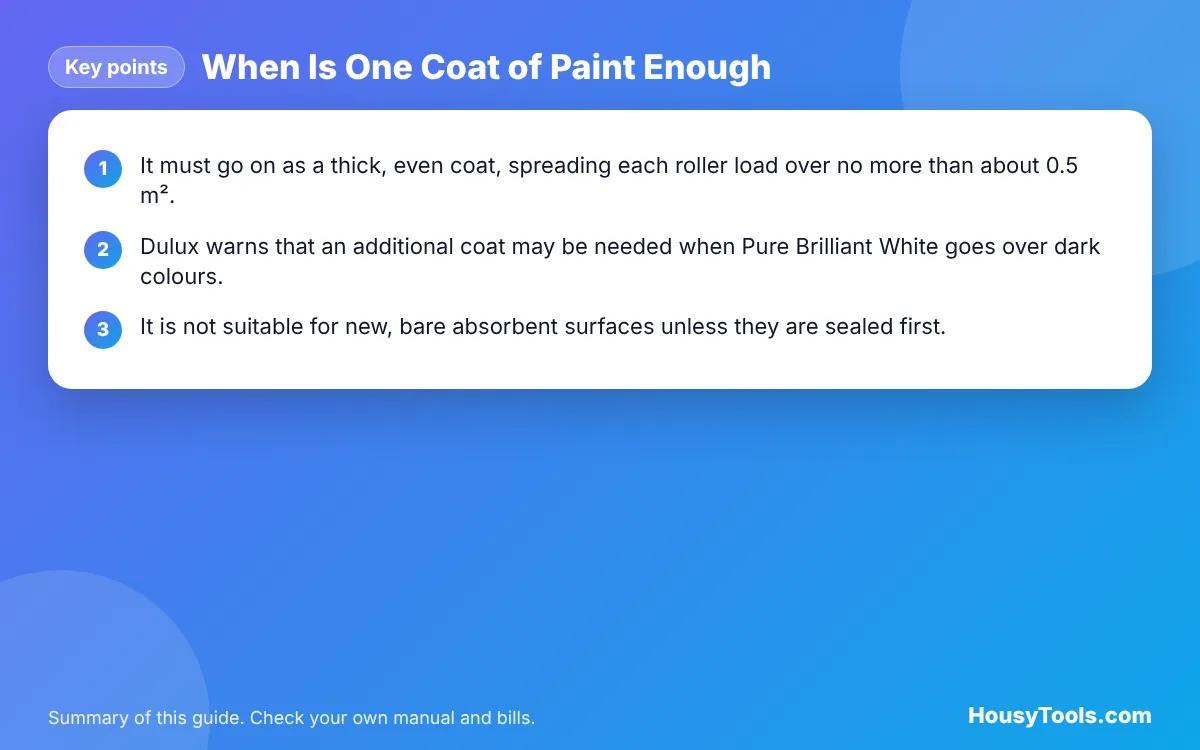
- It must go on as a thick, even coat, spreading each roller load over no more than about 0.5 m².
- Dulux warns that an additional coat may be needed when Pure Brilliant White goes over dark colours, and that strong colour changes may need a second coat.
- It is not suitable for new, bare absorbent surfaces unless they are sealed first.
A one coat paint also covers less area per litre. Dulux lists Simply Refresh at up to 10 m² per litre, against up to 14 m² per litre for Dulux Matt, because it is designed to go on thicker. So one coat of a one coat paint saves time, but not as much paint as you might expect.
How Many Coats Do You Need for a Big Colour Change?
Plan for three coats when going from a strong or dark colour to a light one, or the other way round. Dulux’s own product notes say that if the colour change is strong, more coats may be required, and that applies whether you are going from dark to light or from white to a deep shade.
The safest approach is to apply two coats, let them dry fully, then look at the wall in daylight from an angle. If you can still see the old colour, patchy areas or roller lines, add a third. Buying for three coats from the start avoids a second trip and keeps a mixed colour from the same batch.
How Many Coats Does New Plaster Need?
New plaster needs one thinned mist coat followed by the full coats your topcoat specifies, which for most matt emulsions means three applications in total. Dulux explains in its guide to painting new plaster that plaster takes up to 4 weeks to dry completely, and that emulsion applied to wet plaster is likely to crack and peel.
The mist coat is watered down emulsion that soaks into the porous plaster and seals it, so the next coats stick and dry evenly. Recommended ratios differ: the Dulux retail guide suggests about ten parts paint to one part water, while the Dulux Decorator Centre guide suggests three parts paint to one part water. Follow the instructions on the tin of the paint you are using, or use a dedicated sealer for plaster instead.
How Long Should You Leave Between Coats?
Leave 2 to 4 hours between coats for most water based matt emulsions, but always use the recoat time printed on your tin. Dulux gives 2 to 4 hours for Dulux Matt and 4 hours for Easycare Washable and Tough Matt. Cold, damp rooms slow drying, and Dulux advises against painting in very damp or humid conditions or in extreme temperatures. Keep a window open while you work and while the paint dries.
How Many Coats for Each Painting Job
| Job | Coats | Why |
|---|---|---|
| Refresh, similar colour, one coat paint | 1 thick coat | Dulux Simply Refresh is designed for one coat when applied thickly |
| Refresh or new colour, similar shade, standard emulsion | 2 | Dulux Matt and Easycare both specify 2 coats |
| Dark to light, or light to deep colour | 3, sometimes more | Dulux notes more coats may be needed for strong colour changes |
| New plaster | 1 mist coat plus the topcoats on the tin (usually 2) | Bare plaster is porous and must be sealed first |
| Bare filler patches on a painted wall | Seal the patches, then 2 full coats | Bare absorbent surfaces need sealing, as Dulux notes for its one coat paint |
| Washable or kitchen and bathroom paint | 2 | Dulux Easycare Washable and Tough Matt specifies 2 coats |
How Do Extra Coats Change the Paint You Need?
Each extra coat adds the full wall area again, so three coats need 50% more paint than two. The formula is wall area multiplied by coats, divided by the coverage in m² per litre on your tin. Our paint calculator lets you switch between 1, 2 and 3 coats and shows the litres and tins for each.
Worked example: a lounge, two coats or three?
Example: a 5 m by 4 m lounge with 2.4 m high walls, one door and one window is being repainted from dark navy to a pale grey. The matt emulsion states up to 14 m² per litre on the tin.
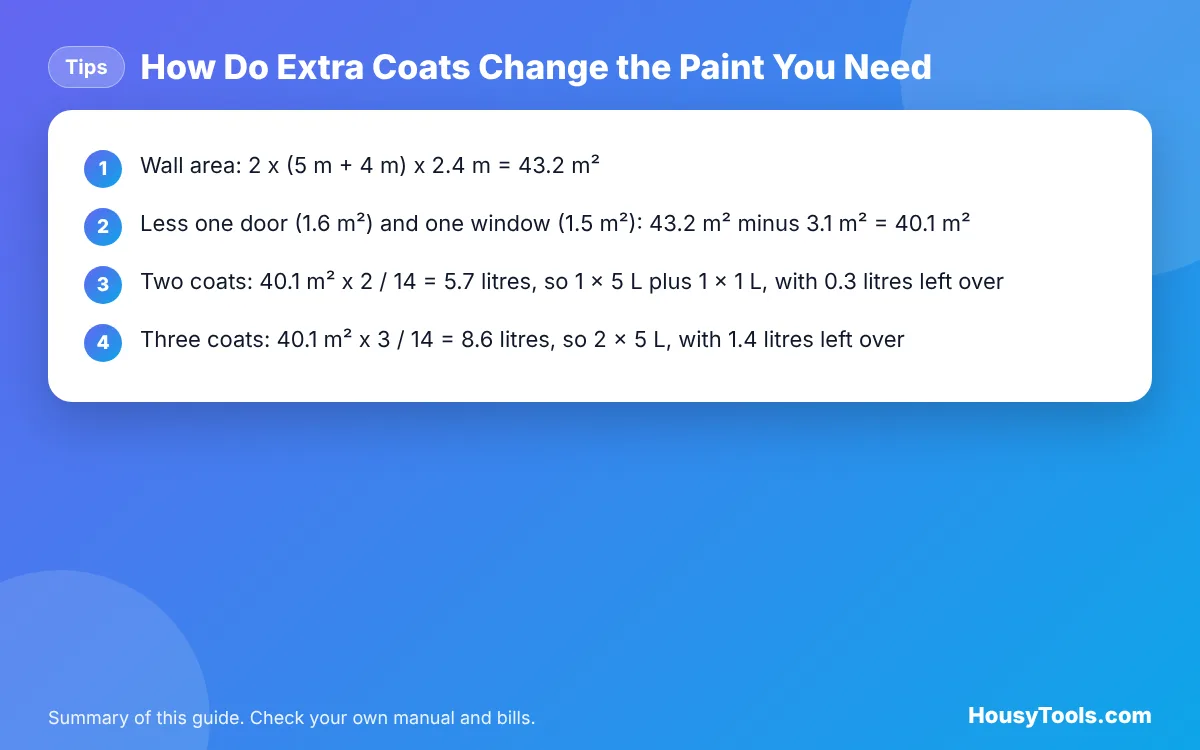
- Wall area: 2 x (5 m + 4 m) x 2.4 m = 43.2 m²
- Less one door (1.6 m²) and one window (1.5 m²): 43.2 m² minus 3.1 m² = 40.1 m²
- Two coats: 40.1 m² x 2 / 14 = 5.7 litres, so 1 x 5 L plus 1 x 1 L, with 0.3 litres left over
- Three coats: 40.1 m² x 3 / 14 = 8.6 litres, so 2 x 5 L, with 1.4 litres left over
Because navy to pale grey is a strong colour change, it makes sense to buy for three coats. Buying all 10 litres up front means every tin comes from the same batch, and the 1.4 litres left over is useful for touch ups. Enter the same room into the paint calculator with 14 m² per litre to check the figures, then price the job with the paint cost calculator. For a fuller walk through of measuring a room, see how much paint you need for a room.
Coverage figures are best case. Makers write “up to” because they measure on smooth, sealed surfaces, so rough or patched walls will use more. If your walls are uneven, enter a lower coverage figure in the calculator. Ceilings use different paint and access, so the ceiling paint calculator handles them separately.
Coats of Paint FAQs
Is two coats of paint always necessary?
Not always, but it is the standard. Most emulsions, including Dulux Matt, specify two coats. One coat only works with a paint designed for it, applied thickly over a sound, similar colour. Anything else usually shows patches or the old colour.
How do I know if I need a third coat of paint?
Let the second coat dry fully, then look at the wall in daylight from the side. If you can see the old colour, dull or shiny patches, or roller lines, apply a third coat. Strong colour changes are a common reason.
Can you put too many coats of paint on a wall?
Extra coats beyond what the wall needs waste paint and time without improving the finish. Apply even coats and leave the recoat time printed on the tin between each one.
Do I need a primer before painting a wall?
A wall already painted in sound emulsion does not usually need primer. Bare surfaces do: new plaster needs a mist coat or plaster sealer, and Dulux says its one coat paint is not suitable for bare absorbent surfaces unless they are sealed first.
How long after the first coat can I apply the second?
For most water based matt emulsions, 2 to 4 hours. Dulux gives 2 to 4 hours for Dulux Matt and 4 hours for its Easycare range. Always check the tin, and allow longer in a cold or humid room.
Does white paint need more coats than colours?
White over a similar pale colour usually covers in two coats. White over a dark colour often needs more: Dulux notes that Pure Brilliant White over dark colours may need an additional coat, even with its one coat paint.
Checked October 2026. Sources: Dulux Matt product data, Dulux Simply Refresh One Coat Matt product data, Dulux Easycare Washable and Tough Matt product data, Dr Dulux: How to paint new plaster, Dulux Decorator Centre: How to paint onto fresh plaster, Tikkurila UK: How many coats of paint should I use?.


