
Paint coverage per litre is the wall area, in square metres, that one litre of paint will cover in a single coat, and it is the number printed on every tin that lets you work out how much to buy. This guide explains what that figure really means, why you rarely get the full amount on the tin, and how to turn it into litres for your own room.
Quick answer: Paint coverage per litre is the area one litre covers in one coat, usually printed as “up to” a figure in m² per litre. Dulux lists up to 14 m² for its retail Vinyl Matt and up to 17 m² for trade Vinyl Matt. Litres needed equal wall area times coats, divided by that figure, then rounded up.

What Does Paint Coverage per Litre Mean?
A coverage of 12 m² per litre means one litre should cover 12 square metres of wall with one coat, under the conditions the manufacturer tested. Manufacturers also call this the spreading rate. It is always for one coat, so a two coat job uses twice as much paint as the tin figure suggests.
The key word on most tins is “up to”. The data sheet for Dulux Trade Vinyl Matt, for example, describes its figure as a guide to the practical coverage achievable under normal conditions, and the product page for Dulux Trade Weathershield Smooth Masonry Paint states that actual coverage will depend on the condition of the surface. In other words, the tin gives you a best case on a smooth, sound, sealed surface. Your real result can be lower.
How Do You Work Out Litres From Coverage per Litre?
The rule is simple: litres needed = area to paint in m² x number of coats / coverage in m² per litre. Dulux gives the same method in its own advice: measure height and width, take off windows and doors, then divide by the square metre per litre figure on the tin or product page.
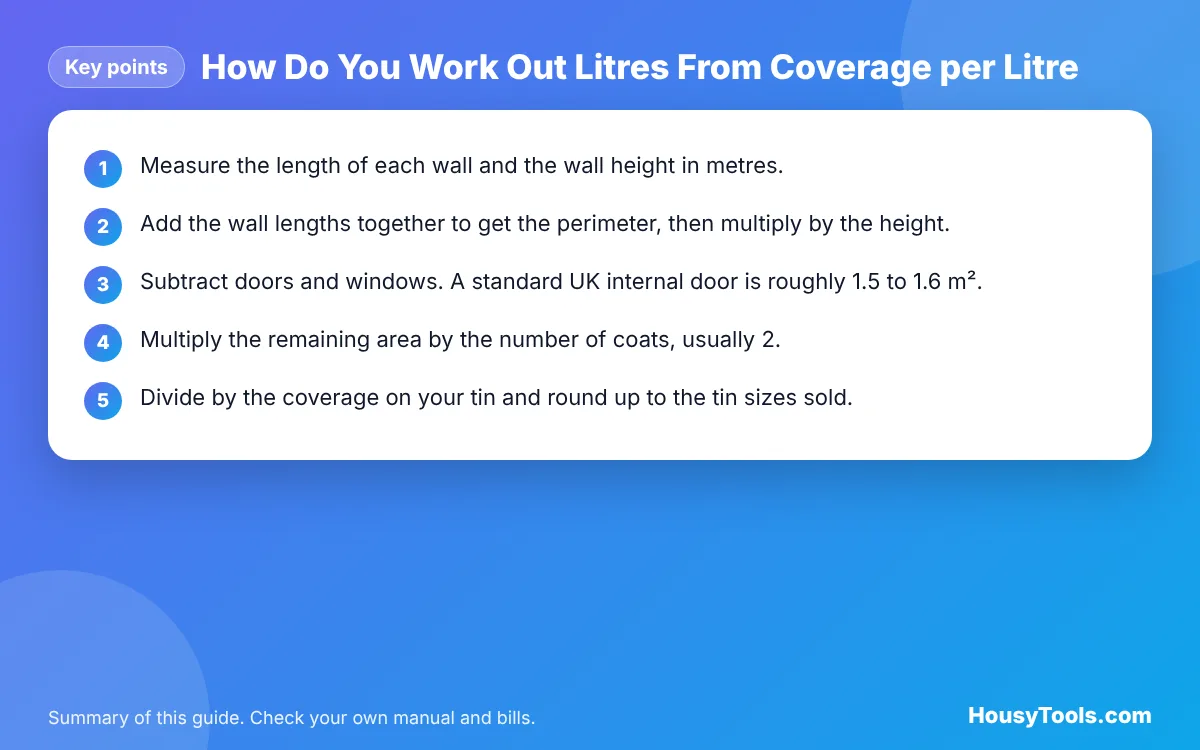
- Measure the length of each wall and the wall height in metres.
- Add the wall lengths together to get the perimeter, then multiply by the height.
- Subtract doors and windows. A standard UK internal door is roughly 1.5 to 1.6 m².
- Multiply the remaining area by the number of coats, usually 2.
- Divide by the coverage on your tin and round up to the tin sizes sold.
If you would rather not do the sums by hand, the HousyTools paint calculator runs exactly this formula, lets you type in the coverage from your own tin and suggests a mix of 5 litre, 2.5 litre and 1 litre tins.
Why Do You Get Less Paint Coverage per Litre Than the Tin Says?
Real coverage falls below the tin figure whenever the surface absorbs or traps more paint, or when you need extra coats to hide the old colour. Manufacturers note these limits on their own pages: Dulux states that a strong colour change may need more coats, and that the surface condition affects actual coverage.
- Porous surfaces. New plaster and bare masonry soak up the first coat, which is why manufacturers recommend a thinned sealing coat first.
- Texture. Rough render, pebbledash and woodchip have far more surface area than a flat wall of the same size.
- Colour change. Going from a dark colour to a light one, or the reverse, can need a third coat.
- Application. Laying paint on thickly, or losing it in the roller tray and on the sheet, reduces the area each litre covers.
- Conditions. Manufacturers state that drying and recoat times depend on temperature and humidity, so follow the times on the tin before adding the next coat.
A practical way to plan is to run your sum twice: once at the tin figure, and once at a lower figure such as 10 m² per litre. The first tells you the minimum, the second tells you how much you may need on a difficult wall.
How Much Does Coverage per Litre Change Between Paint Types?
Coverage can vary by a factor of two between products: in the Dulux Trade range, smooth masonry paint lists up to 16 m² per litre while textured masonry paint lists up to 8 m² per litre. The table below shows the figures printed by one manufacturer for common products. Other brands will differ, so always check your own tin.
| Product (Dulux, checked October 2026) | Stated coverage, one coat | Coats suggested by the maker |
|---|---|---|
| Dulux Vinyl Matt (retail, Dulux Ireland site) | Up to 14 m² per litre | 2 |
| Dulux Trade Vinyl Matt | Up to 17 m² per litre | 2, or 1 over a similar colour in good condition |
| Dulux Trade Supermatt | Up to 18 m² per litre | Thinned mist coat on new plaster, then 2 coats |
| Dulux Trade High Gloss | Up to 18 m² per litre | 1 coat of undercoat, then 1 or 2 coats of gloss |
| Dulux Trade Weathershield Smooth Masonry | Up to 16 m² per litre | Thinned first coat on new or bare surfaces |
| Dulux Trade Weathershield Textured Masonry | Up to 8 m² per litre | 2, or 1 over a similar colour in good condition |
Two points stand out. In this range the trade emulsion lists a higher figure than the retail one, and the textured masonry finish covers about half the area of the smooth one. For outside walls, the masonry paint calculator lets you allow for the lower coverage of rough surfaces.
How Many Coats Should You Allow For?
Allow for 2 coats as the normal rule, because that is the finishing process most wall paint manufacturers describe. Dulux says 1 coat may be enough for some trade emulsions on previously painted surfaces in good condition where a similar colour is used, and more coats may be needed for a strong colour change.
New plaster is a special case. For Dulux Trade Supermatt, the maker recommends a first coat thinned with up to 1 part clean water to 3 parts paint, followed by two finishing coats. The mist coat uses less paint per square metre because it is diluted, but it is still an extra coat to plan for. On woodwork, the undercoat is usually a separate product, so price it separately from the gloss.
What Is Paint Coverage per Litre in Square Feet?
One square metre per litre equals about 10.76 square feet per litre, so a tin that covers 12 m² per litre covers roughly 129 square feet per litre. If you measured your room in feet, either convert the area to square metres (divide square feet by 10.764) or use the imperial setting on the paint calculator, which converts for you.
Worked Example: One Room at Three Coverage Rates
Example: the walls of a bedroom that measures 4 m by 3.5 m are being painted, with walls 2.4 m high, one door of 1.6 m² and one window of 1.5 m². The plan is two coats.
- Perimeter: 4 + 3.5 + 4 + 3.5 = 15 m
- Wall area: 15 m x 2.4 m = 36 m²
- Less door and window: 36 minus 3.1 = 32.9 m²
- Area x coats: 32.9 x 2 = 65.8 m²
Now see how much the coverage figure matters:
- At 17 m² per litre: 65.8 / 17 = 3.9 litres, so one 5 litre tin.
- At 12 m² per litre: 65.8 / 12 = 5.5 litres, so a 5 litre and a 1 litre tin.
- At 10 m² per litre: 65.8 / 10 = 6.6 litres, so a 5 litre and a 2.5 litre tin.
The same room needs anywhere from 3.9 to 6.6 litres depending on the paint and the wall. You can reproduce all three results in the paint calculator by changing only the coverage box. To see what each option costs, put the litres into the paint cost calculator.

Paint Coverage per Litre FAQs
How many square metres does 1 litre of paint cover?
It depends on the product. Dulux lists up to 14 m² per litre for its retail Vinyl Matt emulsion and up to 17 m² per litre for its trade Vinyl Matt. These are one coat figures on smooth, sound surfaces, so real coverage is often lower.
How much wall will 5 litres of paint cover?
Multiply 5 by the coverage on the tin, then divide by the number of coats. At 12 m² per litre, 5 litres covers 60 m² in one coat or 30 m² with two coats. Dulux suggests about 5 litres for the walls of a 4 m by 4 m room.
Is the coverage on the tin for one coat or two?
The figure on the tin is for one coat. If you plan to apply two coats, multiply your wall area by two before dividing by the coverage figure, or you will buy only half the paint you need.
Why does new plaster use more paint?
Bare plaster is porous and absorbs the first coat. Manufacturers such as Dulux recommend a thinned mist coat to seal it, for example up to 1 part water to 3 parts paint for Dulux Trade Supermatt, before the normal two finishing coats.
Does textured masonry paint cover less than smooth?
Yes, usually much less. Dulux Trade lists up to 8 m² per litre for Weathershield Textured Masonry Paint against up to 16 m² per litre for the smooth version, so a textured finish can need about twice as much paint for the same wall.
Should I buy extra paint for touch ups?
Rounding up to the next tin size normally leaves a little spare for touch ups. In the worked example above, a 12 m² per litre paint leaves about 0.5 litres over. Keep the leftover tin sealed and labelled with the room and colour for later repairs.
Checked October 2026. Sources: Dulux: How much paint do I need?, Dulux Trade Vinyl Matt, Dulux Trade Supermatt, Dulux Trade High Gloss, Dulux Trade Weathershield Smooth Masonry Paint, Dulux Trade Weathershield Textured Masonry Paint, Dulux Vinyl Matt.


