
To work out how much paint you need for a room, multiply the distance around the room by the wall height, take off the doors and windows, multiply by the number of coats and divide by the coverage printed on the tin. This guide walks through each step with UK tin sizes, real manufacturer coverage figures and a worked example you can check in our calculator.
Quick answer: Litres needed equals wall area, less doors and windows, times coats, divided by the coverage on the tin. Most emulsions cover 10 to 17 m² per litre. A 4 m by 3.5 m bedroom with 2.4 m walls, one door and one window needs about 5.5 litres for two coats at 12 m² per litre.

How Do You Measure a Room for Paint?
The wall area of a rectangular room is its perimeter multiplied by its wall height: 2 x (length + width) x height. Measure the length and width at floor level, and the height from the top of the skirting board to the ceiling. Round each figure up to the nearest 10 cm so small errors work in your favour.
The most common mistake is using the floor area. A 4 m by 3.5 m bedroom has a 14 m² floor, but at 2.4 m high its four walls add up to 36 m², more than two and a half times as much. For an L shaped room, a chimney breast or an alcove, measure each wall separately as width x height and add them together, which is also the method Dulux recommends in its paint quantity guide.
How Much Does a Litre of Paint Cover?
One litre of interior emulsion typically covers between 10 and 17 m² per coat, depending on the product, so always use the figure printed on your tin. Manufacturers state very different rates, and the label wording “up to” means the best result on a smooth, sealed wall.
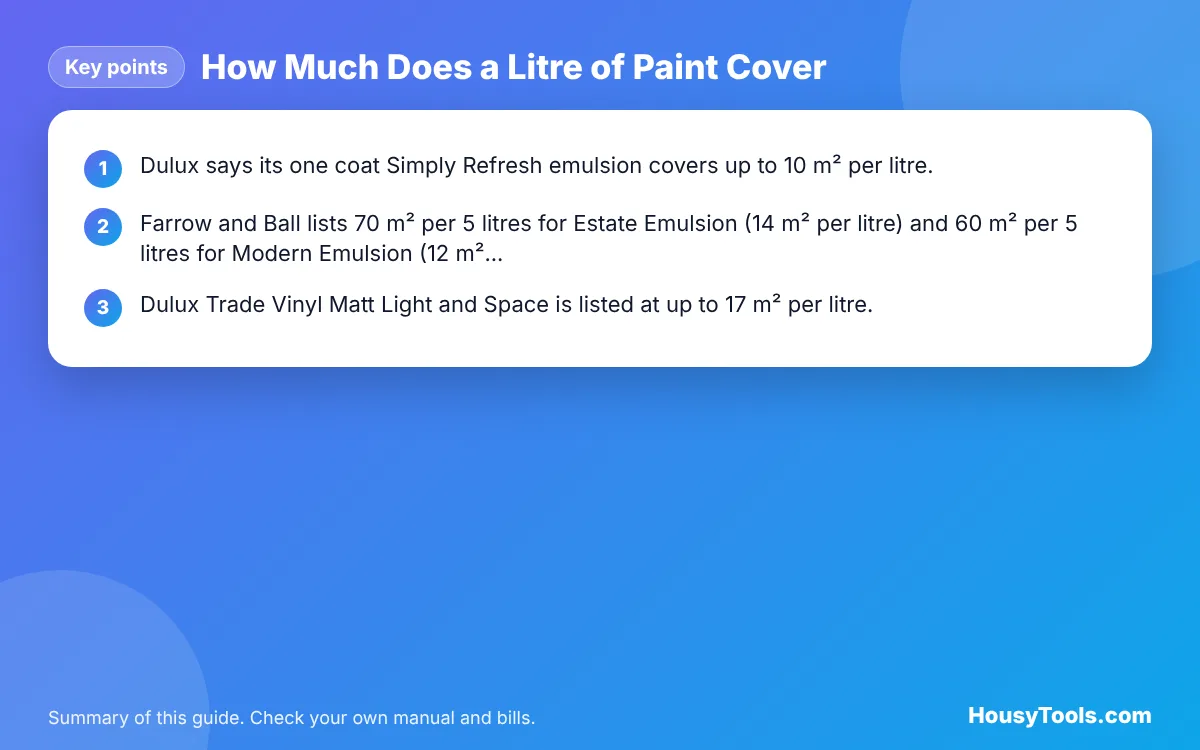
- Dulux says its one coat Simply Refresh emulsion covers up to 10 m² per litre, because it is a thick paint designed to hide in a single coat.
- Farrow and Ball lists 70 m² per 5 litres for Estate Emulsion (14 m² per litre) and 60 m² per 5 litres for Modern Emulsion (12 m² per litre), per coat.
- Dulux Trade Vinyl Matt Light and Space is listed at up to 17 m² per litre.
Real walls with filler, texture or old patchy paint usually get less than the maximum. If you do not know your paint yet, 12 m² per litre is a reasonable middle figure for planning, and 10 m² per litre gives a cautious estimate for rough or porous walls.
How Many Coats Should You Plan For?
Plan for two coats on most rooms: Farrow and Ball recommends two coats for most of its finishes, and Dulux tells buyers of its EasyCare range to double their area for two coats. One coat can be enough when you use a paint sold as one coat over a similar colour in good condition, as Dulux says of Simply Refresh.
Allow a third coat in two situations:
- A big colour change, such as a deep green over white or a pale shade over a dark wall. Farrow and Ball notes that dramatic colour changes can need extra coats.
- New or bare plaster. Fresh plaster soaks up paint, so it needs a thinned first coat, often called a mist coat. The Dulux Trade Vinyl Matt Light and Space product sheet, for example, asks for 1 part water to 5 parts paint as the first coat on new surfaces, followed by 2 full coats. Ratios differ between products, so follow the instructions on your tin.
Should You Subtract Doors, Windows and Radiators?
Subtract each door and window, but not radiators or furniture, because you normally paint behind them. Measure each opening as width x height: a door of 0.76 m by 1.98 m, for example, removes about 1.5 m² of wall, and a window of 1.2 m by 1.25 m removes 1.5 m².
In a small room, one door and one window take about 3 m² off the total, which saves around half a litre over two coats. Patio doors, a bay window or a wall of fitted wardrobes make a bigger difference, so measure their width and height rather than guessing.
How Many Tins of Paint Should You Buy?
Round your litres up to the nearest mix of 5 litre, 2.5 litre and 1 litre tins, and aim to finish with a small amount left over for touch ups. A 5 litre tin of paint at 12 m² per litre gives two coats on about 30 m² of wall, which suits a small double bedroom.
The table shows how much wall area each common tin covers with two coats at three different coverage rates. Find your coverage figure, then read across to the wall area you measured.
| Tin size | Two coats at 10 m²/L | Two coats at 12 m²/L | Two coats at 14 m²/L |
|---|---|---|---|
| 1 litre | 5 m² of wall | 6 m² of wall | 7 m² of wall |
| 2.5 litres | 12.5 m² of wall | 15 m² of wall | 17.5 m² of wall |
| 5 litres | 25 m² of wall | 30 m² of wall | 35 m² of wall |
| 7.5 litres | 37.5 m² of wall | 45 m² of wall | 52.5 m² of wall |
| 10 litres | 50 m² of wall | 60 m² of wall | 70 m² of wall |
If you are buying a mixed colour, buy every tin at the same time and stir them together in a large bucket before you start, so the shade stays consistent from wall to wall. To price the job before you shop, enter your area into the paint cost calculator with your local tin prices.
Do Ceilings and Woodwork Need Separate Paint?
Yes, in most rooms the ceiling and woodwork use different paints, so work them out separately: the ceiling area is simply length x width. A 4 m by 3.5 m ceiling is 14 m², which at 12 m² per litre needs about 2.3 litres for two coats. Our ceiling paint calculator handles this, including a mist coat option for new plaster.
Doors and skirting need much less. Dulux suggests a 750 ml tin for woodwork such as a door or skirting boards, and roughly 1 litre for a single feature wall. Dulux Trade also warns that surfaces painted before the 1960s may contain lead, so check old paint before you sand or strip it.
Worked Example: A Living Room
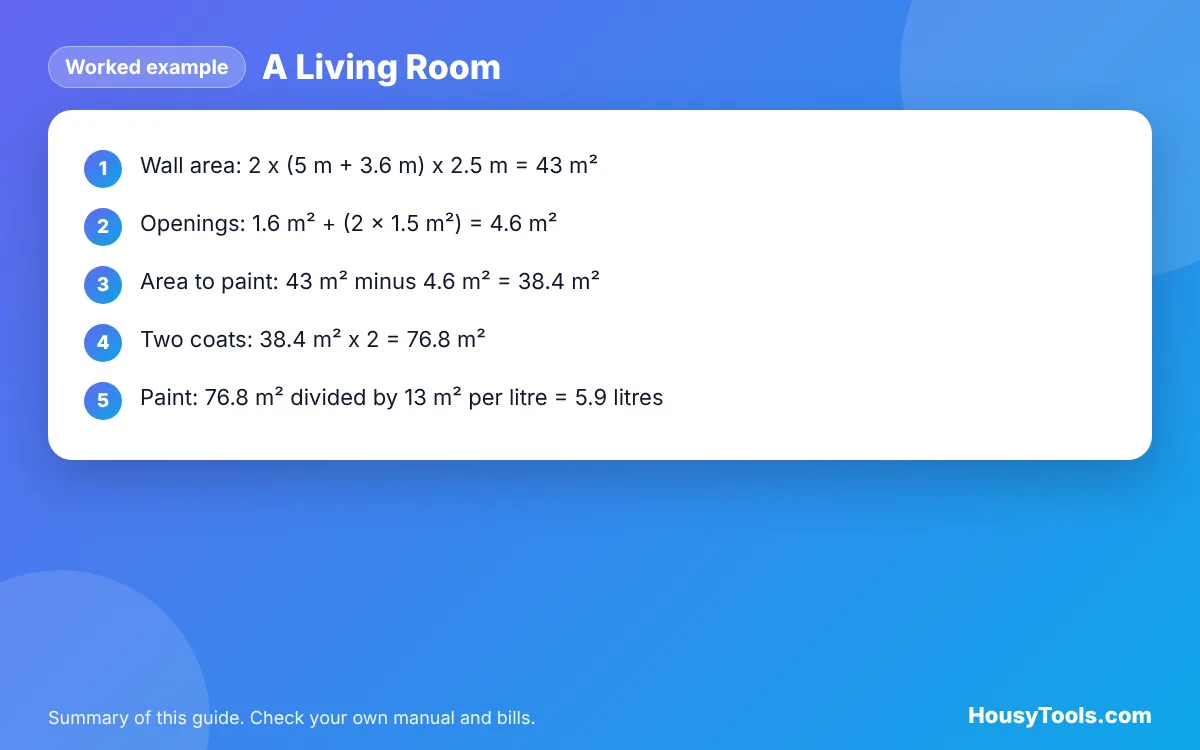
Example: a living room is being repainted. It is 5 m long and 3.6 m wide, with walls 2.5 m high from skirting to ceiling. There is one internal door of 1.6 m² and two windows of 1.5 m² each. The chosen matt emulsion says 13 m² per litre on the tin, and the plan is two coats.
- Wall area: 2 x (5 m + 3.6 m) x 2.5 m = 43 m²
- Openings: 1.6 m² + (2 x 1.5 m²) = 4.6 m²
- Area to paint: 43 m² minus 4.6 m² = 38.4 m²
- Two coats: 38.4 m² x 2 = 76.8 m²
- Paint: 76.8 m² divided by 13 m² per litre = 5.9 litres
- Tins: 1 x 5 L + 1 x 1 L, leaving about 0.1 litres spare
That leaves almost nothing for touch ups, so a 2.5 litre tin might be a better choice than the 1 litre. Two changes show why your inputs matter. If the job were covering a dark wall and needed three coats, the same room would need 8.9 litres, or 2 x 5 L. If the paint covered only 10 m² per litre, two coats would need 7.7 litres, or 1 x 5 L, 1 x 2.5 L and 1 x 1 L. You can reproduce all three results in the HousyTools paint calculator by entering the same figures, and see how long the job will take with the painting time calculator.
How Much Paint Do I Need for a Room? FAQs
How much paint do I need for a 3 x 3 metre room?
A 3 m by 3 m room with 2.4 m walls, one door and one window has about 25.7 m² of wall to paint. At 12 m² per litre, two coats need about 4.3 litres, so one 5 litre tin is enough for the walls.
Is 5 litres of paint enough for a bedroom?
Five litres at 12 m² per litre gives two coats on about 30 m² of wall. That covers a small double bedroom. A 4 m by 3.5 m room with 2.4 m walls needs about 5.5 litres, so add a 1 litre tin.
How many square metres does 1 litre of paint cover?
Most interior emulsions cover 10 to 17 m² per litre for one coat. Farrow and Ball lists 12 to 14 m² per litre for its emulsions, while some trade matts claim up to 17 m². Use the figure on your own tin.
Do I need two coats of paint?
Usually yes. Two coats give an even colour with standard emulsions. A paint sold as one coat over a similar colour can need only one, while a big colour change or new plaster can need three, including a thinned mist coat.
Should I buy extra paint?
Rounding up to whole tins normally leaves enough spare for touch ups. If your total lands just under a tin size, buy the next tin up. For mixed colours, buy everything at once so all tins match.
Does the ceiling count when working out paint for a room?
Only if you use the same paint on it. The ceiling area is length times width, so a 4 m by 3.5 m room adds 14 m². Most people use a separate ceiling white, so calculate it on its own.
For more decorating tools, including wallpaper and masonry paint, see our paint and decorating calculators, and read how our calculators work.
Checked October 2026. Sources: Dulux: How much paint do you need, Dulux: How to paint a wall with just one coat, Dulux Trade Vinyl Matt Light and Space product information, Farrow and Ball: Calculating paint quantities.


