Knowing when to call a Gas Safe engineer is simple in principle: you need one for any installation, repair, service or safety check on a gas boiler, fire, cooker, hob, flue or gas pipework in your home. The one exception to calling an engineer first is a suspected gas leak, when you call the gas emergency number straight away.
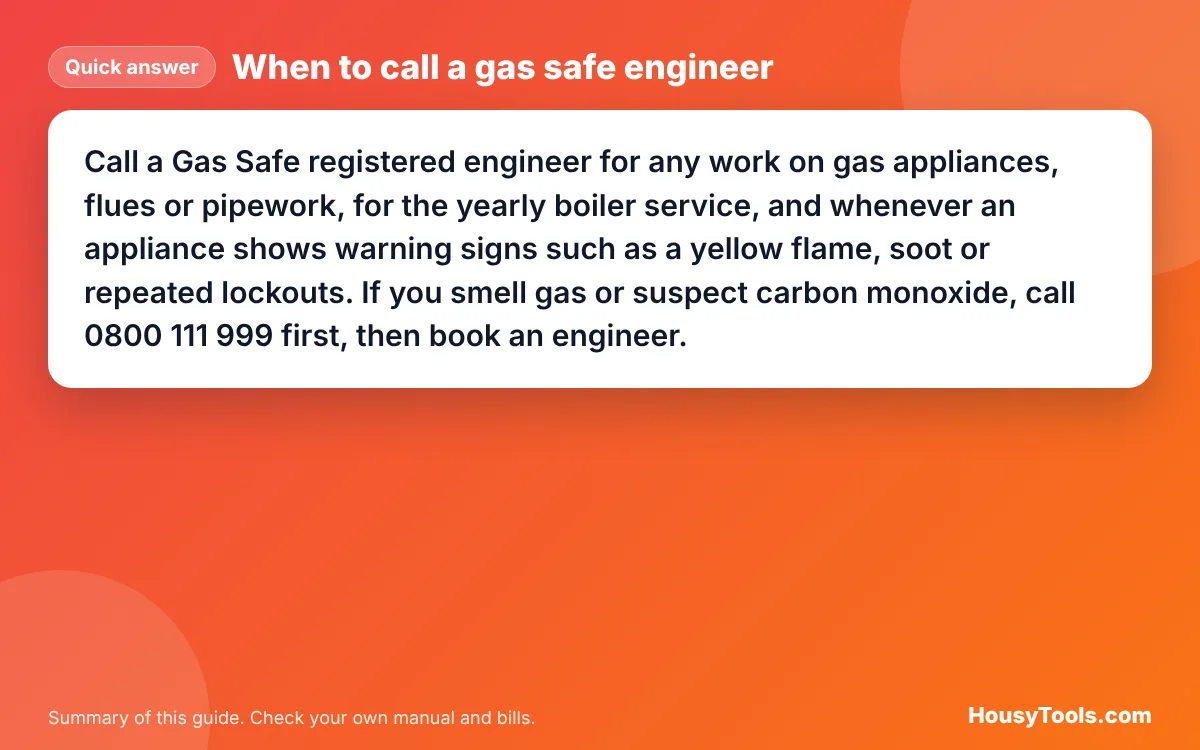
Quick answer: Call a Gas Safe registered engineer for any work on gas appliances, flues or pipework, for the yearly boiler service, and whenever an appliance shows warning signs such as a yellow flame, soot or repeated lockouts. If you smell gas or suspect carbon monoxide, call 0800 111 999 first, then book an engineer.
Who Has to Be Gas Safe Registered?
The rule is clear: according to the Health and Safety Executive, anyone employed to work on gas appliances in domestic premises must be a Gas Safe registered engineer. HSE also strongly advises that all gas appliances, flues and pipework are installed, maintained and serviced by a Gas Safe registered engineer.
Gas Safe Register replaced CORGI as the official register in Great Britain and the Isle of Man on 1 April 2009, and in Northern Ireland and Guernsey on 1 April 2010. If someone tells you they are “CORGI registered”, that scheme no longer covers gas work, so ask for a Gas Safe ID card instead.
What Should You Do If You Smell Gas?
If you smell gas, call the National Gas Emergency number on 0800 111 999 before you call any engineer. HSE advises these steps:
- Call 0800 111 999 (Great Britain).
- Open doors and windows.
- Turn off the gas supply at the meter, if you can reach it safely.
- Do not use gas appliances.

The emergency service makes the supply safe; it does not repair your boiler or appliance. Northern Gas Networks, for example, tells customers that for a boiler problem they must contact their gas supplier or a Gas Safe registered engineer, because its emergency engineers are not there to carry out that work. So after a leak has been made safe, you will still need a registered engineer to find and fix the fault.
Safety: HSE says it is illegal to use a gas appliance you suspect is unsafe. Turn it off and do not touch it until a Gas Safe registered engineer has checked it. If anyone has severe symptoms such as collapse or difficulty breathing, call 999.
What Are the Warning Signs a Gas Appliance Needs an Engineer?
Any one of these signs means turning the appliance off and calling a Gas Safe registered engineer. The Gas Safe Register lists these as warning signs of an unsafe appliance and carbon monoxide risk:
- a floppy yellow or orange flame on a gas hob or oven, rather than a crisp blue one;
- dark, sooty staining on or around a gas appliance;
- a pilot light that keeps blowing out;
- more condensation than usual on windows;
- headaches, dizziness, nausea, breathlessness, collapse or loss of consciousness, especially if symptoms ease when you leave home or several people have them at once.
Carbon monoxide has no colour, taste or smell. If you suspect it, turn off the appliance, open doors and windows, leave the property and call 0800 111 999; for medical advice, contact NHS 111. HSE recommends a carbon monoxide alarm that complies with EN 50291, but an alarm is a backstop, not a replacement for servicing.
Which Boiler Problems Need a Gas Safe Engineer?
Almost every boiler problem beyond pressure, resetting and a frozen condensate pipe needs a Gas Safe registered engineer. The Gas Safe Register’s home boiler guide lists intermittent heating, kettling noises, water leaks, pressure loss, unexpected shutdowns and pilot light failures as reasons to get professional help.
What you can usually do yourself
- Check the pressure gauge and top up through the filling loop, as our guide on how to repressurise a combi boiler explains.
- Reset the boiler once, using the method in your manual.
- Thaw a frozen condensate pipe at ground level with warm, not boiling, water.
- Check the power switch, thermostat, timer and that your gas meter has credit.
What needs a Gas Safe engineer
- Anything behind the boiler casing, including the gas valve, burner, fan, pump and electronics.
- Any work on the flue or gas pipework.
- A fault code that returns after one reset, such as the flame faults covered in our Worcester Bosch EA error code guide.
- Pressure that keeps dropping, which Ideal says is worth investigating if you top up more than once or twice a year.
- Fitting, moving or replacing a boiler, gas fire, gas hob or gas cooker.
HSE notes one narrow exception: temporarily moving a free standing cooker with a bayonet fitting to clean behind it is not treated as gas work, but installing or reconnecting a cooker is.
How Often Should You Book a Gas Safe Engineer?
Book a service at least once a year. HSE strongly advises that gas appliances, flues and pipework are serviced at least annually by a Gas Safe registered engineer, and the Gas Safe Register suggests booking before winter, when breakdowns are most disruptive. Your manufacturer’s warranty may also require an annual service, so check its terms.
Landlords have a legal duty. Under HSE guidance, landlords must arrange an annual gas safety check by a Gas Safe registered engineer, keep the record for 2 years and give a copy to existing tenants within 28 days of the check. Tenants should receive the landlord’s gas safety record when they move in.
How Do You Check an Engineer Is Gas Safe Registered?
Ask to see the Gas Safe ID card and check both sides before any work starts. The Gas Safe Register says the card shows:
- On the front: the engineer’s photo, the business they work for, the start and expiry dates, the licence number and a security hologram.
- On the back: the types of gas work the engineer is qualified to do, split into domestic and non domestic, with expiry dates.
Make sure the photo matches, the licence is in date and the back lists the right category for your job, for example boilers or cookers. You can confirm the licence number through the Gas Safe Register’s online check or by calling 0800 408 5500. If an engineer cannot show a valid card, the register’s advice is not to let them do the work.
Who to Call and How Fast
| Situation | Who to call | How urgent |
|---|---|---|
| Smell of gas | 0800 111 999, then a Gas Safe engineer | Immediately |
| Carbon monoxide symptoms or alarm sounding | 0800 111 999; 999 for severe symptoms; NHS 111 for advice | Immediately |
| Yellow flame, soot or a pilot light that keeps going out | Gas Safe engineer; stop using the appliance | Same day if possible |
| Boiler locks out again after one reset | Gas Safe engineer | Soon; within a day or two |
| Water leaking from boiler or pipework | Gas Safe engineer | Soon |
| Pressure drops more than once or twice a year | Gas Safe engineer | Book a visit |
| Low pressure, first time | You: top up with the filling loop | When convenient |
| Frozen condensate pipe | You: thaw with warm water and reset | When convenient |
| Annual service or landlord check | Gas Safe engineer | Every 12 months |
| New boiler, fire or hob | Gas Safe engineer qualified for that appliance | Planned |
Worked Example: Replacing a Boiler
Example: a 15 year old combi keeps locking out and the Gas Safe engineer advises replacement. HSE says you should follow a registered engineer’s advice, and if you have doubts, follow it in the meantime and seek further advice. Before getting quotes, the homeowner uses our boiler size calculator: 10 radiators, 1 bathroom and 1 shower at a time.
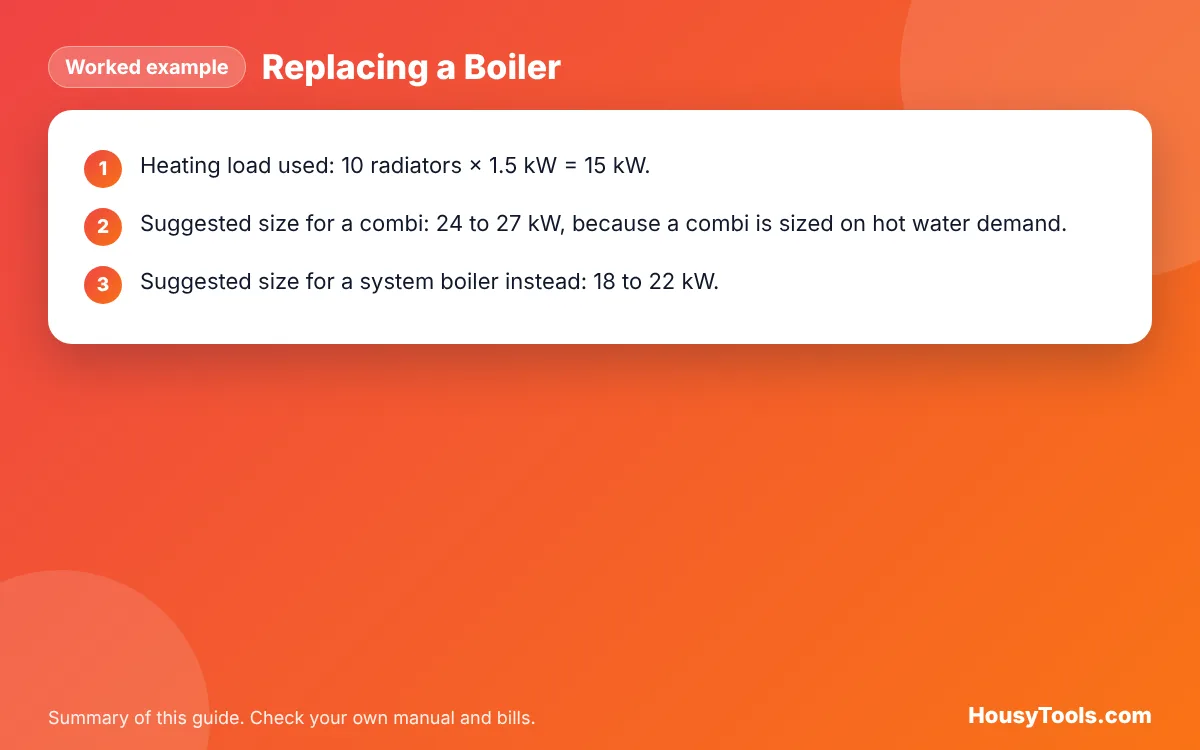
- Heating load used: 10 radiators × 1.5 kW = 15 kW.
- Suggested size for a combi: 24 to 27 kW, because a combi is sized on hot water demand.
- Suggested size for a system boiler instead: 18 to 22 kW.
When each installer arrives, the homeowner checks the Gas Safe ID card, confirms the back lists the right category for boiler work, and asks whether they will do a heat loss calculation to confirm the size. The calculator gives a guide range only; the registered engineer confirms the final size.
When to Call a Gas Safe Engineer FAQs
Do I need a Gas Safe engineer to service my boiler?
Yes. A gas boiler service involves opening the casing and checking the burner, flue and gas connections, which must be done by a Gas Safe registered engineer. HSE strongly advises a service at least once a year.
Should I call a Gas Safe engineer or the gas emergency number first?
If you smell gas or suspect carbon monoxide, call the National Gas Emergency number on 0800 111 999 first. The emergency service makes the supply safe. You then need a Gas Safe registered engineer to repair the appliance or pipework.
Can I fit a gas hob or cooker myself?
No. Installing or reconnecting a gas hob or cooker is gas work and needs a Gas Safe registered engineer qualified for cookers. HSE only excludes briefly moving a free standing cooker with a bayonet fitting to clean behind it.
How do I know if an engineer is really Gas Safe registered?
Ask for the Gas Safe ID card, check the photo, licence number and expiry date, and read the back for the right work category. Then confirm the licence on the Gas Safe Register website or by calling 0800 408 5500.
Can I top up boiler pressure without an engineer?
Yes, on most combi boilers topping up through the filling loop is a user task described in the manual. Call a Gas Safe engineer if the pressure keeps dropping, you see a leak, or you have an external filling loop you are not confident using.
What does a landlord have to do about gas safety?
Landlords must arrange an annual gas safety check by a Gas Safe registered engineer, keep the record for 2 years and give tenants a copy within 28 days. They must also keep appliances, flues and pipework maintained.
For tools on boiler sizing and heating costs, visit our heating calculators hub.
Checked October 2026. Sources: HSE: Domestic gas safety FAQs, Gas Safe Register: Carbon monoxide poisoning, Gas Safe Register: The Gas Safe ID card, Gas Safe Register: The home boiler guide, Gas Safe Register: Renting a property, Wikipedia: Gas Safe Register, Ideal Heating: Topping up boiler pressure.