
In the combi vs system vs heat pump choice, a combi boiler heats water on demand with no cylinder, a system boiler stores hot water in a cylinder for busier homes with more bathrooms, and an air source heat pump is a low carbon electric option that also needs a cylinder and works best in a well insulated home. The right one depends on your hot water demand, space, insulation and budget.
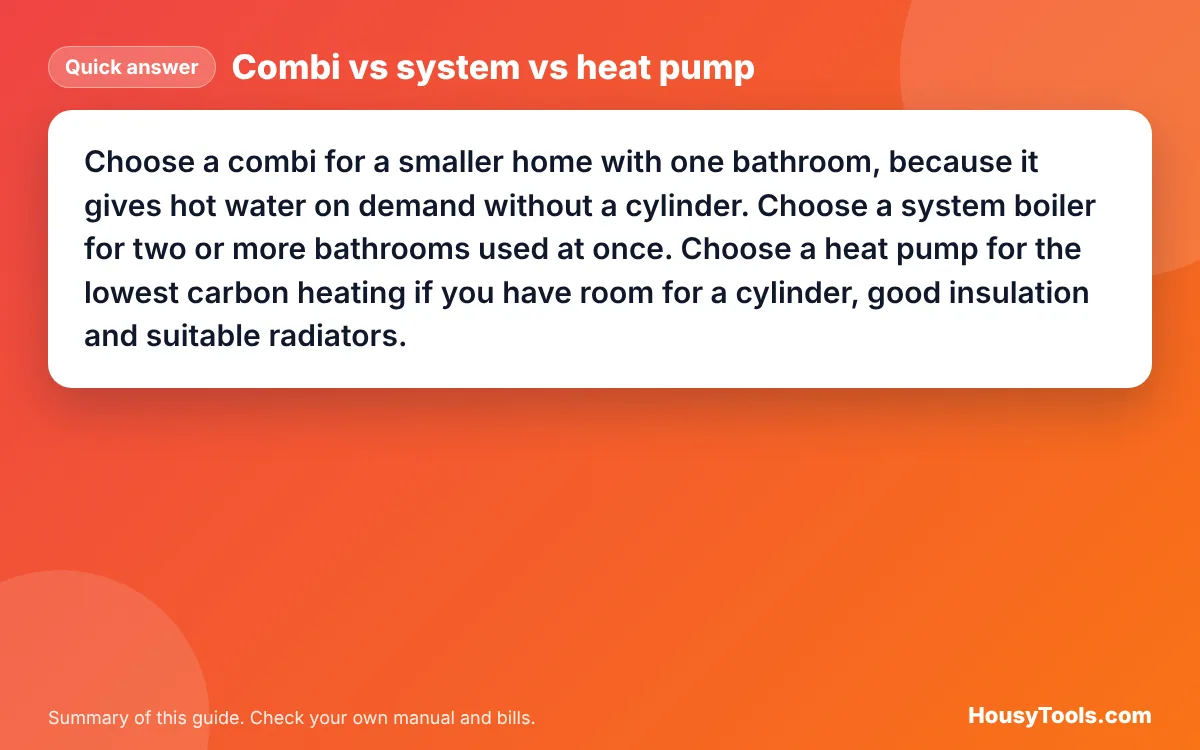
Quick answer: Choose a combi for a smaller home with one bathroom, because it gives hot water on demand without a cylinder. Choose a system boiler for two or more bathrooms used at once. Choose a heat pump for the lowest carbon heating if you have room for a cylinder, good insulation and suitable radiators.
How Does Each System Work?
All three heat radiators with hot water, but only a combi makes hot tap water instantly without a storage cylinder.
Combi boiler
A combi boiler combines central heating and hot water in one unit. When you open a hot tap, it stops sending heat to the radiators and puts all its power into heating the water. Domestic combis are typically rated at 24 kW to 54 kW, giving approximate hot water flow rates of 9 to 23 litres a minute. Viessmann notes that because a combi supplies hot water at mains pressure, you can usually run a shower without a separate pump.
System boiler
A system boiler heats both the radiators and a hot water cylinder, usually in an airing cupboard. Viessmann describes system boilers as ideal for homes with more than one bathroom or that need more hot water than a combi can provide, because several taps and showers can draw from the stored water at once.
Air source heat pump
An air source heat pump takes heat from the outside air and uses a refrigerant and compressor to raise it to a temperature that can heat your radiators and hot water. The Energy Saving Trust says heat pumps are more than three times more efficient than a gas or oil boiler. Most need a hot water cylinder, which the Energy Saving Trust says needs a space of about 80 cm by 80 cm, plus an outdoor unit on a wall or the ground.
Which Is Best for Your Number of Bathrooms?
As a rule of thumb, one bathroom suits a combi, while two or more bathrooms used at the same time suit a system boiler or a heat pump with a cylinder. A combi can only heat so many litres a minute, so running a shower and a bath tap together can leave both lukewarm. Stored hot water avoids that problem until the cylinder runs out.
Our boiler size calculator shows the difference in sizing. For a home with 10 radiators and 1 bathroom, it suggests 24 to 27 kW for a combi, which is sized on hot water demand, but 18 to 22 kW for a system boiler, which is sized on the heating load plus about 3 kW for the cylinder.
How Much Does Each Option Cost to Install?
The Energy Saving Trust puts the typical cost of installing an air source heat pump at around £12,000, and Which?, citing the Energy Saving Trust, gives an average of £3,700 for a gas boiler including installation. Switching from a combi to a system boiler, or to a heat pump, can add the cost of a cylinder and new pipework, and a heat pump may need some larger radiators.
In England and Wales, the Boiler Upgrade Scheme gives £7,500 towards an air source or ground source heat pump when you replace fossil fuel heating. The installer must be MCS certified, and hybrid systems that keep a gas boiler alongside the heat pump are not eligible. GOV.UK also lists an extra £1,500 until March 2027 for homes with oil or LPG heating and no mains gas. Scotland has separate support through Home Energy Scotland.
Which Is Cheapest to Run?
At the October to December 2026 price cap, a heat pump beats an 85% efficient gas boiler on running costs once its seasonal efficiency (SCOP) is above about 2.5 if you disconnect gas, or about 2.8 if you keep a gas supply. Ofgem’s cap rates for this period are 26.32p per kWh for electricity and 7.97p per kWh for gas, with a gas standing charge of 29.68p a day. Electricity costs about 3.3 times as much per kWh as gas, so on unit rates alone the heat pump must deliver 3.3 × 0.85 = about 2.8 units of heat per unit of electricity to match the boiler. Dropping the gas standing charge lowers that to about 2.5.
The Energy Saving Trust notes that on a standard tariff a heat pump may cost slightly more to run than a gas boiler, but a heat pump time of use tariff can reduce running costs significantly. Whether you keep a gas supply also matters: if you still cook on gas, you keep paying the gas standing charge.
Does a Heat Pump Need Bigger Radiators?
Often, yes: a radiator running on water at about 45°C gives only around 40% of the output it gives on the 70°C water it is rated at. The Energy Saving Trust explains that heat pump water typically reaches about 45°C, compared with about 75°C from a traditional boiler, and that a room will not get warm if its radiator is too small. Our radiator output calculator shows what your existing radiators would give at heat pump temperatures.
Combi, System Boiler and Heat Pump Compared
| Feature | Combi boiler | System boiler | Air source heat pump |
|---|---|---|---|
| Hot water | On demand, no cylinder | Stored in a cylinder | Stored in a cylinder |
| Best for | One bathroom, smaller homes | Two or more bathrooms used at once | Well insulated homes with space for a cylinder and outdoor unit |
| Space needed | Boiler only | Boiler and cylinder | Outdoor unit and cylinder (about 80 cm by 80 cm) |
| Fuel | Gas | Gas | Electricity |
| Efficiency | Around 90% for typical condensing models | Around 90% for typical condensing models | More than three times a gas boiler (Energy Saving Trust) |
| Typical install cost | About £3,700 average for a gas boiler (Which?, citing the Energy Saving Trust) | Gas boiler cost plus a cylinder | Around £12,000 (Energy Saving Trust), less £7,500 grant in England and Wales |
| Radiators | Existing radiators usually fine | Existing radiators usually fine | Some may need upsizing for 45°C water |
| Who installs it | Gas Safe registered engineer | Gas Safe registered engineer | MCS certified installer for the grant |
Worked Example: A Household’s Running Costs
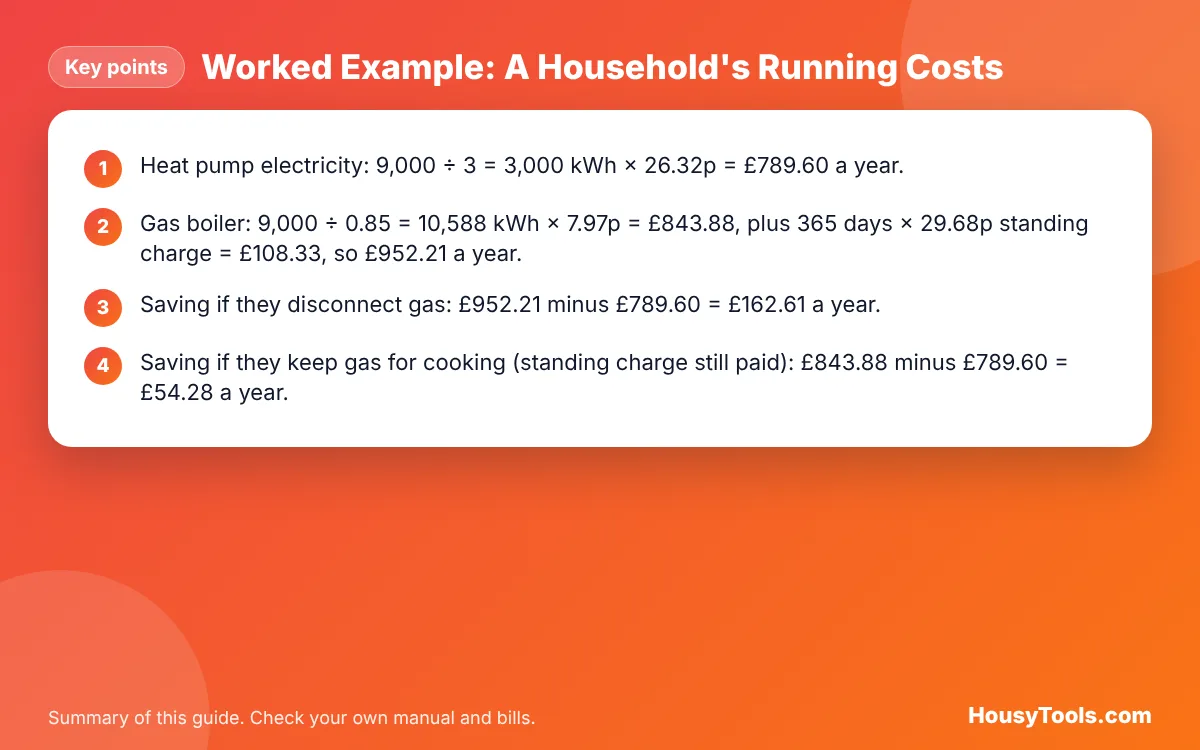
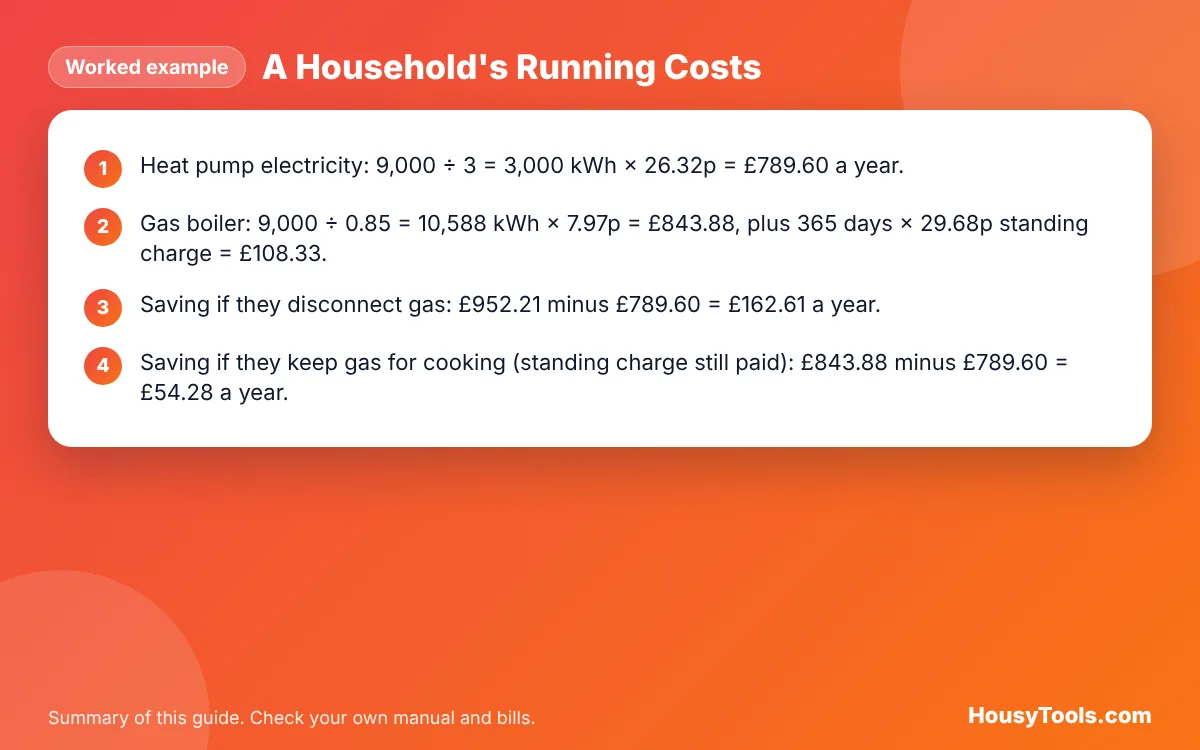
Example: a household needs 9,000 kWh of heat a year and compares an 85% efficient gas boiler with a heat pump at a SCOP of 3, using the October to December 2026 cap rates.
- Heat pump electricity: 9,000 ÷ 3 = 3,000 kWh × 26.32p = £789.60 a year.
- Gas boiler: 9,000 ÷ 0.85 = 10,588 kWh × 7.97p = £843.88, plus 365 days × 29.68p standing charge = £108.33, so £952.21 a year.
- Saving if they disconnect gas: £952.21 minus £789.60 = £162.61 a year.
- Saving if they keep gas for cooking (standing charge still paid): £843.88 minus £789.60 = £54.28 a year.
You can reproduce these numbers in our heat pump running cost calculator, which uses the same defaults and also shows the break even SCOP of 2.49. Set the standing charge saved to 0 to see the keep gas case. To estimate the size of heat pump the household would need, try the heat pump size calculator.
Safety: Installing, moving or replacing a gas boiler, or altering its gas supply, flue or controls inside the casing, must be done by a Gas Safe registered engineer. Heat pumps involve refrigerant circuits and mains electrics, so use a qualified installer, and an MCS certified one if you want the Boiler Upgrade Scheme grant.
Combi vs System vs Heat Pump FAQs
Can a heat pump replace a combi boiler?
Yes, but you will normally need space for a hot water cylinder, about 80 cm by 80 cm according to the Energy Saving Trust, plus an outdoor unit. Some radiators may need upsizing because heat pumps run at lower water temperatures.
Is a system boiler more efficient than a combi?
Both are condensing gas boilers with similar efficiency. A system boiler can be better for homes with high hot water demand, but stored hot water loses some heat from the cylinder over time, so a combi often suits smaller households best.
Is a heat pump cheaper to run than a gas boiler?
It can be. At the October to December 2026 cap, a heat pump needs a SCOP above about 2.5 to beat an 85% efficient boiler if you disconnect gas, or about 2.8 if you keep gas for cooking. A heat pump time of use tariff and disconnecting gas improve the savings further.
How much is the heat pump grant?
The Boiler Upgrade Scheme gives £7,500 towards an air source or ground source heat pump in England and Wales, with an extra £1,500 until March 2027 for homes off mains gas using oil or LPG. Your installer must be MCS certified.
Which is best for a flat?
A combi usually suits a flat because it needs no cylinder. A heat pump is possible, and the Energy Saving Trust notes compact versions exist, but you need somewhere for the unit and permission from the freeholder where required.
Do I need planning permission for an air source heat pump?
Most domestic installations count as permitted development, according to the Energy Saving Trust, so planning permission is not usually needed. Listed buildings and conservation areas may be different, so check with your local planning authority.
Compare more heating options with our heating calculators.
Checked October 2026. Sources: Energy Saving Trust: Air source heat pumps, Energy Saving Trust: The most efficient way to run a heat pump, GOV.UK: Boiler Upgrade Scheme, Ofgem: Energy price cap rates, Viessmann: Which boiler do I need?, Wikipedia: Combination boiler, Wikipedia: Condensing boiler, Which?: Heat pump vs boiler.


