To clean a washing machine filter, you unplug the machine, drain the leftover water into a shallow tray, unscrew the pump filter behind the small flap at the bottom front, rinse away the lint and debris, and screw it back in firmly. This guide explains how to clean a washing machine filter step by step, how often the main manufacturers say you should do it, and the point where a blocked pump becomes a job for a qualified technician.
Quick answer: Switch the machine off and unplug it, put a towel and shallow tray under the filter flap, drain the water through the emergency hose, then unscrew the filter anti-clockwise. Remove lint, coins and hair, rinse it under warm water, check the impeller turns, and screw it back in firmly before testing.
What does a washing machine filter do?
The pump filter, also called the drain or debris filter, catches objects before they reach the drain pump, and most front loaders have one behind a flap at the bottom front corner. Beko explains that the filter is there to protect the drain pump from items such as coins and buttons. Lint, hair, hair grips and tissue collect there too.
When the filter clogs, water cannot leave the drum quickly. Bosch lists vibration, loud noises, longer cycles and laundry that comes out too wet as signs of a clogged filter. If the blockage is bad enough, the machine stops and shows a drain error, such as the LG OE error or the Samsung 5C code.
Many machines also have a small mesh filter where the cold water hose joins the back of the machine. That inlet filter is a different part: it stops grit entering the machine, and a blocked one causes water supply errors rather than drain errors. We cover it briefly further down.
How do you clean a washing machine filter step by step?
Allow about 15 minutes and expect more water than you think: a full drum of water can sit behind a blocked filter. The steps below follow the method that Bosch publishes for cleaning the filter, along with Beko and Samsung guidance for their front loading machines, but the flap and hose layout varies, so keep your user manual to hand.
- Switch off and unplug the machine. Bosch also tells owners to turn off the water supply before starting. Never work on the filter with the plug in.
- Let hot water cool. If the last programme was a hot wash, wait until the machine has cooled before opening anything, as Samsung advises.
- Protect the floor. Lay an old towel down and place a large, shallow tray or baking dish in front of the flap. A bucket will not fit under most filters.
- Open the filter flap. Some flaps push open, some lift off, and some need a coin in a slot. On a few models the flap is part of a plinth panel that unclips.
- Drain through the emergency hose. If there is a small black hose beside the filter, pull it out, hold the end over the tray and remove the stopper. Replace the stopper whenever the tray is nearly full, empty it, and carry on until the flow stops.
- Unscrew the filter slowly. Turn it anti-clockwise a little at a time, because more water usually follows. Pull it out once it is free.
- Clean the filter. Pick off lint, hair and objects, then rinse it under warm (not hot) running water and use a soft brush or old toothbrush on the mesh.
- Check the opening. Shine a torch into the filter housing and remove anything you can reach by hand. Bosch says to check that the impeller (the small plastic paddle wheel inside) moves freely.
- Refit firmly. Screw the filter back clockwise until it is fully home, push the emergency hose stopper back in, and close the flap.
- Test for leaks. Plug in and run a rinse and spin or drain programme while you watch the flap. For drain pump checks, Bosch suggests pouring 1 litre of water into the detergent drawer and running the drain programme to make sure nothing leaks.
Safety: Always switch off and unplug the washing machine before touching the filter or hoses. Stop and book a qualified appliance technician if the impeller will not turn, the filter is cracked or will not seal, water leaks from anywhere other than the filter, or you would need to remove panels or the casing. Do not force a stuck impeller; Bosch advises contacting its customer service instead.
How often should you clean a washing machine filter?
A sensible rule is to check the filter every 1 to 3 months, and monthly if you wash pet bedding, work clothes or very dirty loads. Manufacturers do not agree on one figure, which is why advice online varies. Beko’s general cleaning guide recommends monthly cleaning, while its separate FAQ on how often to check a Beko filter says every three to four months for coins and buttons. Samsung suggests 5 to 6 times a year, and LG suggests every 1 to 2 months depending on use.
| Manufacturer source | Suggested filter cleaning | Notes |
|---|---|---|
| Beko UK (cleaning guide) | Every month | More often with pets or heavily soiled laundry |
| Beko UK (FAQ) | Check every 3 to 4 months | Looking for coins and buttons |
| Samsung (support guide) | 5 to 6 times a year | Also when water drains poorly or a drain code shows |
| LG UK (helpful hints) | Every 1 to 2 months | Depending on usage |
| Bosch UK | No fixed interval stated | Clean when you notice drain problems, noise or wet laundry |
Your own manual has the final word, because it is written for your exact model. If you only remember one thing, check the filter whenever the machine sounds rougher than usual, a cycle takes noticeably longer, or clothes come out wetter than normal.
What should you do if the washing machine filter is stuck?
A stuck filter is usually held by trapped debris or a dried seal, and gentle, steady pressure works better than force. First make sure all the water has drained through the emergency hose, so you are not fighting water pressure. Then grip the filter handle firmly and try turning it anti-clockwise in short movements, easing it back and forth slightly.
Some filters have a safety catch that needs pushing in while you turn, which Samsung describes for certain models. Check your manual for this before trying anything else. Avoid using pliers or levers on the plastic handle: a cracked filter will leak and needs a replacement part. If it will not move, stop and contact the manufacturer or a technician.
How do you clean the inlet filter on a washing machine?
The inlet filter is a small mesh screen at the tap end or machine end of the fill hose, and it only needs attention if the machine fills slowly or shows a water supply error. Bosch, for example, says its E17, F17 and F29 water supply codes can mean the filters in the water connection are blocked or the water pressure is too low. Its method is to switch off and unplug, turn the tap off, remove the hose and clean the mesh with a small brush under running water.
Bosch notes that on some models you remove the hose and use pliers to pull the filter out, so the method varies. If you cannot see a removable mesh, leave it alone and follow your manual. Our guide to the Samsung 4C water supply error shows how this part fits into a fill fault.
How much can a blocked filter cost you?
A blocked filter rarely costs much in electricity on its own, but repeated rewashes and failed cycles add up. Every wash that stops with a drain error usually has to be run again.
Example: a washing machine label says 52 kWh per 100 cycles, which is 0.52 kWh per wash. The machine runs 4 times a week at the October to December 2026 price cap average of 26.32p per kWh. In the electricity cost calculator, you can enter 520 W for 1 hour a day, 4 days a week, which gives the same 0.52 kWh per wash. Each wash costs about 13.7p, or about £28 a year. If a clogged filter forces you to rerun one wash a week, that adds roughly 13.7p a week, plus the extra water and detergent. Cleaning the filter costs nothing.
The bigger risk is the pump itself. A coin or hair grip that passes a neglected filter can jam or damage the impeller, and pump replacement is a technician job. For more on how we work out running costs, see how our calculators work.
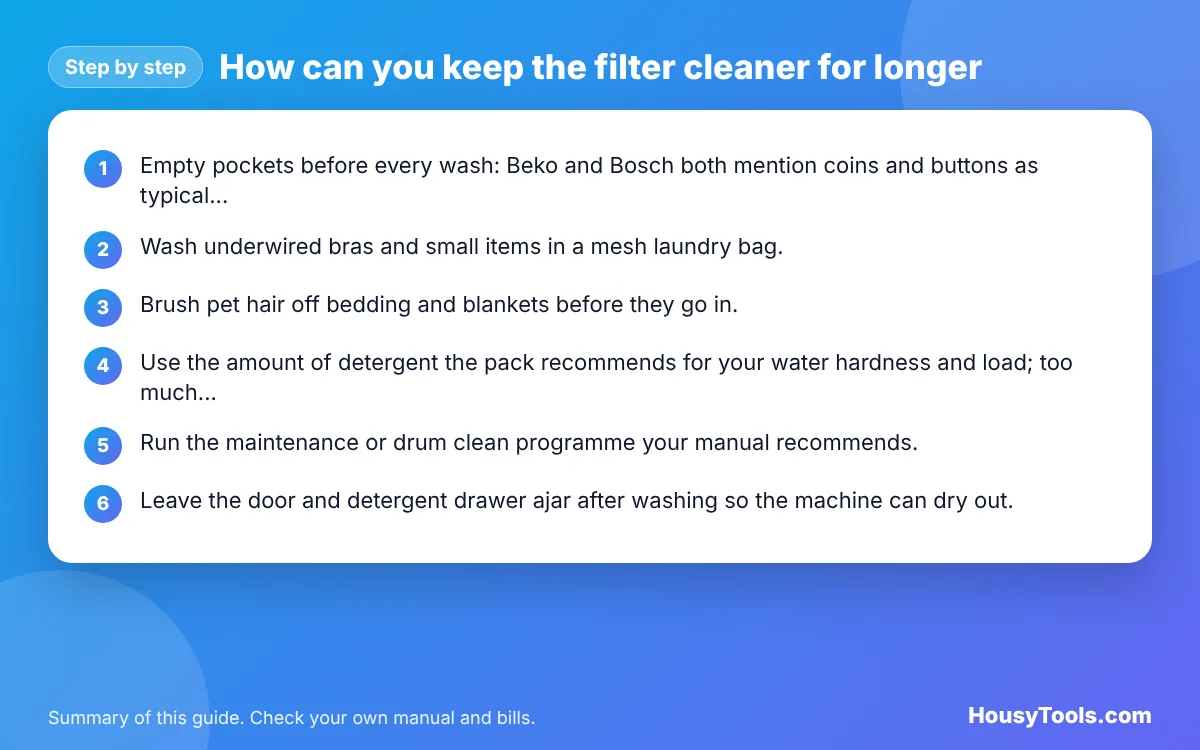
How can you keep the filter cleaner for longer?
- Empty pockets before every wash: Beko and Bosch both mention coins and buttons as typical finds in the filter.
- Wash underwired bras and small items in a mesh laundry bag.
- Brush pet hair off bedding and blankets before they go in.
- Use the amount of detergent the pack recommends for your water hardness and load; too much creates foam and residue, which LG links to drain problems.
- Run the maintenance or drum clean programme your manual recommends.
- Leave the door and detergent drawer ajar after washing so the machine can dry out.
How to Clean a Washing Machine Filter FAQs
Where is the filter on a washing machine?
On most front loading machines the pump filter sits behind a small flap or plinth panel at the bottom front, usually in the right or left corner. Some top loaders and older machines have filters elsewhere or none that owners can reach, so check your user manual.
How much water comes out of a washing machine filter?
Even after a normal cycle a little water remains, so expect a few cups. If the machine stopped mid-cycle with a drain error, the whole wash load of water may be waiting behind the filter. Drain it slowly through the emergency hose into a shallow tray first.
Can a dirty filter make a washing machine smell?
Yes. Lint, hair and trapped water in the filter housing can lead to bacteria and mould, which Beko and Samsung both mention. Cleaning the filter, running a drum clean programme and leaving the door open after washing usually clears a musty smell.
Do all washing machines have a filter?
Many front loaders have a pump filter that owners can reach, but not every machine does, and on some designs only a technician can reach the pump. Your user manual will say whether your model has one and where it is.
Can I clean the filter without draining the water first?
You can, but it is messy. Unscrewing the filter with water still inside releases it all at once onto the floor. Using the emergency drain hose, or loosening the filter slowly over a tray as Bosch describes, keeps the flow under control.
What if the machine still will not drain after cleaning the filter?
Check the drain hose for kinks and blockages, and make sure the sink trap or standpipe is clear. If those are fine and the pump makes no sound during a drain or spin, the pump may have failed, which needs a qualified technician.
Checked October 2026. Sources: Beko: How do I clean my washing machine pump filter, Beko: How often do I need to clean the filter, Bosch UK: Cleaning the filter, Bosch UK: Washing machine not draining, Samsung: Cleaning the pump filter of your washing machine, Bosch: E17, F17 or F29, LG UK: Washing machine not draining, Ofgem: Energy price cap unit rates and standing charges.