For most UK tiling jobs, grout joints should be at least 2 mm wide on standard wall tiles and at least 3 mm on floor tiles, with wider joints for larger or less regular tiles. This grout width guide explains where those minimums come from, how tile size, edge type and grout product change the right choice, and how joint width affects the amount of grout you buy.
Quick answer: In the UK, BS 5385 guidance summarised by The Tile Association sets a minimum joint of 2 mm for wall tiles under 0.1 m² with no side over 600 mm, 3 mm for wall tiles from 0.1 to 1 m², and 3 mm for all floor tiles. Go wider for uneven tiles, and stay within your grout’s stated joint range.
What Is the Minimum Grout Width for Wall Tiles?
The minimum grout width for most wall tiles is 2 mm. According to The Tile Association’s technical FAQs, joints should not be less than 2 mm wide for tiles with a face area under 0.1 m² and no side longer than 600 mm. That covers small and mid sized wall tiles such as 100 x 100, 75 x 150 metro and 200 x 400 mm.
Bigger wall tiles need more room. For tiles with a face area of 0.1 to 1 m² and no side over 1200 mm, the minimum rises to 3 mm. A 300 x 600 mm tile is 0.18 m², a 600 x 600 mm tile is 0.36 m² and a 600 x 1200 mm tile is 0.72 m², so all three fall into this band when fixed to a wall.
To work out which band a tile is in, multiply its length by its width in metres. A 250 x 400 mm tile is 0.25 x 0.4 = 0.1 m², which puts it in the 0.1 to 1 m² band, so its minimum is 3 mm, not 2 mm.
What Grout Width Should You Use for Floor Tiles?
Floor tile joints should be at least 3 mm wide, whatever the tile size. The Tile Association states that floor joint width should not be less than 3 mm, citing BS 5385-3, the code of practice for floor tiling.
Many tilers go wider than 3 mm on floors where tiles are not perfectly regular. Natural stone, reclaimed tiles and handmade or rustic tiles often vary in size from one piece to the next, and a wider joint hides that variation. Measure several tiles from different boxes before you choose your spacers. If they differ by a millimetre or two, a 3 mm joint will make the difference obvious.
Can Rectified or Large Format Tiles Have Narrower Joints?
Rectified tiles do not change the UK minimums: 2 mm on standard wall tiles and 3 mm on floors still apply. Rectified tiles are ground after firing so their edges are straight and their sizes very consistent, which is why many American guides suggest joints as narrow as 1/16 inch, about 1.6 mm. That is below the BS 5385 floor minimum and below the 3 mm wall minimum for tiles over 0.1 m².
Large format tiles have more reason for a wider joint, not a narrower one: on walls, any tile of 0.1 m² or more already needs at least 3 mm, and a very tight joint shows every small difference in height between neighbouring tiles. Always read the tile box or the maker’s fixing guide, as some manufacturers recommend a joint wider than the minimum for their product.
How Do You Match the Grout to the Joint Width?
Every grout is made for a stated range of joint widths, printed on the bag and data sheet, and your joint must sit inside it. Three examples from one maker show how much this varies:
- Mapei Ultracolor Plus is rated for joints from 2 to 20 mm wide, on floors and walls.
- Mapei Keracolor FF is a fine grout for joints up to 6 mm wide.
- Mapei Kerapoxy CQ, an epoxy grout, is made for joints of at least 1 mm.
Fine grouts suit narrow joints because they press into small gaps and finish smoothly. Coarser grouts contain sand and are designed for wider joints. As Wikipedia’s grout article explains, unsanded grout is finer and gives a smoother surface, while sanded grout contains fine silica sand. If you plan a 2 mm joint, check that the grout’s minimum is 2 mm or less. If you plan joints wider than 6 mm, avoid a grout whose range stops at 6 mm.
How Does Grout Width Change How Much Grout You Need?
Grout use rises in direct proportion to joint width: doubling the joint from 2 mm to 4 mm doubles the grout. The amount also depends on tile size and thickness, because smaller tiles have far more joint length per square metre. Our grout calculator uses the standard consumption formula: tile length plus width, divided by length times width, multiplied by joint width, joint depth and grout density.
Width also changes the look. Narrow joints in a colour close to the tile give a calmer, more continuous surface. Wide joints in a contrasting colour make a grid pattern stand out, which suits metro tiles and patterned floors but also shows any unevenness.
Grout Width Guide: Quick Reference Table
| Where and what | Minimum joint (BS 5385, via The Tile Association) | Points to consider |
|---|---|---|
| Wall tiles under 0.1 m², no side over 600 mm (for example 100 x 100, 75 x 150, 200 x 400) | 2 mm | Go wider if tiles vary in size or are handmade |
| Wall tiles 0.1 to 1 m², no side over 1200 mm (for example 250 x 400, 300 x 600, 600 x 600) | 3 mm | Check the maker’s guide for large format tiles |
| Floor tiles, any size | 3 mm | Wider for natural stone, reclaimed and rustic tiles |
| Rectified tiles | Same as above | Consistent edges do not lower the UK minimum |
| Any tile | Within the grout’s stated range | For example 2 to 20 mm for Mapei Ultracolor Plus |
This guide covers grout joints only. Movement joints, which are filled with a flexible material rather than grout, are a separate design requirement in BS 5385, so ask your tile or adhesive supplier where yours need to go.
Worked Example: Bathroom Walls and Floor
Example: a bathroom is being tiled. The walls take 14 m² of 200 x 400 mm ceramic tiles, 8 mm thick. At 0.08 m² each, they are under 0.1 m², so the wall minimum is 2 mm. The floor takes 4.5 m² of 600 x 600 mm porcelain tiles, 10 mm thick. The plan uses the default density of 1.6 kg per litre and grout in 5 kg bags.
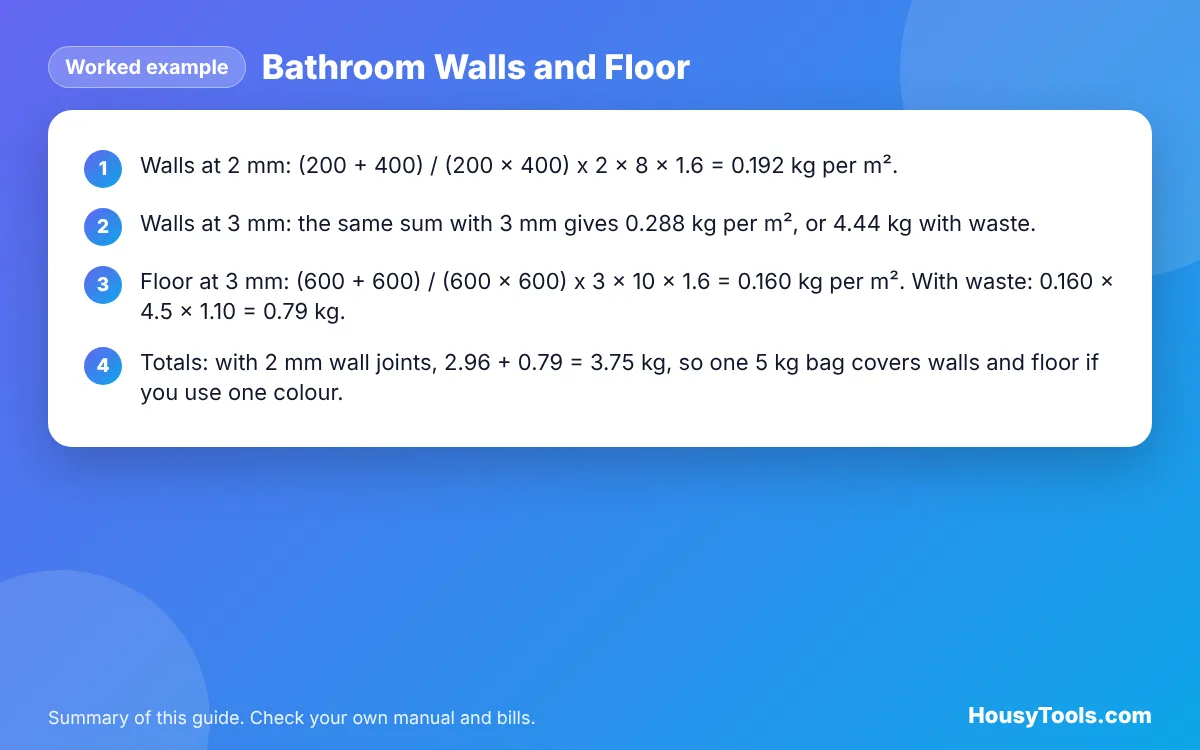
- Walls at 2 mm: (200 + 400) / (200 x 400) x 2 x 8 x 1.6 = 0.192 kg per m². With 10% for waste: 0.192 x 14 x 1.10 = 2.96 kg.
- Walls at 3 mm: the same sum with 3 mm gives 0.288 kg per m², or 4.44 kg with waste.
- Floor at 3 mm: (600 + 600) / (600 x 600) x 3 x 10 x 1.6 = 0.160 kg per m². With waste: 0.160 x 4.5 x 1.10 = 0.79 kg.
- Totals: with 2 mm wall joints, 2.96 + 0.79 = 3.75 kg, so one 5 kg bag covers walls and floor if you use one colour. With 3 mm wall joints, 4.44 + 0.79 = 5.23 kg, which means a second bag.
Picking 2 mm on the walls and 3 mm on the floor meets both minimums with one bag. If you later chose 5 mm floor joints for a rustic look, the floor would need 1.32 kg and the total would be 4.28 kg, still inside one bag. You can reproduce each line by entering the same area, tile size, joint width and thickness in the grout calculator, then work out tiles with the tile calculator and the bed underneath with the tile adhesive calculator.
Grout Width FAQs
Is 2 mm grout too small for floor tiles?
Yes, in the UK. The Tile Association states that floor joints should not be less than 3 mm, citing BS 5385-3. A 2 mm joint is fine for most wall tiles under 0.1 m², but floors need at least 3 mm.
What size spacers should I use for 600 x 600 tiles?
Use at least 3 mm spacers. A 600 x 600 mm tile has a face area of 0.36 m², so the 3 mm minimum applies on walls, and 3 mm is also the minimum for every floor tile. Check the tile maker’s guide in case it recommends wider.
Can you tile with no grout lines at all?
No. Butt jointing tiles with no gap goes against BS 5385 guidance, which sets minimum joint widths of 2 mm on walls and 3 mm on floors. Joints allow for small size differences and help the tiled surface cope with minor movement.
Do metro tiles need a particular grout width?
A 75 x 150 mm metro tile is far below 0.1 m², so the minimum on walls is 2 mm. Many people choose 2 or 3 mm. Small tiles use much more grout per square metre, so run the numbers before buying.
Does a wider grout line use more grout?
Yes, in direct proportion. Going from 2 mm to 4 mm joints doubles the grout needed for the same tiles and area. Tile size and thickness matter too, which is why a calculator using your exact tile size is more reliable than a flat rate.
Should wall and floor grout lines match?
They do not have to. Floors need at least 3 mm, while most wall tiles can go down to 2 mm. Some people match them at 3 mm for a consistent look where walls and floor meet. Both choices meet the UK minimums.
Checked October 2026. Sources: The Tile Association, technical FAQs on joint widths, The Tile Association, relevant standards (BS 5385), Mapei Ultracolor Plus, Mapei Keracolor FF, Mapei Kerapoxy CQ, Wikipedia, Grout.